★★★★★
“job well done good communication throughout the job very clean and tiddy when the job is finish flat roof replacement many thanks.”
Sumit Bal
On a dormer bungalow the stack is the easy part of the roof. The narrow lined channel running between it and the dormer cheek is not, and that is usually where the water is actually getting in.
West Kirby has an unusual amount of single-storey housing for a town of its size. Between the wars and again through the 1950s and 60s the ground behind the front — Grange, Newton, the roads climbing off Column Road, Darmonds Green and out towards Caldy — filled up with bungalows and chalet bungalows on generous plots, and a great many of them are still as they were built. Nearer the station there are older two-storey villas as well, but the bungalow is the roof shape that defines the place.
It is also a roof shape that changes what a chimney job involves. A bungalow stack stands on a single-storey ridge and it is short, because it only ever had to clear that ridge. On a chalet bungalow the rooms in the roof brought dormers with them, and those dormers were frequently built into the same slope as the chimney, a tile or two away from it. The result is a roof where the chimney is the most accessible thing on it and the details packed in beside the chimney are the least.
Roofline Solutions works on all of it: repointing and re-forming heads, aprons, soakers, stepped flashings, back gutters, box gutters and dormer cheek flashings, pots, cowls and bird guards, part rebuilds and stack removals down to roof level. Anything inside a live flue — lining it, sweeping it, or deciding whether an appliance draws properly — belongs to a HETAS or Gas Safe registered installer and a chimney sweep. The two-storey roofs nearby are dealt with the same way as those at Hoylake.
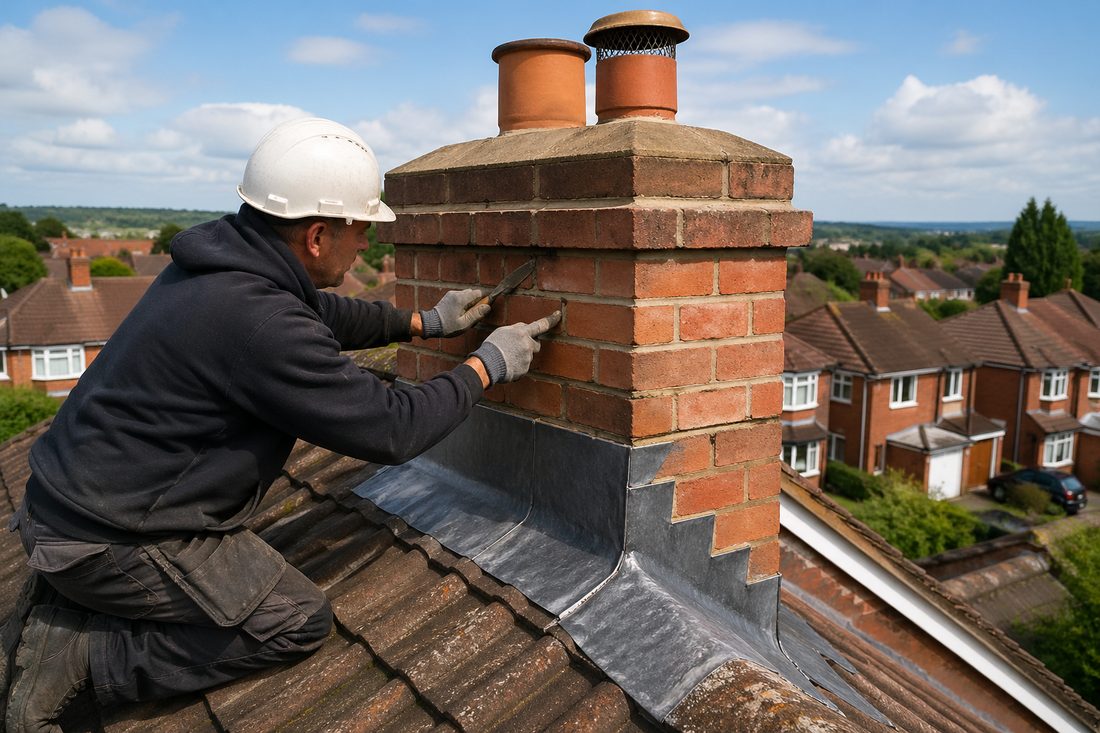
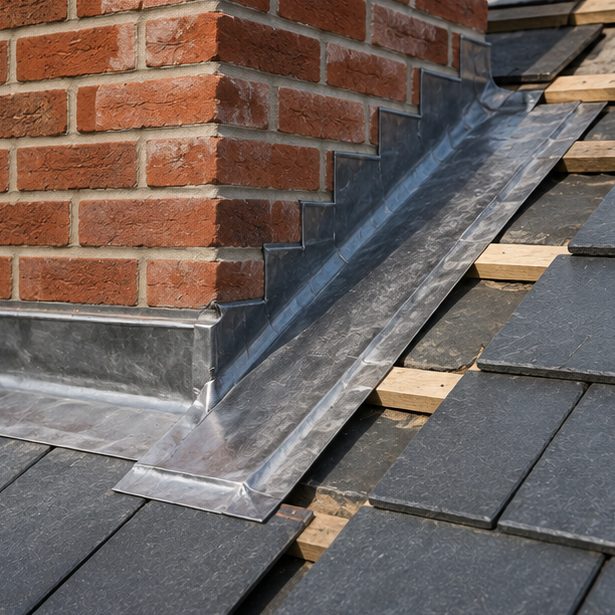
Images above are for illustration purposes only.
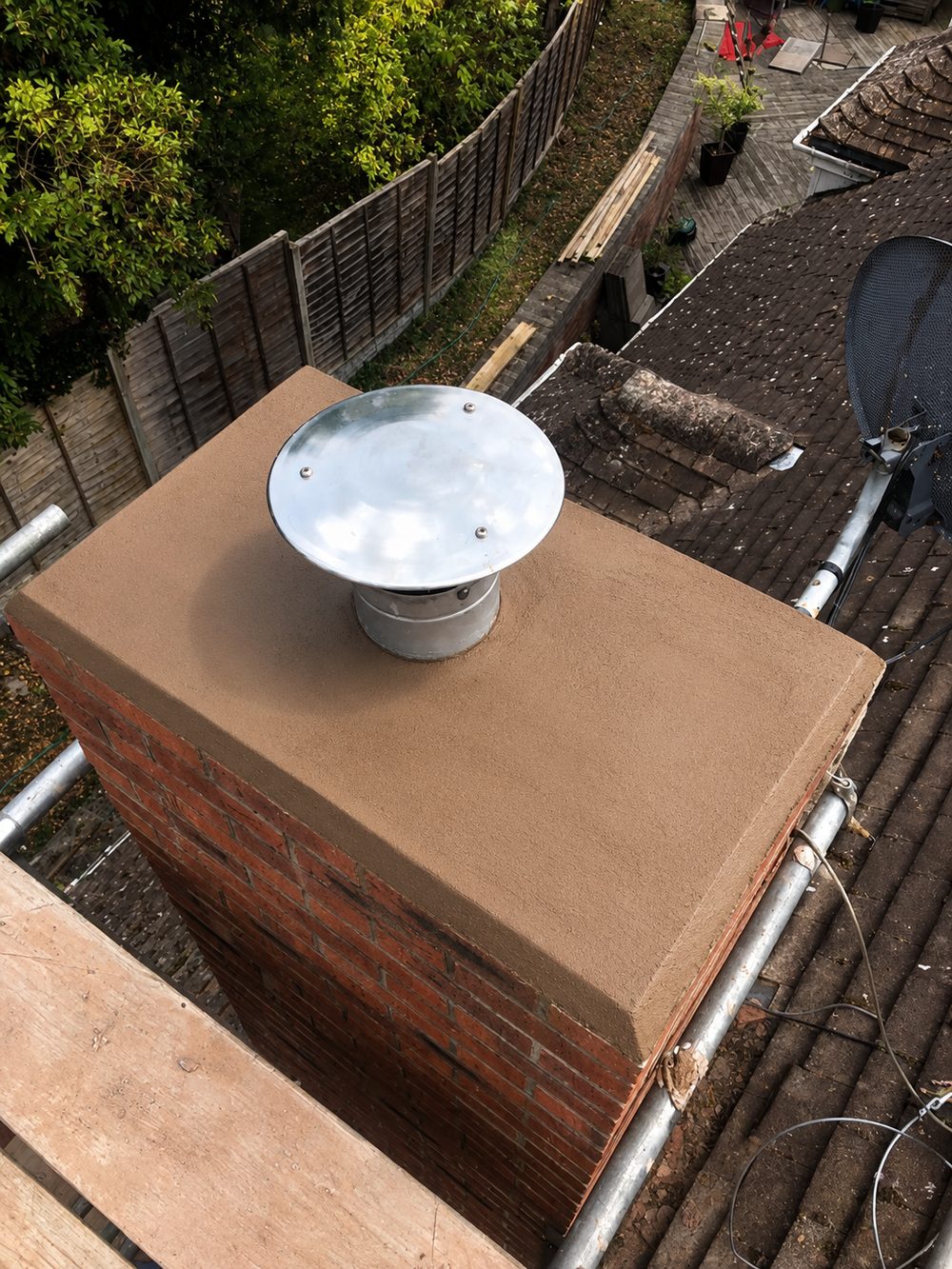
Photographs of our own chimney work. There are more on the main chimney repairs page and in the gallery.
Start with the good news, because it is genuine. A bungalow stack is the least demanding masonry on any roof we work on. It stands perhaps a metre above a single-storey ridge, all four faces can be reached from one platform, and on plenty of these houses a tower or a single lift does the whole job. Where a two-storey stack means a week of access for a morning’s pointing, a bungalow stack often does not. The mistake is assuming the rest of the roof is as simple as the chimney is.
What sits next to it very often is a box gutter. Where a dormer is built into a slope, water coming down the roof above has to get past it, and it does that through a channel running down one or both cheeks. Sometimes that is a proper lead-lined box gutter on a timber sole with an upstand each side and a fall along its length; sometimes it is a secret gutter barely wider than a hand, tucked under the tiles so nothing shows. Where the chimney stands in the same slope, its own back gutter often discharges straight into that channel, so one narrow trough takes the slope above, the dormer roof and the chimney together, and carries the lot to the eaves.
Then it fails, invisibly. It may have been laid flat with no fall, so water stands along it and finds the laps. It may be one long unbroken piece of lead, which will buckle and split as it expands. The upstands may be too shallow for the water actually arriving, or tucked under a wedge of mortar at the stack rather than chased into a joint. And on a planted plot the channel silts up with leaf and moss until it is a border rather than a gutter. What makes it a chimney question is the junction itself: an apron off the stack and a cheek flashing off the dormer can end up two or three courses apart, with no room to dress either properly unless the whole detail is set out as one piece of work. Filling the gap with mortar or sealant instead is what most of the leaks we are called to here turn out to be.
A bungalow tells you about a leak faster and more accurately than a house does. On a two-storey roof water can run along a rafter, drop onto a joist and appear a good distance from where it came in. In a shallow bungalow roof void there is almost no journey to make, so a stain turns up close to the fault and sometimes within the hour. A leak that appears only in heavy rain and stops soon after it does is about volume, and points at a gutter that cannot cope or has silted up. One that follows driving rain from a particular direction and takes days to dry is about the faces of the stack.
Inside, the marks to look for on a chalet bungalow are at the head of a dormer window, along the line where a sloping ceiling meets the flat one above it, and on the chimney breast below. Outside, sight along the slope rather than looking straight at it: a dip beside a dormer is a gutter that has lost its fall, and a dark green strip down the same line is one holding water. Look for cut tiles bedded in mortar where a lined channel should be, for lead somebody has painted or taped, and at the eaves, because water running down the face of the fascia means the gutter above is not discharging where it should.
This is one of the few places we work where the honest answer to “do we really need a full scaffold” is sometimes no. On a true bungalow with an accessible stack, a mobile tower or a single lift on hard standing will often reach everything, and we would rather say so than quote for access nobody needs. The condition is that the platform has to serve the whole job: if the box gutter, the dormer cheek or the far side of the stack is part of the work, a tower parked in front of the chimney is no use at all.
The plots help and the extensions do not. Gardens here are generally wide with room to stand a base, but bungalows attract single-storey additions, and conservatories, flat-roofed rear extensions, garages and car ports have a habit of occupying exactly the ground a scaffold wants. Those get boarded and propped rather than loaded directly. The other thing worth saying is that a low roof is a tempting roof: many of the bodged repairs we find on these houses were done by somebody standing on the covering off a ladder, and the tiles they broke are part of why it leaks now.
A box gutter is a piece of leadwork with a specification rather than a strip of metal pushed into a gap. It wants a timber sole laid to a definite fall, lead heavy enough to be knelt on and to stand water sitting in it, the length broken into lapped sections with a drip or a step rather than run in one, welted edges where it turns out over the covering, upstands carried well up behind the dormer cheek cladding and chased into a joint at the stack, and an outlet that delivers into the eaves gutter. Get those right and it needs nothing but clearing.
The top of a short stack raises a different question, and it is one we will point you at somebody else for. A bungalow flue is short to begin with, and short flues draw poorly; where a dormer, a roof conversion or an extension has gone up since the house was built, a stack that used to stand clear of everything may now be sitting in the shelter of something taller. Guidance on where a flue has to terminate relative to the roof around it exists for exactly that, and the decision belongs to the appliance installer. What we do is the masonry and the weathering, and on a flue that is finished with, a cap that still lets air through.
Repointing, flaunching, stack rebuilds and removals, lead aprons, soakers, stepped flashings and back gutters, pots, cowls and bird guards — and the roof around the stack when it needs attention at the same time.
“job well done good communication throughout the job very clean and tiddy when the job is finish flat roof replacement many thanks.”
Sumit Bal“Excellent work from the lads at roofline solutions. I had a leak in my valley, they came out and sorted it within a day.”
Chris Hollewell“The guys did a great job in repairing our chimney. They were reliable, friendly and efficient. Buddy kept me in the loop throughout the whole process and I would not hesitate to use Roofline again!”
Hollie FurnivalWritten for homeowners working out which part of a chimney has failed, before anyone comes out.
Every town below has its own page, written around the stacks that are actually on the roofs there.
Describe what you can see and roughly where you are, and we will come back to you — usually the same day. If water is coming in now, please call instead.
Prefer to talk? Call 07464 259566 · WhatsApp 0044 7464 259566 · Email Evensbuddy@yahoo.com
We cover West Kirby from our base at Elton, just north of Chester.
2 Manley View
Elton
Chester
CH2 4QF
Almost all of our work happens at your property rather than here, so please call before travelling.
Monday – Friday — 24hrs — Emergency Call-Outs
Saturday — 8:00 – 19:00
Sunday — 8:00 – 19:00
Weekday emergency call-outs are answered around the clock. Weekend cover is 8:00 to 19:00.