Chimney repairs, repointing, leadwork and pot replacement across Chester, Cheshire and the Wirral by Roofline Solutions

Chimney Repairs Macclesfield

Up towards the hill the stacks are gritstone rather than brick, and stone will not take pointing the way brick does. Repointing, heads, lead cut to the stone, pots and rebuilds, worked from a scaffold.

★ 5.0 from 63 Google reviews
Repointing, flaunching, leadwork & pots
Fully insured
Free written quotations
Chester, Cheshire & Wirral
HomeChimney RepairsChimney Repairs Macclesfield
Macclesfield & Surrounding Areas

Chimney Work in Macclesfield

Macclesfield climbs. The older part of the town sits low by the Bollin, the silk streets run up behind it through Hurdsfield and Sutton, and the houses keep going until they stop on the edge of the moor below Tegg’s Nose and Kerridge. Down in the middle most of what you see is brick. Above that line it turns to stone, because the stone was lying in the next field: Millstone Grit, taken out of the ridge and used for walls, farms, cottages, mills and the chimneys on top of them.

Gritstone is not what people expect when they hear the word stone. It is hard, coarse and sandy, and a well-cut block of it will see out almost anything else on the roof. What it will not do is behave like brickwork. It comes in courses of unequal height, or in no courses at all; the joints run from a hairline to the width of a thumb; and the wall is very often two faces of decent stone with a packed core of rubble and mortar between them. Nearly everything a roofer does to a stone stack follows from those three facts.

Roofline Solutions works on the outside of stacks of both kinds across the town and out through Bollington, Rainow, Langley and Prestbury: raking out and repointing, cutting off and re-forming the head, lead at the roof junction, pots, cowls and guards, part rebuilds and removals down to roof level. The inside of a live flue is a different trade, and lining, sweeping and appliance testing belong to a HETAS or Gas Safe registered installer and a chimney sweep. What we do cover is set out on the main chimney repairs page.

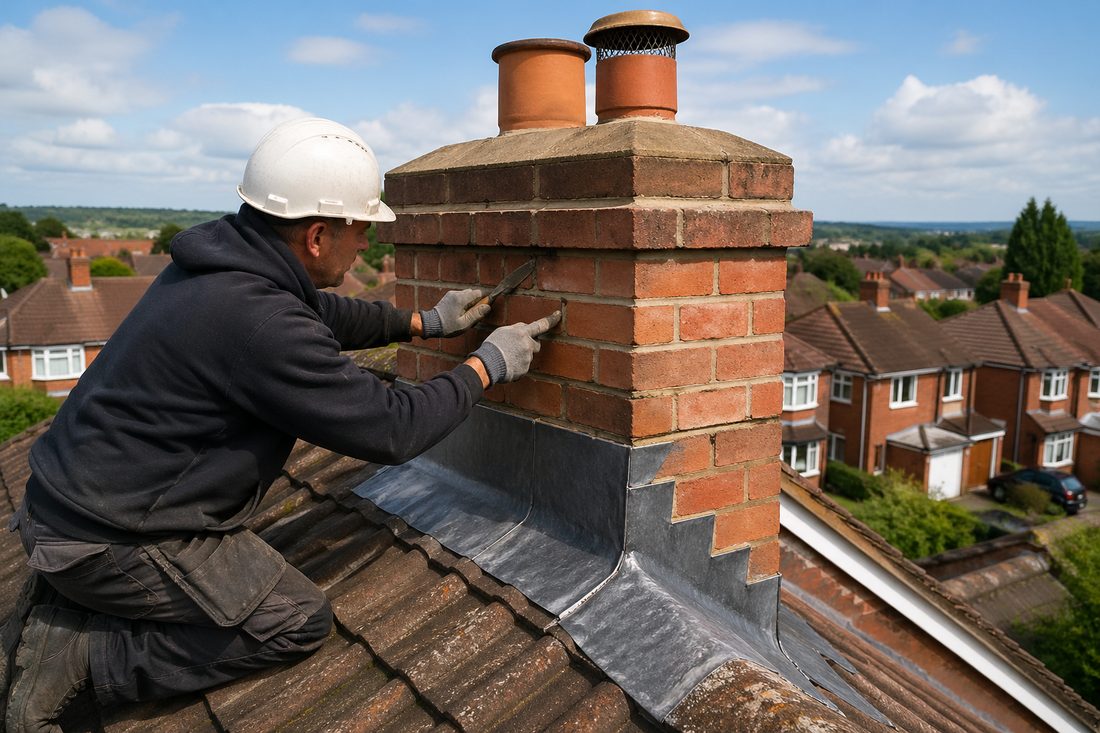
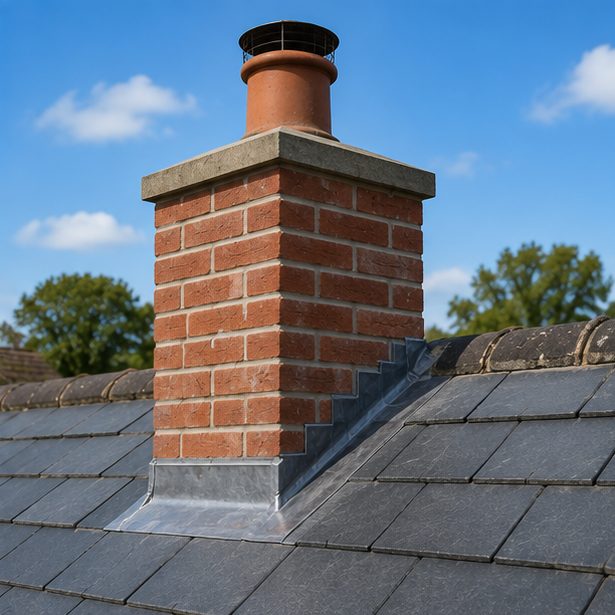
A roofer pressing fresh mortar into the joints on the corner of a stack that has already had its lead renewed below A finished stack standing against open sky, the head weathered off, a guard over the pot and new lead stepped down to the apron

Images above are for illustration purposes only.

Our Own Work

Chimneys We Have Repaired

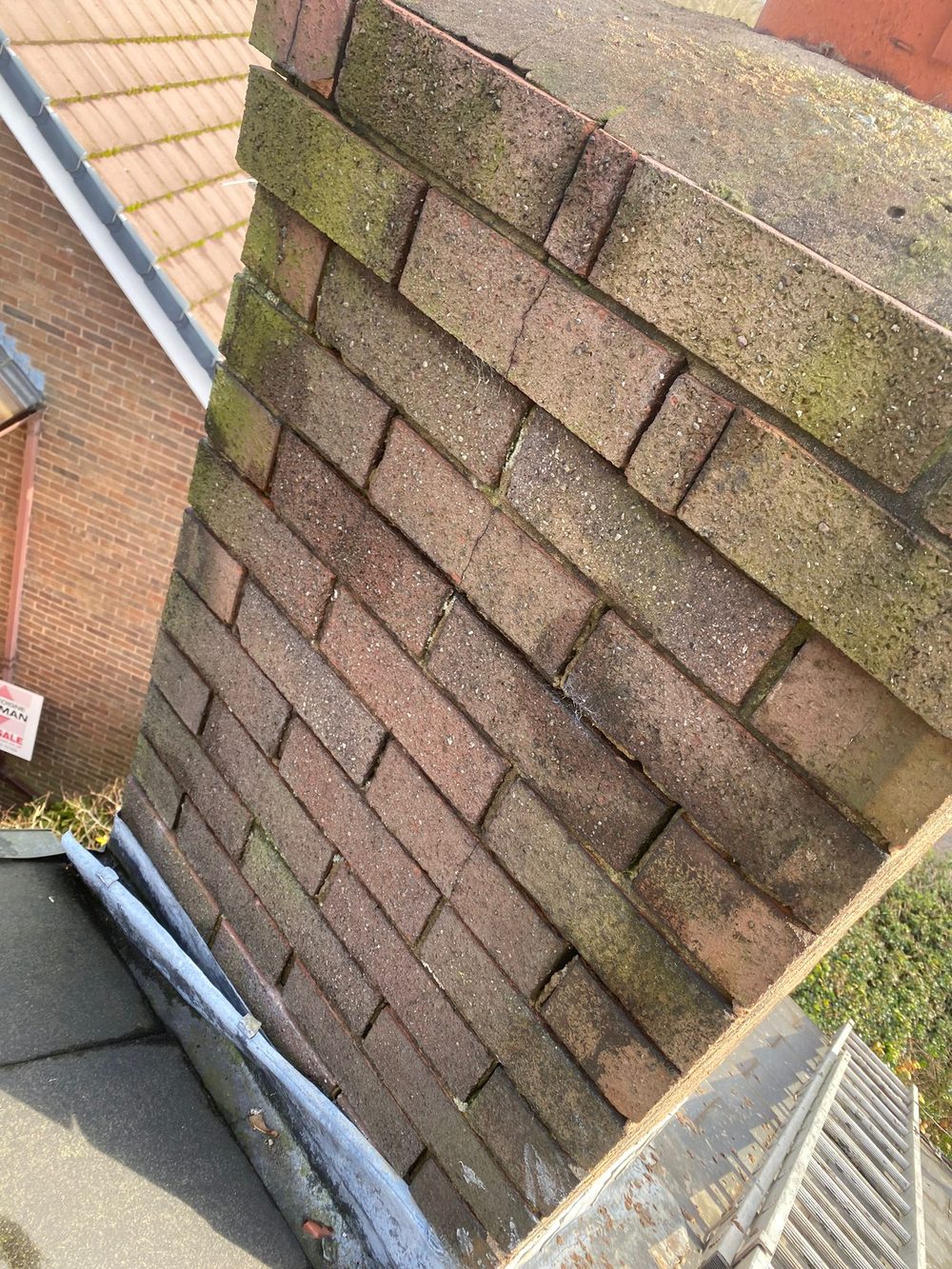
A close view of bedding mortar washed out from between the courses, with the vertical joints standing open right through the face

Photographs of our own chimney work. There are more on the main chimney repairs page and in the gallery.

Coursed, Random, and What That Does to the Pointing

Stone stacks here come in two families and it is worth knowing which is on your roof. Coursed squared rubble is the tidier sort: blocks roughly dressed to a face and laid in continuous courses, but with each course a different depth from the one below, so the beds run level and parallel and are anywhere between a hundred and three hundred millimetres apart. Random rubble is the other, common on cottages and farm buildings, where stones of whatever size came to hand are fitted together with no continuous bed running through the wall at all.

That geometry is why a stone stack cannot be pointed to the same recipe as a brick one. The joints are all different widths, and the mortar is weathering the wall and holding the packing behind it at the same time. So it is cut out by hand with a plugging chisel rather than run out with a disc; wide joints are pinned as they are filled, with slivers of the same stone pushed in so the mortar is not one thick slab that shrinks and cracks; and the finish is kept back a little from the edge of each stone rather than spread out over the face, because a smeared joint makes the stone look smaller than it is and comes off in sheets when it lets go.

The lead is where the difference bites hardest. A stepped flashing on brick is simple in principle, because there is a bed joint every seventy-five millimetres and you chase into the ones that follow the pitch. On coursed gritstone there may be one bed for every three or four brick courses, so the steps come out long, shallow and unevenly spaced — which looks wrong to anyone used to brickwork and is in fact correct. On random rubble there is frequently no usable bed where the lead needs to go, and the honest answer is a raggle: a chase cut level into the face of the stone itself, deep enough to take the lead and a wedge, then pointed. That is a permanent mark on the stone, so it is set out once and cut straight the first time.

Reading a Wet Face After the Rain Comes Off the Moor

The hill gives the weather a clear run at these roofs, and rain arriving nearly horizontally is driven into the joints rather than landing on them, so the face that takes it stays wet for days and reads darker than the rest of the stack. That on its own is not a fault. What matters is what the water finds. A stack with its wide joints still full will shed most of it and dry out; one with the joints washed back is taking water into the rubble core between the two faces, and a wet core has no wind and no sun on it to take it out again.

So what to look for from the ground is emptiness rather than cracking. Take binoculars to the joints and look for shadow: a dark line where the mortar has gone back behind the face of the stone, a gap under a stone that should be bedded on something, or a pinning missing from a wide bed. Grit and the odd stone sliver on the flags or in the gutter mean the joints are emptying now rather than at some point in the past. Indoors, a wet core shows in the loft as a broad dark band across the full width of the masonry rather than a run down one side.

Getting to the Stack in Macclesfield

Plenty of the older properties on this side of the town are roofed in stone slate off the local quarries — heavy, thick flags laid in diminishing courses and often hung on oak pegs rather than nailed. The flags break at the head where the peg hole is, and there is no such thing as walking across one carefully, so the stack is reached off a scaffold and a flag that has to come off for a soaker is lifted and re-hung rather than levered up.

Getting a scaffold to the house takes more working out on the hill than on the flat. The lanes towards Rainow and Kerridge are narrow with nowhere for a wagon to stand, several town centre frontages sit straight on the footway and need a licence from Cheshire East Council, and some cottage plots have no vehicle access beyond a gate. The other thing people underestimate is weight. A gritstone quoin is a two-man lift and a head slab is more than that, so a rebuild wants a hoist and a planned loading route, and the stones that come off are set aside in the order they came down so the same ones go back where they were.

Leadwork, Pots and Cowls in Macclesfield

Soakers on a stone slate roof are cut on site rather than bought to a size, because the courses diminish as they climb and each one has to suit the course it sits in, with the cover flashing laid over the top of them. Where that cover flashing goes into the wall is the choice described above: stepped to the beds that exist, or run into a raggle cut level across the stone. Either way it is turned in, wedged with lead and pointed in the same mortar as the rest of the stack, and kept in short lapped pieces so it can move with the sun.

The top of a stone stack is often not what people picture either. A good many round here never had a mortar flaunching at all: the head is finished with a dressed slab or a run of coping, weathered to a fall, with the flue openings cut through it and the pots bedded into those. Where a slab has cracked or its joints have opened, the repair is to the stonework rather than to a bed of mortar, and it is worth saying so before anybody quotes to re-flaunch something that has none. The pots are usually plain cans, and a sound one is lifted, cleaned and bedded back rather than swapped for a new one.

Please do not go up to look. A chimney is at the highest point of the roof and the ground below it is usually a path or a drive. Call 07464 259566 and describe what you can see from the garden, or send a photograph on WhatsApp — a phone zoomed in from below shows us more than you would think.

What We Do

Chimney and Roofing Services in Macclesfield

Repointing, flaunching, stack rebuilds and removals, lead aprons, soakers, stepped flashings and back gutters, pots, cowls and bird guards — and the roof around the stack when it needs attention at the same time.

Customer Reviews

What Our Customers Say

5.0
★★★★★
63 Google reviews
★★★★★

“Excellent workmanship by Buddy Evans. I was impressed and amazed at how quickly the job was done. Obviously due to many years' experience. I've used several mediocre or bad roofers in the past and now I've finally found a good one.”

Czeslaw birukowsk
★★★★★

“Rapid response and fair pricing. Good workmanship. Pleasant staff.”

Ben Green
★★★★★

“Had Roofline Solutions come and do our guttering today and done a great job. Our guttering was dangerous, after messaging over the weekend, they came Tuesday and sorted it out by Wednesday. Tidy and communicated everything to me. Thanks”

Emma Pickett

Leave Roofline Solutions a Google review →

Advice Centre

Chimney Guides

Written for homeowners working out which part of a chimney has failed, before anyone comes out.

FAQs

Chimney Repairs Macclesfield — Questions

My chimney is stone rather than brick. Is it a different job?
The materials and the principles are the same but the method is not. The joints vary in width, the beds are nothing like brick courses and the wall usually has a rubble core behind the face, so the mortar is cut out by hand, wide joints are pinned with stone as they are filled, and the pointing is kept back from the edge of each stone. It is slower than pointing brickwork and it wants somebody who has done it before.
Can the old mortar not just be cut out with a grinder?
Not on stonework. A disc runs straight while a stone joint wanders, so it cuts across the edges of the blocks either side and leaves two parallel scars that no amount of pointing will cover afterwards. It also widens the joint permanently, which changes how the wall looks from the ground. Hand tools are slower and they follow the joint that is there rather than cutting a new one.
What are the little stones wedged into the mortar joints?
Pinnings, sometimes called gallets depending on who taught you. They are slivers of the same stone pushed into a wide bed while the mortar is soft. They stop a thick joint behaving like a slab of mortar that shrinks and cracks, they take some of the load off the bed, and on random rubble they are part of how the wall was built rather than decoration. When they drop out they are put back.
There is no straight course for the flashing to follow. What happens?
One of two things, decided on the roof. Where the stack is coursed, the steps are set out to whichever bed joints exist, which gives longer and less even steps than a brick stack and is correct. Where there is no usable bed, a raggle is cut level into the face of the stone, the lead turned into it, wedged and pointed. Cutting into stone is permanent, so it is marked out and agreed before anybody starts.
One face of the stack is soaked for days after rain. Is that serious?
It depends entirely on the joints. Gritstone takes up water and lets it go again, and a dark face after a wet, windy spell is normal on an exposed roof. What is not normal is water getting past the pointing into the core of the wall, because the core cannot dry and it will freeze. If the joints are washed back far enough to throw a shadow, or if grit is collecting below the stack, the water is going in rather than running off.
Where We Work

Chimney Repairs Across Cheshire & the Wirral

Every town below has its own page, written around the stacks that are actually on the roofs there.

Free Quotation

Tell Us About the Chimney

Describe what you can see and roughly where you are, and we will come back to you — usually the same day. If water is coming in now, please call instead.

Prefer to talk? Call 07464 259566 · WhatsApp 0044 7464 259566 · Email Evensbuddy@yahoo.com

Find Us

Roofline Solutions, Elton, Chester

We cover Macclesfield from our base at Elton, just north of Chester.

Where We Are

2 Manley View
Elton
Chester
CH2 4QF

Almost all of our work happens at your property rather than here, so please call before travelling.

Opening Hours

Monday – Friday — 24hrs — Emergency Call-Outs
Saturday — 8:00 – 19:00
Sunday — 8:00 – 19:00

Weekday emergency call-outs are answered around the clock. Weekend cover is 8:00 to 19:00.