★★★★★
“Excellent work replacing ridge tiles, repointing chimney and repairing flashing. Also fixed other broken tiles. Clean and tidy job. Would definitely recommend.”
NeilA damp chimney breast has three quite different causes, and they need three different trades. This sets out what each one looks like on the wall, how they behave through the year, and how to tell which you have.
A brown patch on a chimney breast is one of the most misread things in a house, because three unrelated faults produce something that looks broadly the same on the wallpaper. One is water arriving from the top of the stack and travelling down inside the brickwork. Another is moisture condensing inside a flue that has no air moving through it. The third is not really damp at all in the ordinary sense: it is salt in the plaster, left by decades of burning, quietly drawing water out of the air in the room.
They matter because they lead to completely different places. The first is work on the outside of the stack, done from a scaffold. The second is a ventilation problem and is usually solved by a cap and a vent rather than by masonry work. The third cannot be fixed on the roof at any price, because the material causing it is already inside the wall of the room, and the answer is a plasterer.
What makes this worth the effort of working out is how often the wrong one is treated. A stack gets repointed to cure a patch that was salts and the patch comes straight back, or a fireplace is boarded up and sealed to tidy a damp corner and the damp doubles. The good news is that the three behave very differently over a year, and the difference is visible from an armchair.
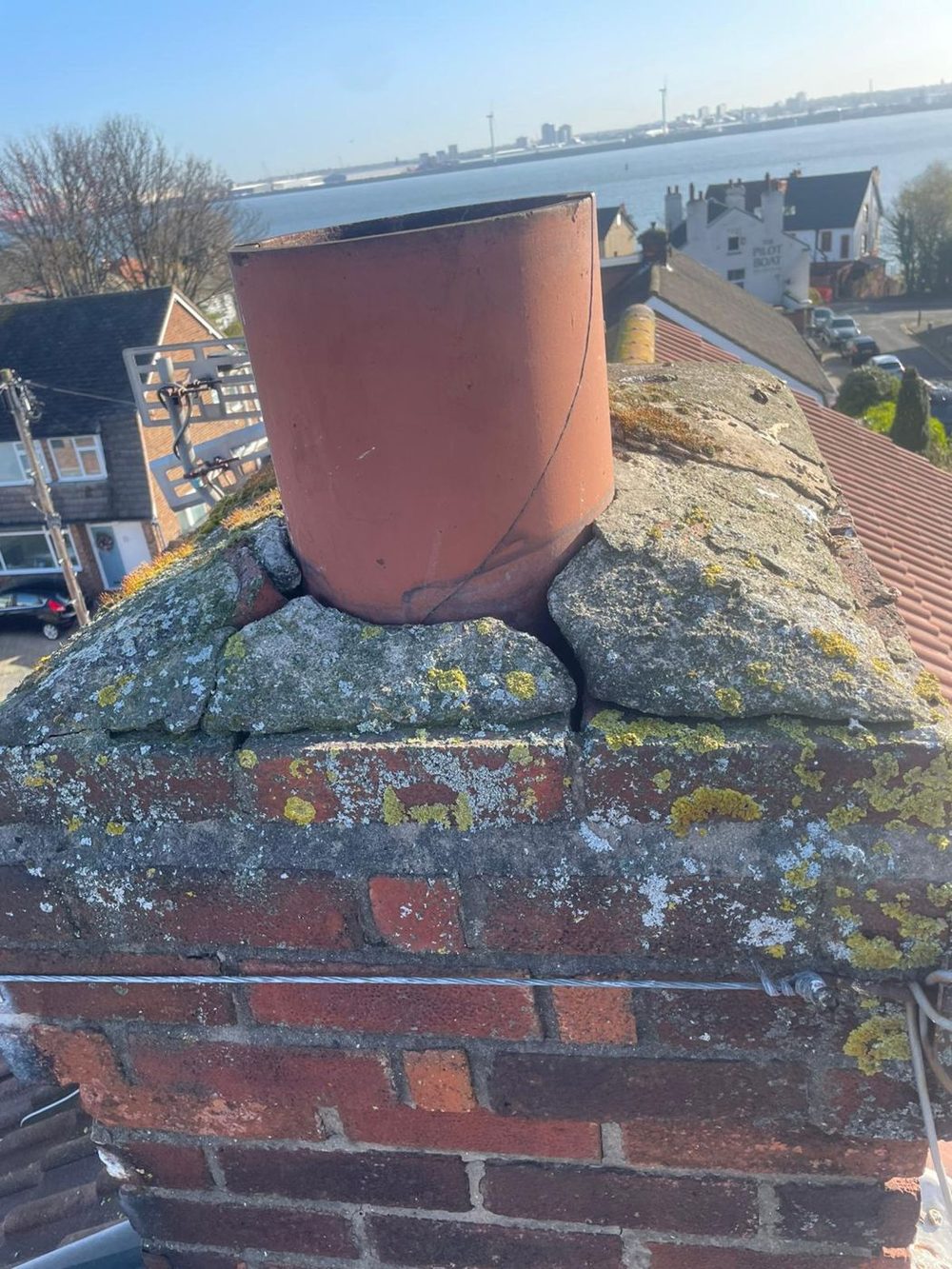
Photograph of our own work.
Water entering at the head of a stack behaves like water. It runs, which means the mark on the breast tends to have a definite edge, often a tide line, and frequently a streak or a run rather than a soft circle. It appears or darkens within a day or so of rain, and in between spells it fades and the wall dries back, even if the staining left behind does not disappear. Over a year it is a winter problem far more than a summer one.
The other signature is direction. Because the water has to get in somewhere specific, one face of the stack is usually doing the letting in, and that face is normally the one that takes driven rain. So a leak tends to be repeatable: the same weather, the same corner, every time. If your notes over a couple of months show that the wall goes dark after a south-westerly and not after anything else, that is a leak talking.
The confirming evidence is in the roof space rather than the bedroom. Where the breast passes through the loft, a leak from above usually leaves the brickwork visibly wet on one face, sometimes with a trail running down it, and there may be staining on the timber alongside. A flue with a condensation problem tends to look dry up there, because the moisture is inside the flue rather than on the outside of the brickwork. That one observation separates the first two causes more reliably than anything else available to a householder.
A working fire keeps its own flue dry, because a flue in use is warm and air is going up it all day. Take the fire out, board the opening over, and that stops. What is left is a tall cold masonry shaft, open at the top to the weather, closed at the bottom, with still air inside it. Warm damp air from the house works its way in at the bottom through the boarding and the plaster, meets a cold surface some way up, and gives up its moisture there.
The result soaks into the brickwork from the inside out and appears on the breast as a soft patch with a vague edge, often quite high on the wall or along the ceiling line, and often spreading rather than running. It is at its worst in a cold snap with the heating on hard, which is precisely when a leak is least likely to be happening. It can be perfectly obvious in the middle of a dry fortnight in January. Sometimes there is a faint sooty smell with it, which a leak does not generally give you.
There is a version of this that people create for themselves without realising. A flue capped off solid at the top, with the fireplace plastered over at the bottom, has been sealed at both ends, and a sealed flue cannot dry. Everything that gets into the brickwork stays in it. The route out of that is a cap that deliberately lets air through and a grille or air brick low down on the breast, so that a slow current runs through the flue all year. That is a small piece of work by the standards of chimney repairs and it very often resolves the whole thing.
Open fires leave more than soot. Combustion produces chlorides, nitrates and sulphates, and over fifty or a hundred years of use those travel out of the flue into the brickwork around it, and eventually into the plaster on the room side. They are hygroscopic, which simply means they take water out of the air, and they will go on doing it for as long as they are there. Nothing happening on the roof puts them there, and nothing happening on the roof takes them away.
On the wall this is the version that never quite goes. The patch is there in August as well as February, it darkens on muggy days and lightens in dry heat, and it has no relationship at all to rainfall. Paint over it and the stain bleeds back through in weeks, usually with a yellow-brown edge. The plaster may feel cool and slightly clammy, there can be a powdery white crust or little clusters of crystals where the surface has broken, and wallpaper lifts and stays lifted.
This is the one that most often gets billed to the wrong trade. A damp meter will read high on a salt-contaminated wall on a dry day, and a meter reading is easily mistaken for proof of a leak, because what the meter is really responding to is conductivity rather than water as such. The repair is an internal one: the contaminated plaster is taken off, back to brick and usually a good deal wider and higher than the stain, and the wall is made good in a system intended to hold salts back. That is plastering work, not roofing work, and any roofer who tells you otherwise is guessing.
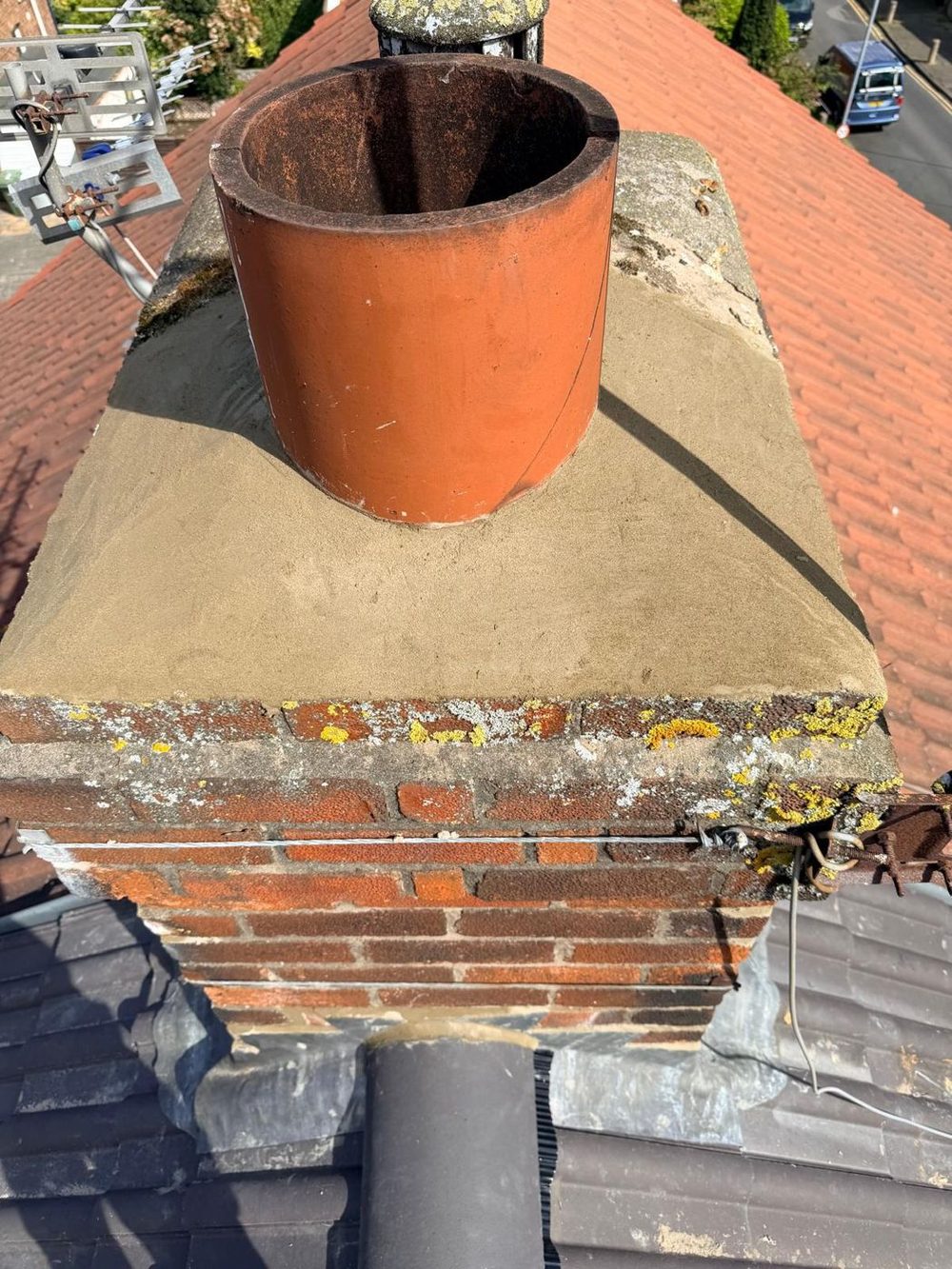
Photograph of our own work.
Start with a diary, because all three declare themselves over time rather than in a moment. For a month, write down the date, whether it rained and how hard, whether the heating was on, and how the patch looked. Rain-following says leak. Cold-and-heating-on says condensation. Neither, with the patch simply always there, says salts. A month of that is worth more than any single visit.
Then do the foil test, which costs nothing. Tape a piece of kitchen foil or a square of clear plastic to the worst part of the breast, sealing all four edges with tape, and leave it a few days. If moisture forms on the face towards the room, the wall is cold and the air in the room is condensing on it. If the side against the plaster comes away wet while the room side stays dry, moisture is coming through the wall. The test is crude and it can be muddled by a cold snap, so run it twice in different weather before believing it.
Finally, go and look in the roof space with a torch, ideally after rain, and look at the stack where it passes through. Wet brickwork up there with a trail down one face points at a leak. Dry brickwork up there, with the damp only appearing downstairs, points at something happening inside the flue or inside the plaster. Do not go up on the roof to look at the stack itself — it is the highest point of the house and nothing about a damp patch is urgent enough to justify it. Work the question out from inside, and from the garden with the phone zoomed in.
One last thing that catches people out: these are not mutually exclusive. A stack that has been letting water in for years is also a stack that has been carrying salts down into the plaster, and a flue that has been sealed at both ends will be condensing on top of both. That is why the order matters. Stop the water first, get air moving through the flue second, and leave the plastering until last, because replastering a wall that is still being wetted is money spent twice.
The rest of the series, on the questions people ask most.
Every town has its own page, written around the stacks that are actually on the roofs there. Start with the main chimney repairs page.
“Excellent work replacing ridge tiles, repointing chimney and repairing flashing. Also fixed other broken tiles. Clean and tidy job. Would definitely recommend.”
Neil“The guys did a great job in repairing our chimney. They were reliable, friendly and efficient. Buddy kept me in the loop throughout the whole process and I would not hesitate to use Roofline again!”
Hollie Furnival“Highly recommend. Very quick and efficient. Great communication. Went above and beyond to work the weekend to complete the work that needed to be done. Very happy with the results.”
Karen JonesDescribe what you can see and roughly where you are, and we will come back to you — usually the same day. If water is coming in now, please call instead.
Prefer to talk? Call 07464 259566 · WhatsApp 0044 7464 259566 · Email Evensbuddy@yahoo.com
We cover Chester, Cheshire, the Wirral and Flintshire from Elton, just north of Chester.
2 Manley View
Elton
Chester
CH2 4QF
Almost all of our work happens at your property rather than here, so please call before travelling.
Monday – Friday — 24hrs — Emergency Call-Outs
Saturday — 8:00 – 19:00
Sunday — 8:00 – 19:00
Weekday emergency call-outs are answered around the clock. Weekend cover is 8:00 to 19:00.