★★★★★
“Excellent work replacing ridge tiles, repointing chimney and repairing flashing. Also fixed other broken tiles. Clean and tidy job. Would definitely recommend.”
NeilWhere a chimney passes through a roof, the joint is closed either with lead or with a wedge of mortar. They look similar from a distance and they behave nothing alike. This is how to tell which one you have.
A chimney is a wall that comes up through a roof, and the line where the two meet is a genuinely awkward piece of building. On the downhill side, water running off the roof arrives at the brickwork. On the uphill side, water coming down the slope piles up behind the stack and has to be caught and sent around it. Down the two sloping sides, the covering steps past the brickwork course by course. Every one of those junctions has to be closed against weather while still allowing the two materials to move independently, because they do.
There are two ways that gets done on houses in this country. The first is sheet lead, formed and dressed into the shape of the junction and fixed into a cut groove in a mortar joint. The second is a fillet: a wedge of mortar, sometimes called a cement fillet or a sand-and-cement flaunch, trowelled into the angle between the brickwork and the covering. From twenty metres away in flat light they can look surprisingly similar. They are not similar, and knowing which you have changes what any repair is going to involve.
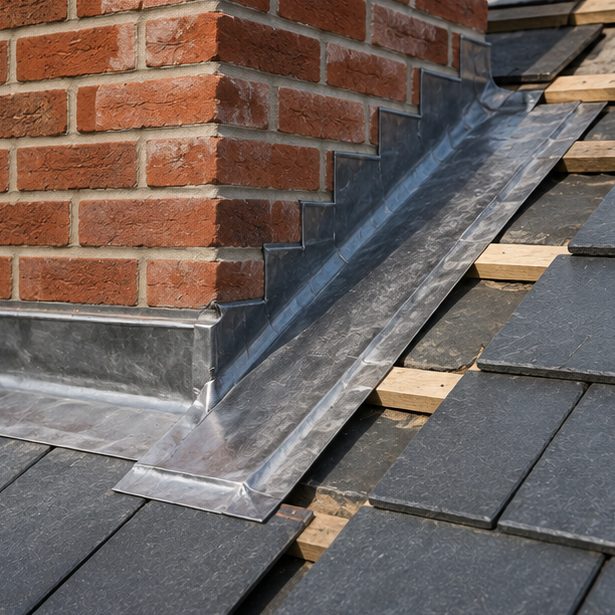
Image above is for illustration purposes only.
Colour and surface come first. Lead that has been up for any length of time is a flat mid-grey, often with a chalky white bloom on it, and it has a slightly rippled, hand-worked surface that catches light unevenly. Fresh lead is brighter and more silver and settles down within a year or so. Mortar is the colour of the pointing around it, usually a lighter grey or a buff, and it reads as matt and even, with the texture of a trowelled surface rather than a beaten one.
Shape is the more reliable test, and the giveaway is on the sloping sides of the stack. Lead up a slope is made as a staircase, because it has to be tucked into horizontal brick joints that step up the wall one course at a time, so you see a series of small square shoulders following the brick courses. A fillet cannot do that. It is trowelled as one continuous wedge running straight up the angle at the pitch of the roof, so it reads as a single smooth diagonal band with no steps in it whatever. If the sides of your stack show steps, there is lead there. If they show a plain diagonal stripe, there is not.
Then look at how it sits. Lead on the downhill face is a separate sheet lying on top of the tiles or slates with a visible free edge and a shadow line under it, and it typically extends a fair way down the slope. A fillet fills the internal angle instead, so it has no free edge and no shadow; it looks like part of the brickwork poured into the corner. Finally look for cracks. A long, more or less straight crack running along the length of a grey band at the base of a stack is the commonest single thing to see there, and mortar is what cracks like that.
A properly leaded stack has up to four separate components, and this is worth knowing because it explains why the view from the ground can be genuinely misleading. There is an apron across the downhill face. On a slate or plain-tile roof there are soakers up the two sloping sides, individual pieces of lead laid one per course; against a modern interlocking concrete or clay tile there are no soakers at all, because a single-lap tile leaves nowhere to interleave them, and the side flashing is dressed straight over the tile instead. There is a stepped cover flashing up each side, chased into the brick joints. And behind the stack, on the uphill side, there is a back gutter.
Of those, the apron and the stepped flashing are visible from outside. The soakers are not, by design — they live underneath the covering and only a narrow turned-up edge of each one is ever in daylight. The back gutter is not visible either, from any position on the ground, because it sits behind the stack in the shadow of it and below the line of the head.
Two consequences follow, and they cut in opposite directions. A stack with a handsome apron and neat steps on both sides can still be letting water in at the back gutter, which is the piece that fails most often and the piece nobody can inspect from a garden. And equally, a stack with a mortar fillet across the front is not necessarily filleted all the way round; it is quite common to find a fillet on the face somebody could reach easily and original lead still in place elsewhere. Neither the presence nor the absence of visible lead settles the question on its own.
The reason a fillet fails is not bad workmanship. It is that the job is impossible. The fillet is a rigid bar of mortar bridging between brickwork and a roof covering, two things that expand, contract and move at different rates and in different directions. Timber under the covering takes up moisture and gives it back with the seasons, the stack itself warms and cools on a different cycle, and a slate or a tile lifts a fraction under wind. Mortar has almost no capacity to accommodate any of that, so it cracks, and it usually cracks along its whole length rather than in one spot.
Once it has, the crack is a slot sitting in the exact line where water concentrates, and it feeds water directly into the joint the fillet was put there to close. Lead deals with the same movement simply by being a soft metal that can flex and by being made in lapped pieces rather than one long rigid length.
There is a third thing you may see, which is neither one nor the other: mortar or mastic run along the top edge of existing lead where it meets the brickwork. That is somebody closing a gap that opened when the lead came out of its groove, and it tells you that the fixing has failed rather than that the lead has. Lead is supposed to be held in a cut chase with folded lead wedges and pointed over. Sealant along that line is a patch with a short life, and it is worth recording when you see it because it says something about what has been done to the stack before.
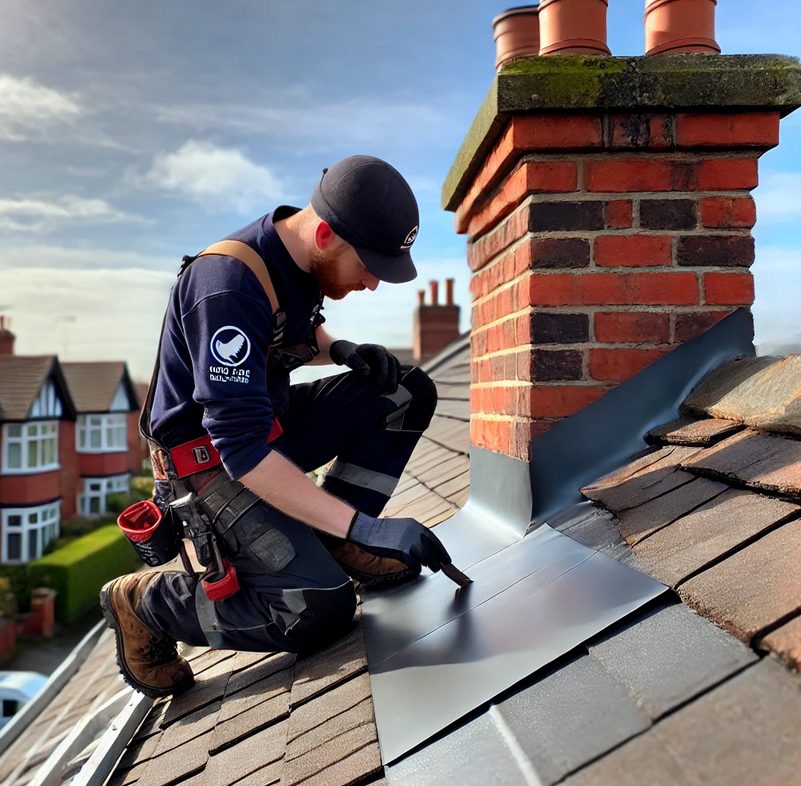
Image above is for illustration purposes only.
Taking a fillet off and putting proper lead in is more work than it sounds, and it is fair to know that before asking for a price. The covering has to come off around the stack so that soakers can be laid in with the slates or tiles. Chases have to be cut into the bed joints, which is careful work on soft old brick. The pieces are cut, bossed and dressed to the shape of the roof, wedged into the chases and pointed, and the covering goes back over the top. That is a different order of job from running another fillet round the base, which is why it is sometimes offered instead.
The questions worth asking are short. Which of the four pieces are being replaced, and which are being left? What code of lead is going on, and in what lengths, given that long single pieces buckle and split as they expand? Is the lead being chased into a cut joint and wedged, or bedded on the surface? Is the back gutter included, since it is the piece nobody can see and therefore the piece easiest to leave out of a price? And is the finished lead going to be treated with patination oil on the day, which stops the white weathering bloom washing down and staining the roof below.
One last point on how the work gets sequenced. There is no purpose in renewing lead at the base of a stack whose head is still shedding water into the brickwork, because the water will simply arrive below the new lead instead of above it. Mortar at the top and lead at the bottom are usually done as one visit for that reason. What a stack needs at the top is a separate subject, taken up in repointing a chimney, and if you are still working out whether the stack is the source at all, start with where the water is getting in.
The rest of the series, on the questions people ask most.
Every town has its own page, written around the stacks that are actually on the roofs there. Start with the main chimney repairs page.
“Excellent work replacing ridge tiles, repointing chimney and repairing flashing. Also fixed other broken tiles. Clean and tidy job. Would definitely recommend.”
Neil“The guys did a great job in repairing our chimney. They were reliable, friendly and efficient. Buddy kept me in the loop throughout the whole process and I would not hesitate to use Roofline again!”
Hollie Furnival“Highly recommend. Very quick and efficient. Great communication. Went above and beyond to work the weekend to complete the work that needed to be done. Very happy with the results.”
Karen JonesDescribe what you can see and roughly where you are, and we will come back to you — usually the same day. If water is coming in now, please call instead.
Prefer to talk? Call 07464 259566 · WhatsApp 0044 7464 259566 · Email Evensbuddy@yahoo.com
We cover Chester, Cheshire, the Wirral and Flintshire from Elton, just north of Chester.
2 Manley View
Elton
Chester
CH2 4QF
Almost all of our work happens at your property rather than here, so please call before travelling.
Monday – Friday — 24hrs — Emergency Call-Outs
Saturday — 8:00 – 19:00
Sunday — 8:00 – 19:00
Weekday emergency call-outs are answered around the clock. Weekend cover is 8:00 to 19:00.