★★★★★
“The guys did a great job in repairing our chimney. They were reliable, friendly and efficient. Buddy kept me in the loop throughout the whole process and I would not hesitate to use Roofline again!”
Hollie Furnival
Whole streets here went up to one design in one season, so when a stack is due the ones either side of it usually are too. What going together off a single scaffold really changes, and what it does not.
Winsford grew twice. First around the salt works along the Weaver, and then, from the 1960s, as a town taking overspill housing on a scale that reshaped it — Wharton, Over, Swanlow, Dene Drive and Grange Lane all laid out as single contracts. Long runs of semis and short terraces, one or two house types repeated the length of a road, put up by one gang in one or two seasons.
That has a consequence people rarely think about until something goes wrong at roof level. The houses either side of you are not merely similar to yours; they are the same house. Same brick out of the same batch, same mortar mixed by the same hands, same pitch, same tile, same stack built to the same detail in the same month, standing in the same wind ever since. Chimneys on a street like that do not go one at a time for no reason. They come due together.
So it is entirely normal here for two or three neighbours to be asking about the same thing in the same fortnight, and there is a sensible way to handle that. Roofline Solutions surveys, quotes and works on the outside of the stack — pointing, heads and flaunching, lead, pots, cowls, part rebuilds and removals — and there is nothing unusual about looking at two or three houses on one visit. Flue lining, sweeping and appliance work belong to a HETAS or Gas Safe registered installer and a sweep. Where a stack sits astride a party wall there is more about that on the Birkenhead page.
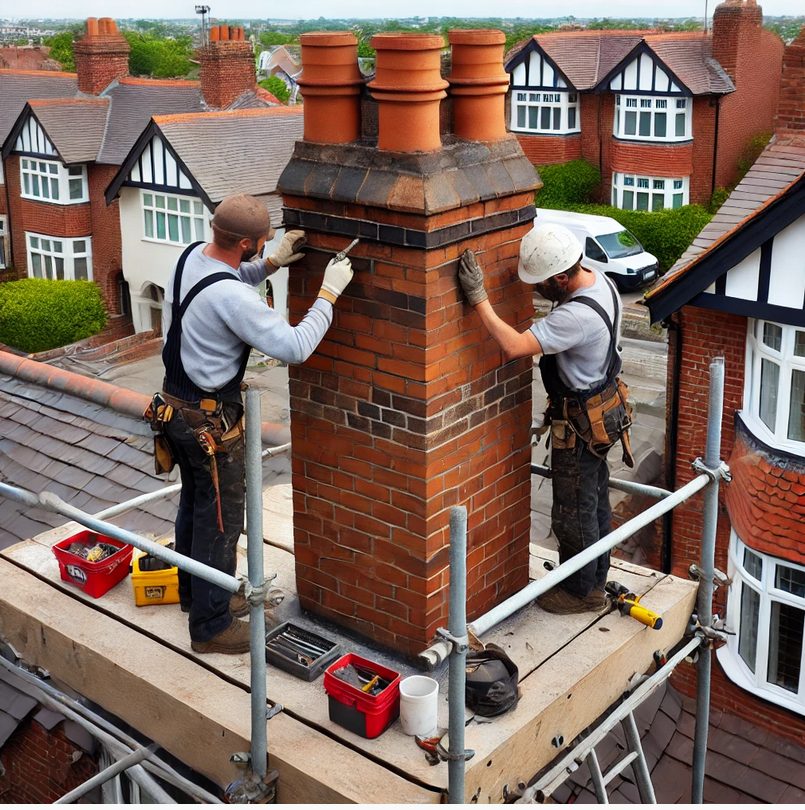
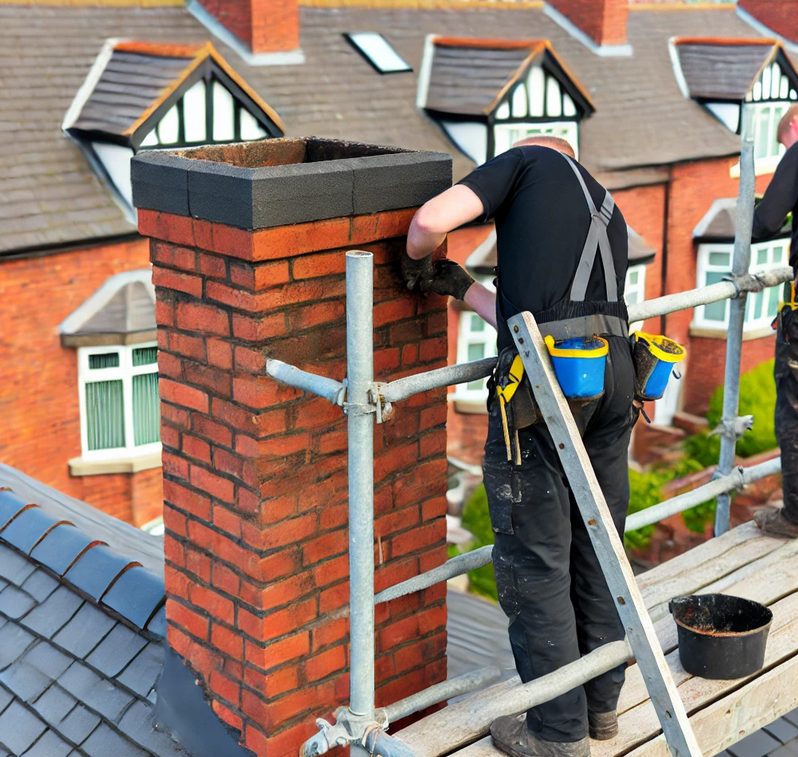
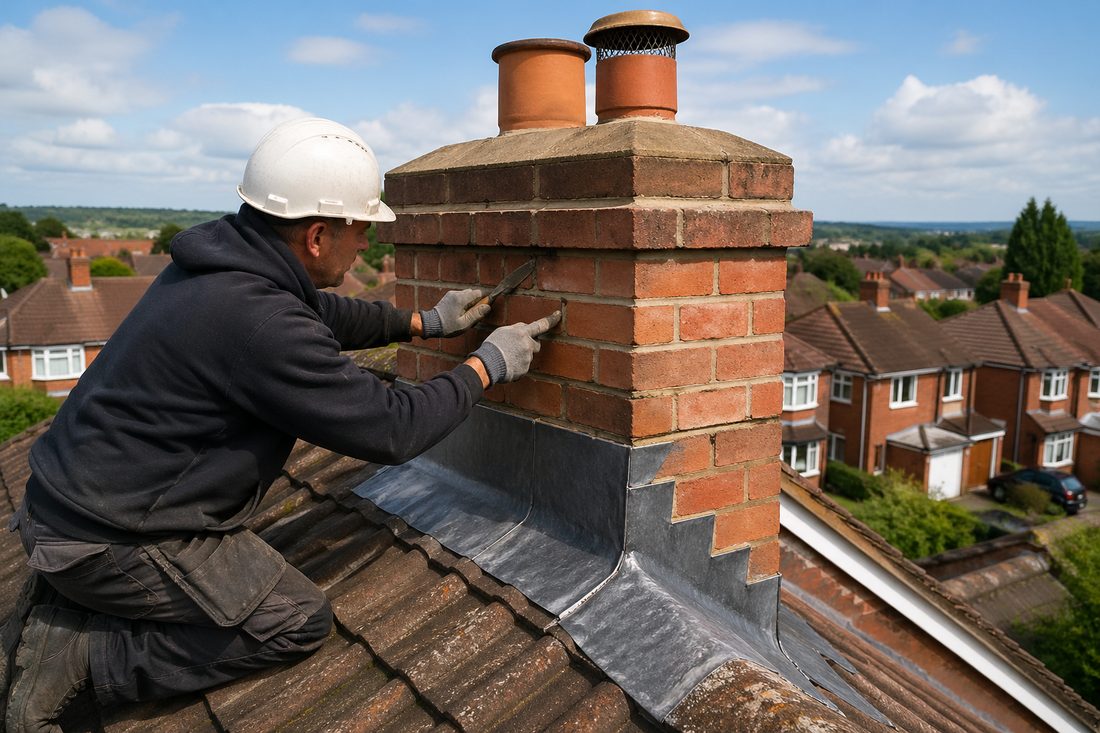
Images above are for illustration purposes only.
Start with what genuinely changes. Access is one of the largest single items in any chimney job, and it is very nearly fixed whatever happens on the roof afterwards: a wagon, an erection, a hire period, a dismantle, and a licence if any of it stands on the footway. On a pair of semis one scaffold structure can serve both stacks — a single run of standards along the pair with the platform continuous across the middle, one delivery, one erection, one dismantle and one hire period covering both houses.
Now what it does not change, which matters just as much. Each house stays its own job, with its own survey, its own written quotation and its own customer, and neither neighbour can commit the other to anything. Identical houses stop having identical stacks fairly quickly: one has had a stove put in and its flue is live and warm, one was pointed in a hard mix in the 1980s and is losing brick faces because of it, one has an aerial mast strapped to it, one has had the pots taken off and a slab laid across the top. The work on each stack takes what that stack needs. Sharing the access does not shorten the pointing, the flaunching or the leadwork by a single hour.
Then there is the part that is nobody’s trade. Somebody has to be the point of contact for the scaffold, because it is one structure standing partly on one property and partly on the other, and both owners have to be content with where it stands and what it ties into. And it is worth settling the small shared questions early — mortar colour, whether the pots stay or go, whether a pair that has always matched is going to carry on matching — which are far easier to agree before the scaffold goes up.
A street of identical houses hands you something a one-off never will: a row of controls. Walk the road and look at four or five stacks of the same age and the same build. If they all look alike — the same green shading on the same face, joints receded to the same depth, the same tired grey on the heads — then what you are seeing is the age of the whole contract, and yours is due when everybody else’s is. If yours looks markedly different from its neighbours, something specific happened to it, and it is usually on a short list: a live stove flue keeping one stack warm and dry while the rest sit cold, an earlier repair in the wrong mix, an aerial mast, a tree, or an extension that changed the way wind comes over that roof.
Specifics to check from the pavement, in order. The heads against the sky across several houses, because one that reads ragged or noticeably lower than its neighbours has lost material. The pots, for height and for upright. The line of your stack against the one next door, which on a mirrored pair gives you a free plumb reference. The base of each stack, because a grey fillet on one roof and lead on the rest means somebody has patched rather than repaired. And the mortar colour, which gives away where a stack has been repointed since. Then look down: grit and mortar crumbs in the gutter or on the drive say which stack is losing material now.
On the usual Winsford pair the stack sits on or close to the party line at the ridge, so a platform has to reach the highest point of two roofs at once. One run of scaffold along the front or the back of the pair does it, which is why going together works so neatly here. The ground is the part to sort out first: gates that tube will not go through, a fence panel that may have to come out and go back, block paving and lawns wanting sole boards, and a shared drive that a wagon needs to stand on for an hour. Where a frontage runs onto the footway with no side access, the platform needs a licence from Cheshire West and Chester Council.
Working across two houses also doubles the ordinary courtesies. Two sets of windows to keep shut while mortar is being cut out, two lots of cars to move, and whatever sits under the scaffold in both gardens — washing lines, greenhouses, a conservatory — sheeted or boarded over. The covering on most of these roofs is interlocking concrete tile, brittle at the nibs and no friend of anybody walking on it, so the stacks are reached off the platform and any tile that does break is replaced.
A pair of semis is handed, so the two lead sets are mirror images of each other: the steps run the opposite way up the sides, the apron falls to the other hand, and the back gutter sits on the equivalent slope reversed. That is an argument for making them at the same time rather than a year apart, because the same setting-out suits both, the same code of lead suits both roofs and it is a good deal quicker to form eight pieces in one go than to come back for the second four. It also settles the detail across the pair, which matters where one stack has a mortar fillet round its base and the other has proper lead.
The top of the stack is where two neighbours most often want different things. If one house keeps its pots and the other has its head flattened off, the pair stops reading as a pair from that day on. Where both flues are finished with, both heads can be closed the same way and left able to breathe. Where one house has a live stove flue, that pot stays and may want a cowl chosen for the fault it actually has. And flaunching colour is the easiest thing to match across two houses, provided both heads are formed from the same sand in the same week.
Repointing, flaunching, stack rebuilds and removals, lead aprons, soakers, stepped flashings and back gutters, pots, cowls and bird guards — and the roof around the stack when it needs attention at the same time.
“The guys did a great job in repairing our chimney. They were reliable, friendly and efficient. Buddy kept me in the loop throughout the whole process and I would not hesitate to use Roofline again!”
Hollie Furnival“Highly recommend. Very quick and efficient. Great communication. Went above and beyond to work the weekend to complete the work that needed to be done. Very happy with the results.”
Karen Jones“Would highly recommend roofline solutions they arrived in time an explained to me what need to be done well spoken and polite”
Kyle CummingsWritten for homeowners working out which part of a chimney has failed, before anyone comes out.
Every town below has its own page, written around the stacks that are actually on the roofs there.
Describe what you can see and roughly where you are, and we will come back to you — usually the same day. If water is coming in now, please call instead.
Prefer to talk? Call 07464 259566 · WhatsApp 0044 7464 259566 · Email Evensbuddy@yahoo.com
We cover Winsford from our base at Elton, just north of Chester.
2 Manley View
Elton
Chester
CH2 4QF
Almost all of our work happens at your property rather than here, so please call before travelling.
Monday – Friday — 24hrs — Emergency Call-Outs
Saturday — 8:00 – 19:00
Sunday — 8:00 – 19:00
Weekday emergency call-outs are answered around the clock. Weekend cover is 8:00 to 19:00.