★★★★★
“The guys did a great job in repairing our chimney. They were reliable, friendly and efficient. Buddy kept me in the loop throughout the whole process and I would not hesitate to use Roofline again!”
Hollie FurnivalA good share of what gets reported as a roof leak is rainwater that never got into the roof at all. Tracing that is a different exercise.
Water that gets past a roof covering is a roofing problem. Water that the rainwater system fails to carry away is a drainage problem. They produce similar-looking damp and they are completely different jobs.
The single most useful discriminator: ceiling damp is usually the roof; vertical damp on a wall is usually the drainage.
The second: timing. A roofing leak generally follows wind-driven rain from a particular direction. A drainage failure generally follows prolonged heavy rain regardless of wind, because it is about volume.
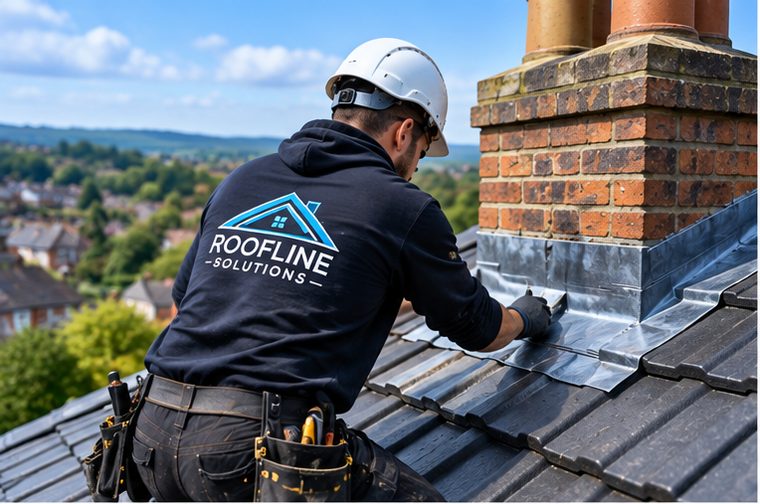
This is the whole method and it takes five minutes. Go outside during heavy rain, with a coat, and look at each part of the system.
Water pouring over the front lip of a gutter along a length: the gutter is blocked or at capacity.
A vertical curtain of water at one point: a failed joint.
Water running down the wall behind the gutter: the gutter has dropped, or the underlay at the eaves does not carry into it, so the roof is discharging behind rather than into it. This is the one most often mistaken for a roof leak.
A downpipe that is dry while the gutter is full: the outlet is blocked.
Water spraying from a joint in a downpipe: a split or an open socket, common on old cast iron that has frozen.
Water backing up out of a gully at the bottom: the problem is below ground and the whole pipe is backed up.
The hopper head - the open funnel at the top of some downpipes, particularly on older and larger buildings. They fill with leaves and then overflow directly onto the wall behind them, and because they are high up and out of the way nobody looks.
The back of the gutter. A gutter can be clear and still fail if the water is going behind it.
Shared and hidden gutters. On a terrace or a building with a parapet, a box gutter carries the water from several roofs and discharges through one or two outlets. When it blocks it overflows inside the building line, which produces a serious leak from a modest blockage.
The gully. Below the downpipe, a blocked or silted gully backs water up the pipe until it overflows at the nearest joint - so the symptom is halfway up the wall and the cause is at ground level.
Two local factors.
Salt and exposure. Cast iron rainwater goods, which a lot of the older housing here still has, corrode faster in salt air - and they corrode from the inside, where you cannot see it. A cast iron downpipe with a hairline split behind it produces a damp stripe on a wall with nothing visible from the front.
Frost. A gutter or downpipe holding silt holds water, and water in a cast iron pipe that freezes splits it. That is why so many drainage faults announce themselves in late winter rather than in autumn when the blockage actually formed.
And the general one: a good proportion of what we are called to here as chimney or roof leaks turns out to be a downpipe running down a wall next to a stack, which has been soaking the masonry for years.
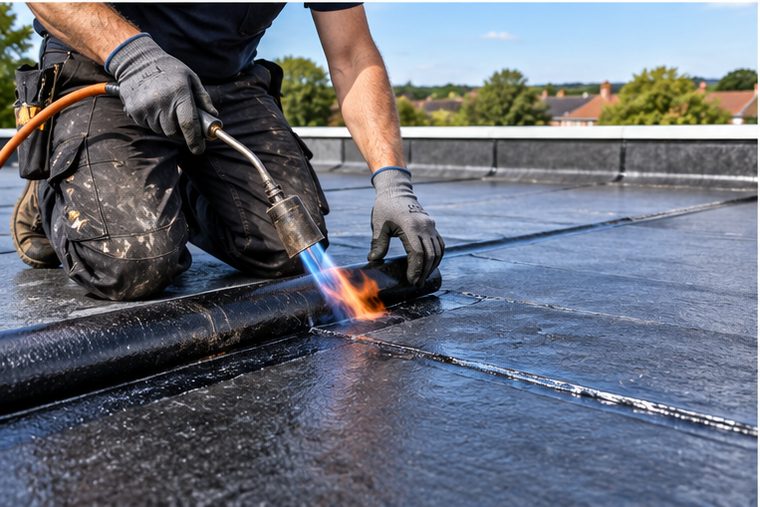
Usually clearing, which is the cheapest outcome in the trade.
Sometimes re-hanging a length of gutter to restore its fall, or renewing a joint.
Occasionally replacing a corroded or split section, and on a building with cast iron that is a materials decision - matching cast iron or a convincing equivalent rather than substituting plastic, particularly where appearance matters.
And where the roof is discharging behind the gutter, correcting the eaves detail so the underlay carries over into it. That is a roofing job, it is small, and it fixes a problem people have often been chasing for years.
The rest of the series, on the questions people ask most.
Every town has its own page, written around what the roofs there are actually like. Start with the main roof repairs page.
“The guys did a great job in repairing our chimney. They were reliable, friendly and efficient. Buddy kept me in the loop throughout the whole process and I would not hesitate to use Roofline again!”
Hollie Furnival“I needed help removing a chimney.
Buddy discussed the options available to me, taking into account my budget, timeline and DIY ability.
We settled that his team would remove the chimney to the roofline, using scaffolding and ladders.
He gave a detailed description of the steps his team were going to take, how long it would take them, and provided a fair quote.
His team were pleasant and worked efficiently. They got the job done in the estimated time and I was happy with the end result.”
“Rapid response and fair pricing. Good workmanship. Pleasant staff.”
Ben GreenDescribe what is happening and roughly where you are, and we will come back to you — usually the same day. If water is coming in now, please call instead.
Prefer to talk? Call 07464 259566 · WhatsApp 0044 7464 259566 · Email Evensbuddy@yahoo.com
We cover Chester, Cheshire, the Wirral and Flintshire from Elton, just north of Chester.
2 Manley View
Elton
Chester
CH2 4QF
Almost all of our work happens at your property rather than here, so please call before travelling.
Monday – Friday — 24hrs — Emergency Call-Outs
Saturday — 8:00 – 19:00
Sunday — 8:00 – 19:00
Weekday emergency call-outs are answered around the clock. Weekend cover is 8:00 to 19:00.