★★★★★
“Excellent service from Buddy and the team in installing a new garage roof in a really professional manner. Was kept updated at all stages and given good advice as to our options. Would highly recommend”
Peter AspinallIf your tiles are breaking rather than slipping, the likeliest culprit is water that was already inside them when it froze.
Every roofing tile is porous to some degree. Clay and concrete both absorb water into the body of the tile, which is normal and not in itself a problem - the tile dries out again between wettings.
The problem is what happens if it freezes while saturated. Water expands as it turns to ice, and inside a tile that expansion has nowhere to go, so it pushes against the material from within. One cycle does nothing measurable. A few hundred over decades opens the pore structure, and once it is opened the tile takes up more water, which makes the next winter worse.
That is why frost damage is progressive rather than sudden, and why it accelerates. A tile that has started to go will go faster from here.
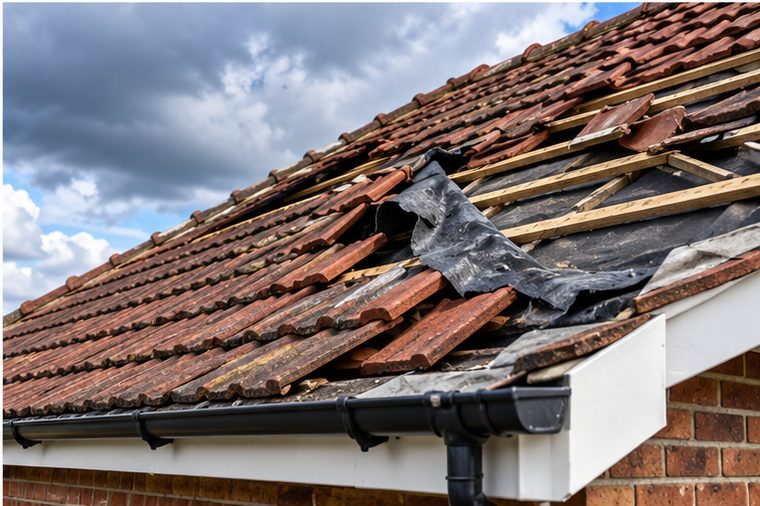
Frost damage is not spread evenly over a roof. It concentrates where the covering stays wet longest, and that is the slope that gets least sun.
On a typical Bebington semi with its ridge running front to back, that is usually the north or north-east facing slope. It dries slowest, holds moss and debris longest, and goes through the freeze-thaw cycle wetter than its opposite number.
So a roof where one slope is visibly crazed, spalling or shedding surface while the other looks tolerable is not a roof with two different coverings. It is one covering, of one age, in two different microclimates.
Overhanging trees and permanent shade do the same thing for the same reason. A slope kept damp is a slope on a shorter clock.
A great deal of inter-war Bebington housing still carries its original clay tiles, and clay does not fail like concrete.
Concrete tiles lose their surface. They are made with a coloured cement slurry on a grey body, and when that weathers off the tile goes patchy and starts absorbing water rather than shedding it. That is ageing, not breakage.
Clay tiles delaminate - they split into layers, parallel to the face, like a book coming apart. Frost gets into the laminations of the clay and levers them apart. You see it as flakes coming off the face, or as a tile that has come away in two thin pieces rather than snapping cleanly.
Handmade and early machine-made clay tiles vary in density across a single batch, so it is entirely normal for a few tiles on an otherwise sound roof to fail this way while their neighbours have another fifty years in them. A handful of delaminated tiles is not a condemned roof.
On these houses the slipping is mostly at the hips and the ridge, because both were bedded in mortar and ninety years of thermal movement and frost has loosened it.
The other slipping mechanism is the nib. Plain and interlocking tiles hang on a small projection at the head of the tile which hooks over the batten, and only some courses are nailed. A snapped nib, or a batten that has softened, and the tile creeps downward a few millimetres at a time. A row sitting slightly lower than the row beside it is worth looking at well before anything actually falls.
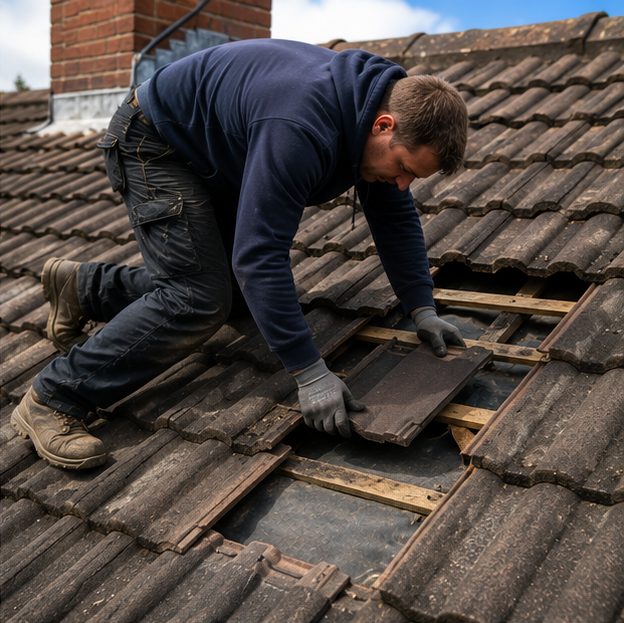
The strong recommendation on a ninety-year-old clay roof is to match rather than substitute. Salvaged tiles of the same pattern are usually obtainable, and four modern tiles in the middle of an old roof are visible from the street permanently.
It is also worth resisting the jump from "several tiles have delaminated" to "the roof needs replacing". What decides that is the condition of the tiles generally and of the battens underneath - not the fact that a few of them have failed, which is normal for the age and the material.
The rest of the series, on the questions people ask most.
Every town has its own page, written around what the roofs there are actually like. Start with the main roof repairs page.
“Excellent service from Buddy and the team in installing a new garage roof in a really professional manner. Was kept updated at all stages and given good advice as to our options. Would highly recommend”
Peter Aspinall“The men were genuine and trustworthy. Turned up every time when they said they would, and phoned ahead. Very respectful and did an amazing job.,thank you x”
freda markham“Had Roofline Solutions come and do our guttering today and done a great job. Our guttering was dangerous, after messaging over the weekend, they came Tuesday and sorted it out by Wednesday. Tidy and communicated everything to me. Thanks”
Emma PickettDescribe what is happening and roughly where you are, and we will come back to you — usually the same day. If water is coming in now, please call instead.
Prefer to talk? Call 07464 259566 · WhatsApp 0044 7464 259566 · Email Evensbuddy@yahoo.com
We cover Chester, Cheshire, the Wirral and Flintshire from Elton, just north of Chester.
2 Manley View
Elton
Chester
CH2 4QF
Almost all of our work happens at your property rather than here, so please call before travelling.
Monday – Friday — 24hrs — Emergency Call-Outs
Saturday — 8:00 – 19:00
Sunday — 8:00 – 19:00
Weekday emergency call-outs are answered around the clock. Weekend cover is 8:00 to 19:00.