★★★★★
“Excellent work replacing ridge tiles, repointing chimney and repairing flashing. Also fixed other broken tiles. Clean and tidy job. Would definitely recommend.”
NeilThere are no numbers on this page and the first section explains why. What is useful instead is knowing exactly what a chimney quotation has to separate out, and what to ask when two of them do not match.
It would be easy to put a range here and it would be dishonest. Roofline Solutions has not published a price list, and inventing a figure to fill the gap would mislead the person it was meant to help.
It would also be close to meaningless, because the words cover such different work. “Repointing a chimney” can mean a small stack on a bungalow reached from a tower, or a tall four-flue stack on a three-storey terrace with a pavement licence, a suspended parking bay and a scaffold standing for a fortnight. Access can easily be the larger part of the job, and access is decided by the building rather than by the repair.
What is genuinely useful is knowing what a quotation has to itemise, because that is what turns a number into something you can check, compare and hold somebody to. A quotation is a firm offer to do described work for a stated sum; an estimate is an opinion about what it may come to. Either way it should be in writing, dated, in the name of the business, with an address and a way of contacting them that is not only a mobile number. Ours are free and in writing, and the rest of this guide is what to look for on anybody’s.
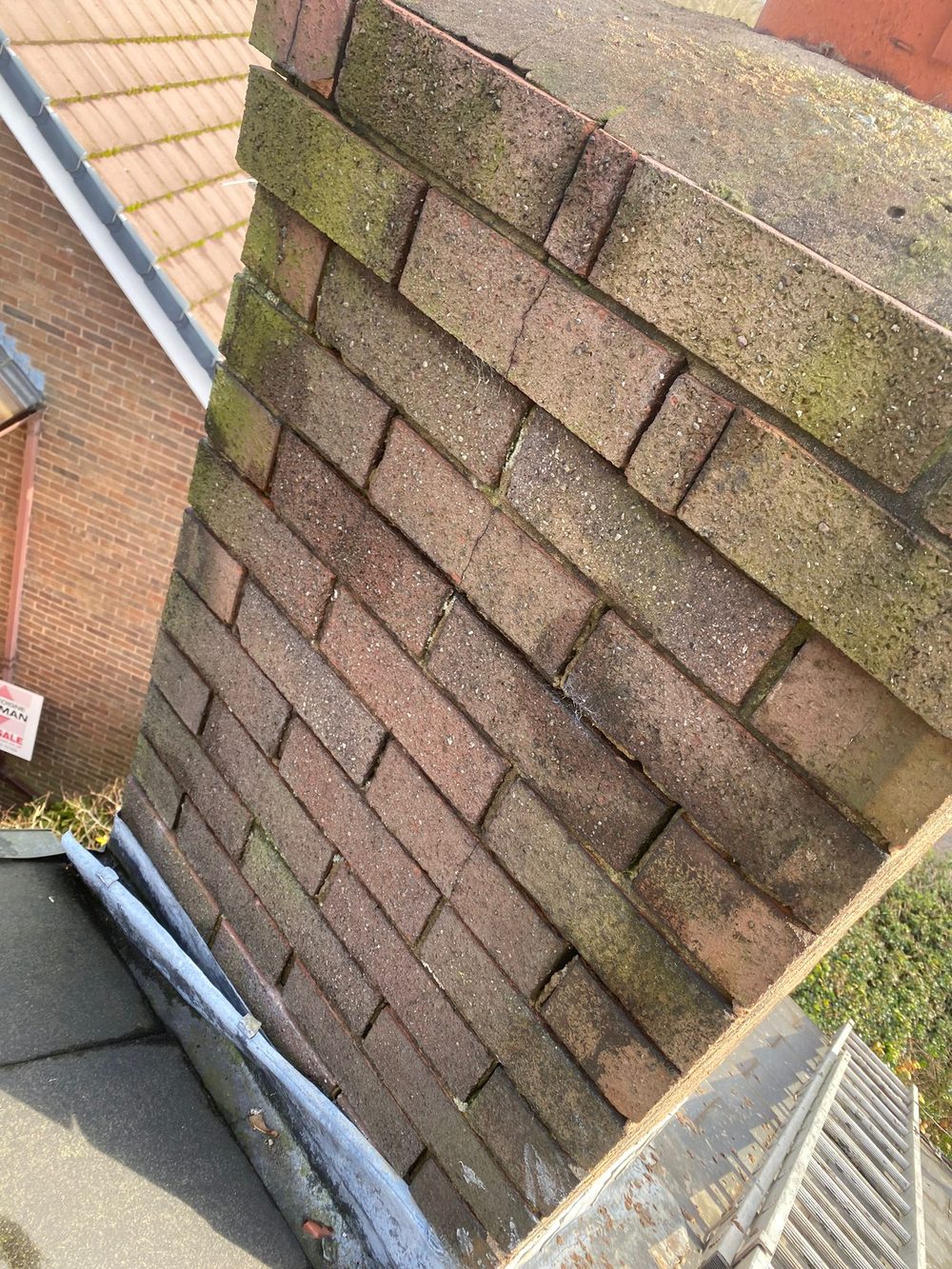
Photograph of our own work.
Start here, because it is where quotations diverge most and where the omissions hide. The quotation should say what access is being used — scaffold, tower or something else — and whether it is included or excluded. A price that excludes access is not comparable with one that includes it.
Then the detail. How many lifts, and does it include a chimney lift that puts the working platform at the right height against the stack rather than somewhere below it? How long is the hire period, and what happens if weather or extra work pushes the job past it? Who erects and dismantles, and is that in the figure quoted?
And then the permissions, which are nobody’s favourite subject and cause most of the delays. A scaffold standing on a public footway or highway needs a licence from the council, and a bay may need suspending. On a terrace or a semi the platform often has to stand on or tie into the neighbour’s property, which needs their agreement in advance — see shared and party chimney stacks. The quotation should say who is obtaining what, who pays for it, and what happens if permission is refused.
A single line reading “repoint chimney” is not a specification, and it is the commonest thing to find on a poor quotation. Four things should be named. Which faces are being pointed, and if it is not all four, why not. How the joints are being prepared — raked to what depth, cut by hand or by disc. What the mix is, given in parts or as a lime designation, and why that mix suits your brickwork rather than the one in the van. And how the colour is being matched, which is a question about the sand rather than about a dye.
The top of the stack is a separate item and should appear as one. Is the mortar around the pots being cut back and re-formed, or renewed completely, and is it laid to a fall with an edge that sheds clear? Are the pots being lifted and reseated, reused as they are, or replaced, and with what?
If brickwork is coming down, the quotation should say how far and why that course. A head rebuild, a rebuild to roof level and a rebuild below it are three different jobs. It should say where the brick is coming from and how it is being matched, whether a damp-proof tray is being built in, and what happens to the existing pots. It should also say what happens if the brickwork proves worse once the head is off, because that is a common discovery and a much better conversation to have before the scaffold goes up. The thresholds behind all of this are set out in repoint, rebuild or remove.
Lead should be itemised piece by piece, because there are up to four pieces and they are not the same job. The front apron on the downhill face, the soakers up the sloping sides where the covering is slate or plain tile, the stepped cover flashing up each side, and the back gutter behind the stack. On an interlocking tiled roof there are no soakers, so a quotation for one is a quotation that has not looked at your roof. The back gutter is the one to look for: it is invisible from the ground, it fails more often than the others, and it is therefore the easiest thing to leave out of a price quietly. If a quotation says “renew flashings” and nothing else, ask which of the four that covers.
Then the specification. What code of lead, which is the number that goes up with thickness, and in what lengths, since long unbroken pieces buckle and split as they expand. Is it chased into a cut joint, wedged and pointed, or bedded on the surface? Is patination oil being applied on the day, to stop the new lead weathering a white bloom down the roof below? If the covering comes off to lay soakers in, the quotation should say it is going back and how broken tiles will be dealt with. Telling lead from a mortar fillet before you ask is covered in lead flashing or a cement fillet.
Making good is the rest of it, and it is worth having in writing because it is the small stuff that gets argued about afterwards. The roof covering around the stack put back and left sound. Mortar droppings cleared out of the gutters rather than left to set in them. The path, drive and garden protected. And a clear statement of what is not included: a roofer does the outside of the stack, so plastering or decorating indoors is not normally part of it.
Waste and materials off the job should have a line. Who takes the rubbish away, and is a skip included? Old lead has a scrap value, so the quotation should say plainly whether it goes with the firm or stays with you; it is a small matter and exactly the sort of silence that causes bad feeling later.
Weather belongs in writing too, because it genuinely governs this work. Fresh mortar will not cure in a frost and washes out in heavy rain, so pointing and re-forming a head are booked into settled spells while lead and pot work are far less fussy. A quotation should give a realistic start window rather than a date that cannot be kept. If water is coming in now, it should say what is being done to make it safe in the meantime.
Then the paperwork itself. Insurance: public liability cover and the firm’s arrangements for working at height — Roofline Solutions is fully insured and will say so when asked. Whether the quotation is inclusive or exclusive of VAT, so that you compare like with like. Payment terms, and whether money is asked for before work starts and what it is for. How long the quotation stands. And what the firm will do about putting something right if a problem shows up afterwards, in their own words rather than yours.
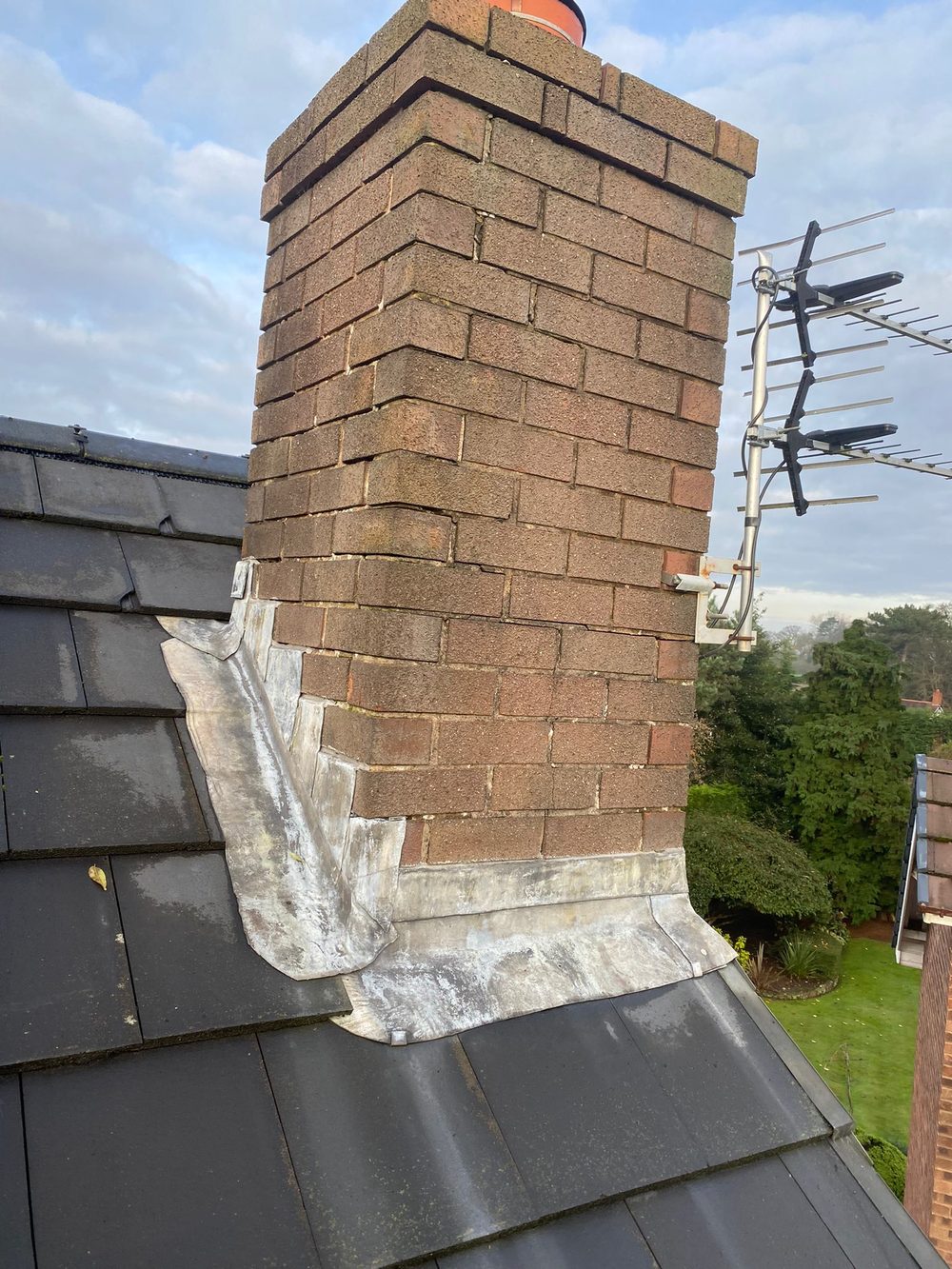
Photograph of our own work.
The method that works is dull and takes ten minutes. Write the items down the left of a sheet — access, permissions, which faces, preparation, mix, head and pots, each of the four lead pieces, brick and tray if any, making good, waste, VAT — and put each quotation in a column beside it. Tick what each one actually names. What you usually find is not that one firm is dearer but that they are describing different jobs, and the gaps cluster in the same places: access, the back gutter, the faces nobody can see from the road, and the mix.
Once the gaps are visible, ask each firm the same questions and compare the answers rather than the totals. A firm that tells you which faces, what mix and why, and which pieces of lead, has looked at your chimney. One that will not put the stack on a scaffold, or that has quoted without seeing the back of it, is quoting for something other than what you need. Be wary of anything that arrives at the door unasked and expires today.
One last thing costs nothing and is worth a great deal. Ask for photographs from the scaffold before it comes down: the back gutter, each face, the head and the pots. None of that is visible from the ground, and you should not be going up to look — a chimney is the highest point on the house and the worst place to put a ladder. Photographs from the platform are the only practical way to see what you paid for, and no reasonable firm minds being asked. What can sensibly be checked afterwards from the garden is covered in what to look for from the ground.
The rest of the series, on the questions people ask most.
Every town has its own page, written around the stacks that are actually on the roofs there. Start with the main chimney repairs page.
“Excellent work replacing ridge tiles, repointing chimney and repairing flashing. Also fixed other broken tiles. Clean and tidy job. Would definitely recommend.”
Neil“The guys did a great job in repairing our chimney. They were reliable, friendly and efficient. Buddy kept me in the loop throughout the whole process and I would not hesitate to use Roofline again!”
Hollie Furnival“Highly recommend. Very quick and efficient. Great communication. Went above and beyond to work the weekend to complete the work that needed to be done. Very happy with the results.”
Karen JonesDescribe what you can see and roughly where you are, and we will come back to you — usually the same day. If water is coming in now, please call instead.
Prefer to talk? Call 07464 259566 · WhatsApp 0044 7464 259566 · Email Evensbuddy@yahoo.com
We cover Chester, Cheshire, the Wirral and Flintshire from Elton, just north of Chester.
2 Manley View
Elton
Chester
CH2 4QF
Almost all of our work happens at your property rather than here, so please call before travelling.
Monday – Friday — 24hrs — Emergency Call-Outs
Saturday — 8:00 – 19:00
Sunday — 8:00 – 19:00
Weekday emergency call-outs are answered around the clock. Weekend cover is 8:00 to 19:00.