★★★★★
“Excellent work replacing ridge tiles, repointing chimney and repairing flashing. Also fixed other broken tiles. Clean and tidy job. Would definitely recommend.”
NeilThis picks up where you already know the flue is redundant. What to do with it, why it has to breathe at both ends, and what actually happens inside a shaft that has been closed off solid top and bottom.
This guide assumes the question has already been settled: the fire or the appliance has gone, nothing is going back, and the flue serving it is redundant. Working out whether damp on a breast is a leak, condensation or salts is a separate exercise and it belongs in damp on a chimney breast. What follows starts one step later, with a shaft nobody is using and a decision about what to do with it.
Doing nothing is a real option and it is not always the wrong one. A stack in good order, with sound mortar and lead, an open pot and a fireplace still open at the bottom, has air moving up it all day and stays perfectly dry. What it also has is an open mouth at the top, so it collects rain, it collects jackdaws in the spring, and it pulls heated air out of the room below at a rate that is noticeable on a cold day. Most people want that stopped, and stopping it properly is what capping means.
Beyond capping there is removal, which is a larger piece of work and a different decision, covered in repoint, rebuild or remove. The point worth holding on to here is that capping is the middle course. It leaves the stack standing, keeps the roofline as the architect drew it, and keeps the option of using the flue again later, at the cost of a small amount of ongoing ventilation.
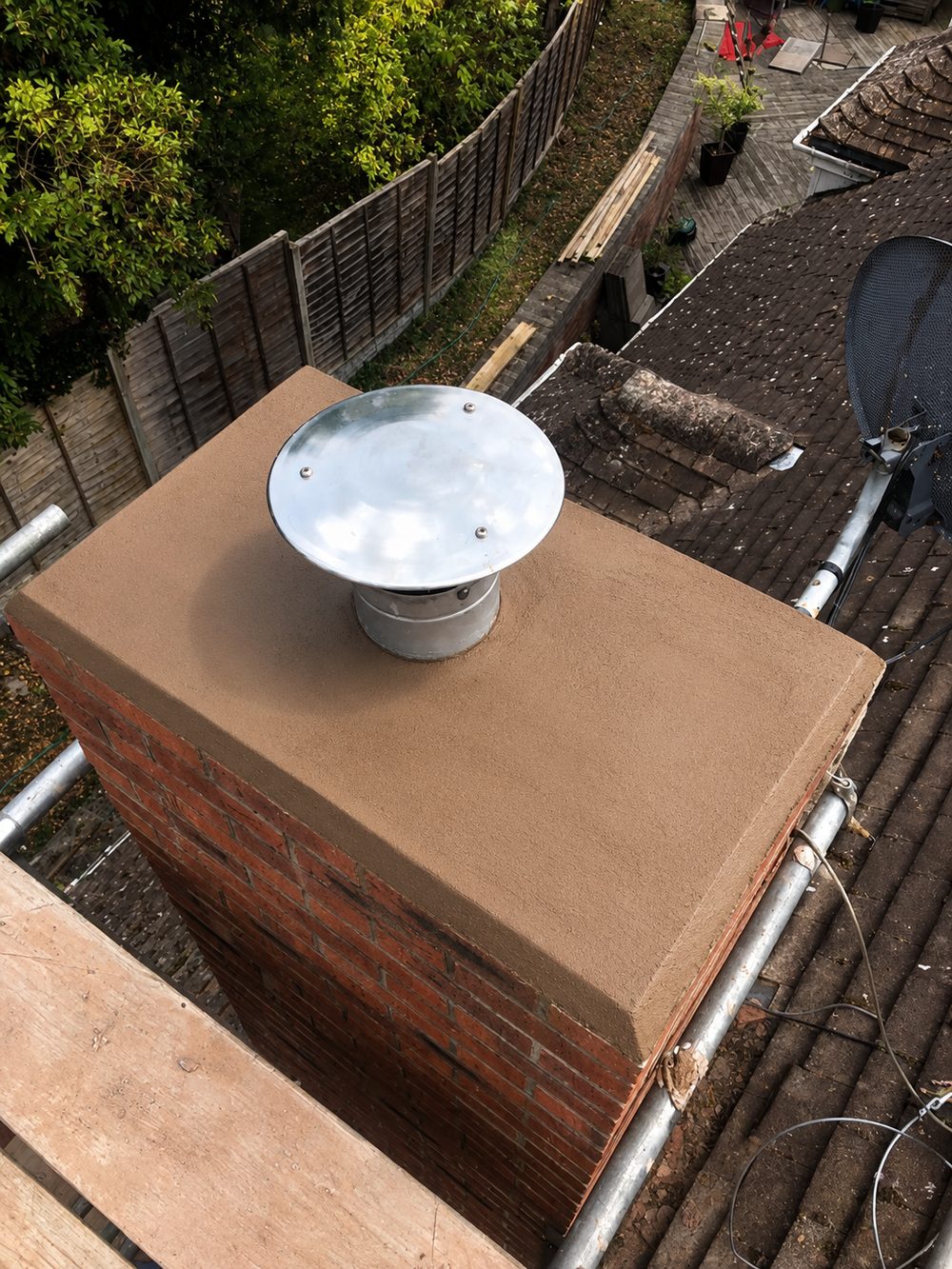
Photograph of our own work.
A chimney flue is a tall masonry shaft with a large internal surface area, and it is cold, because it is surrounded on most of its length by outside air. Moisture arrives in it from three directions at once. Some comes through the brickwork from outside, because masonry is porous and always has been. Some comes from the house, as warm damp air working its way in through the plaster and whatever the opening has been closed up with. And on a flue that has burned coal or wood for decades, the soot and salts lining it take moisture out of the air all by themselves.
While air is moving up the shaft, none of that matters, because the moisture is carried away as fast as it arrives. Stop the airflow and the arithmetic reverses. The shaft becomes a cold surface in still air, water condenses on it, and it has nowhere to go but into the brickwork. The brickwork it soaks into is the same brickwork that forms your chimney breast in the bedroom, so that is where it eventually shows: on the plaster, often high up, often months after somebody capped the top and boarded the bottom and thought the job was finished.
This is why a slab of concrete across the head is the single commonest mistake made to a chimney. It is cheap, it is quick, it stops rain going down the flue, and it converts the flue into a sealed container. The same is true in reverse: a beautiful vented cap on top of a flue that is plastered solid at the bottom has nothing to ventilate, because air will not move through a pipe that is open at one end only. What makes air move is a difference in temperature between the two ends and an opening at each of them. A trickle is all that is needed, and a trickle is all you get, but both ends have to be there.
The simplest is a capping cowl that sits over the existing pot: a stainless or terracotta fitting with a solid lid and open, usually meshed, sides, clamped to the rim. Rain cannot get in, air can, birds cannot. It keeps the pot, which matters on a house where the pots are part of the look of the street, and it is the least invasive thing that can be done.
Where the pot is cracked, ugly or simply unwanted, it can come out altogether and the opening be closed in the mortar instead. A half round ridge vent, a clay or concrete vented capping unit, or a purpose-made hood is bedded into the new mortar as the head is formed, leaving a deliberate air path through it. That gives a lower, tidier profile, and on a stack where several flues are being capped at once it is often what gets done.
A hooded pattern is worth knowing about for exposed positions. Rather than venting sideways all round, it faces the opening downward or to one side under a hood, which keeps driven rain out of the vent itself on a stack that takes weather off an estuary or from across open country.
Whichever goes on, two things apply to all of them. The mortar bed on top of the stack does the holding, so it is formed fresh, laid to a fall so water runs off rather than sits, and finished with an edge that sheds clear of the brickwork. And the flue itself is left hollow. Filling a redundant flue with rubble or mortar is an idea that surfaces occasionally and it is a poor one: it puts weight into a shaft that was never built to carry it, it bridges the inside of the wall with damp material, and it makes the flue impossible to open up again.
The lower vent is the half of the job that is not on the roof, and it is the half people leave out. If the fireplace opening is still there and open, you already have it. If the opening has been blocked up, the vent has to be made through whatever blocked it: an air brick or a small grille low down in the brickwork or board that fills the opening, or a vented register plate where a stove has been removed and a plate closes the throat.
Where it goes is worth thinking about for a minute. It wants to be in the room, low down, and preferably in a room that is heated, because the temperature difference between the room and the top of the stack is what drives the trickle of air. It does not want to be behind a wardrobe, inside a fitted cupboard, under a boxed-in shelf or in a cold unused back bedroom where nothing will move. Each flue needs its own vent, so a breast with two flues in it needs two.
The commonest thing that undoes all of this is somebody covering the vent up later. It gets painted over, wallpapered across, blocked with a draught excluder because a cold breath was felt on a still day, or lost behind a new plasterboard wall during a redecoration. If the damp comes back on a breast that was dealt with years ago, the vent is the first thing to go and look for.
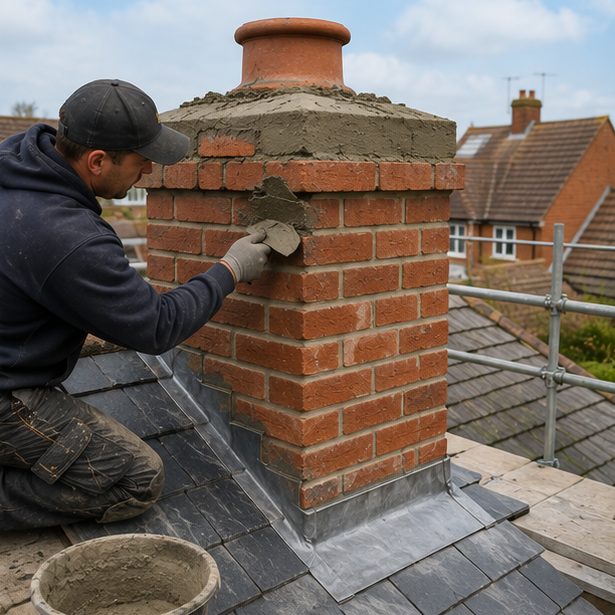
Image above is for illustration purposes only.
On a normal two-storey house the top half is scaffold work. The pot is either lifted out or left in place, the old mortar comes off back to the top course, the cap or vented unit is bedded in as the new head is formed, and the lead and pointing around it get looked at while the access is there, because there is no sense putting a scaffold up twice. Where the flue has been in use, having it swept first is worth the small cost: the deposits left in it are exactly the material that holds moisture. We do not sweep, line or test flues, and on that we will send you to a chimney sweep rather than take the work. None of the work at the top is a ladder job for a householder: a stack stands at the highest point of the roof, and whatever you want to see up there can be photographed from the platform instead.
The failures are easy to list because they repeat. A solid slab or a bag of mortar across the top, with no vent in it. A vent at one end only. A balloon or a bag pushed up the chimney and forgotten, which both blocks the flue and rots. A cap clamped to a pot that was already split. And capping a flue in a stack that is shared with next door, where the neighbour’s flue may still be live and the stack is not wholly yours to work on — that is covered in shared and party chimney stacks.
One last thought about the future. A capped flue is not a dead one. Take the cap off, have the flue swept and tested, and it can serve a stove or a fire again, though whether it needs lining to do so is a question for a HETAS or Gas Safe registered installer and not for us. That optionality is the real argument for capping and venting a stack rather than taking it off the roof.
The rest of the series, on the questions people ask most.
Every town has its own page, written around the stacks that are actually on the roofs there. Start with the main chimney repairs page.
“Excellent work replacing ridge tiles, repointing chimney and repairing flashing. Also fixed other broken tiles. Clean and tidy job. Would definitely recommend.”
Neil“The guys did a great job in repairing our chimney. They were reliable, friendly and efficient. Buddy kept me in the loop throughout the whole process and I would not hesitate to use Roofline again!”
Hollie Furnival“Highly recommend. Very quick and efficient. Great communication. Went above and beyond to work the weekend to complete the work that needed to be done. Very happy with the results.”
Karen JonesDescribe what you can see and roughly where you are, and we will come back to you — usually the same day. If water is coming in now, please call instead.
Prefer to talk? Call 07464 259566 · WhatsApp 0044 7464 259566 · Email Evensbuddy@yahoo.com
We cover Chester, Cheshire, the Wirral and Flintshire from Elton, just north of Chester.
2 Manley View
Elton
Chester
CH2 4QF
Almost all of our work happens at your property rather than here, so please call before travelling.
Monday – Friday — 24hrs — Emergency Call-Outs
Saturday — 8:00 – 19:00
Sunday — 8:00 – 19:00
Weekday emergency call-outs are answered around the clock. Weekend cover is 8:00 to 19:00.