★★★★★
“Very professional efficient team great communication
Would definitely recommend made the process quick and easy will definitely look to keep for any future need
Thankyou”

Flat roof repairs, overlays and full EPDM replacement on the hillside plots above Macclesfield — garages up a climbing drive, rear extensions, dormers and porch canopies, with the access worked out before anything is carried up.
Macclesfield is where the Cheshire Plain runs out and the hill starts, and a flat roof knows about it. Above Hurdsfield and Tytherington, out towards Kerridge, Rainow and Bollington, the ground under a house is rarely level: the drive climbs to the garage, the back garden is a set of terraces, and the rear extension sits a step or two below the kitchen. None of that changes what a flat roof is. All of it changes how a flat roofing job runs.
The buildings themselves are the usual mixture — a detached or attached garage carrying the oldest covering on the property, a rear extension over a habitable room, the odd dormer, a canopy over the front door. What is different is that a good many of them are looked down on. From an upstairs window, or from the garden above, you can often see the whole of your own flat roof, and quite often the neighbour’s as well.
Where we replace a covering we replace it in EPDM rubber, and what the material is, how the deck beneath it is built and how the sheet is bonded down are set out on the EPDM rubber roofing page rather than repeated here. This page is about the other half of the job in Macclesfield: getting to the roof, getting the materials up to it, and working on something higher and more exposed than the equivalent roof down on the plain.
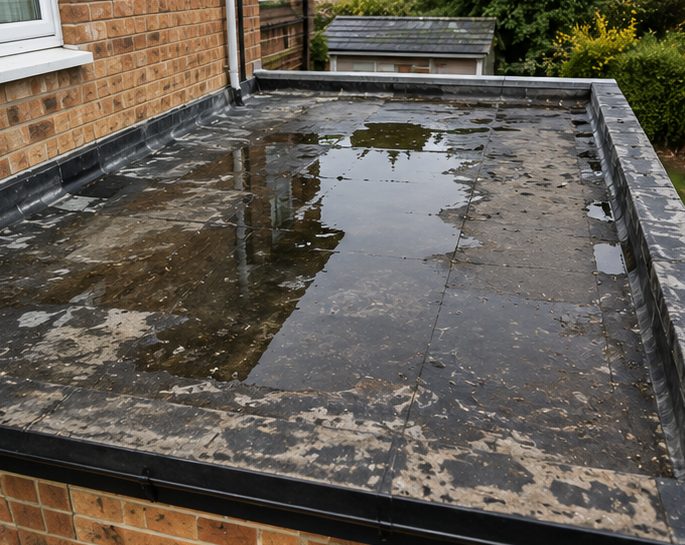
Images above are for illustration purposes only.
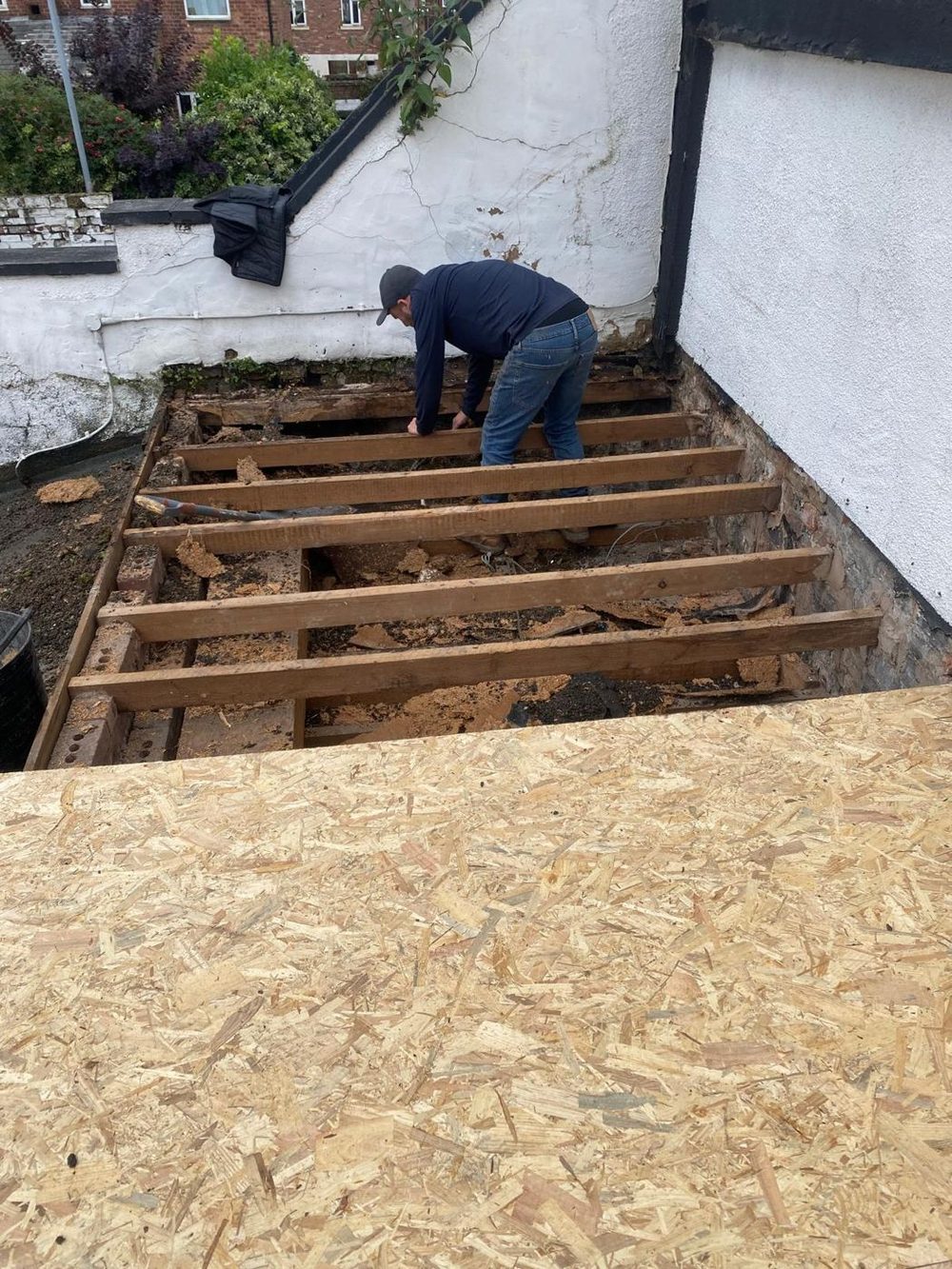
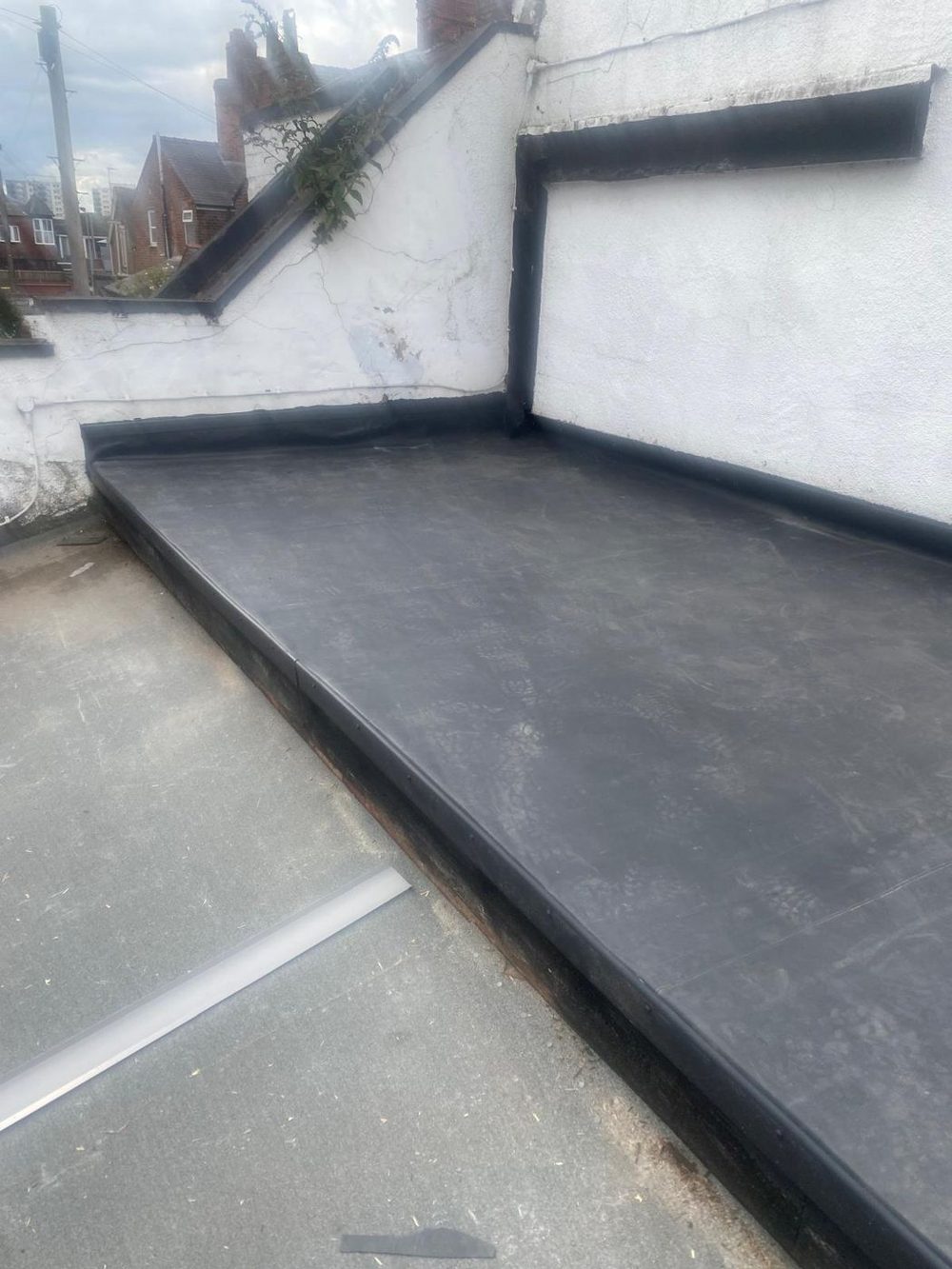
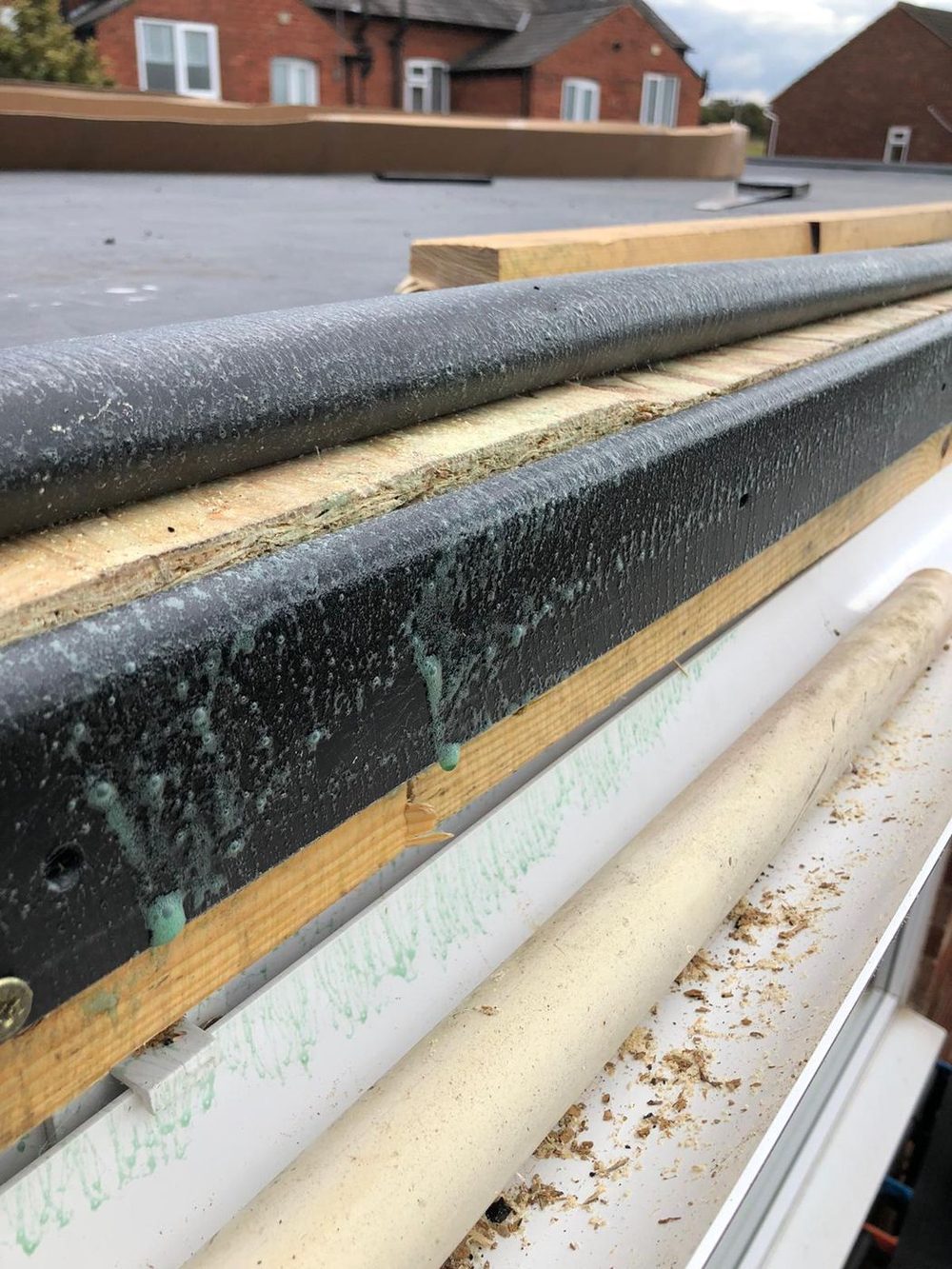
Photographs of our own flat roofing work. There are more on the main flat roof page and in the gallery.
A flat roof replacement is a materials job before it is a roofing job. A new deck means full-size sheets of decking board, and a sheet is heavy, awkward and behaves like a sail in anything more than a light breeze. On a level street that is a short carry from the kerb to the back gate. Where the drive climbs, or where the only route to the rear is a flight of garden steps, every sheet goes up by hand and the old covering comes back down the same way.
Scaffold on sloping ground is its own problem. Every standard needs a firm, level bearing under it, so where a garden falls away the answer is sole boards, adjustable bases and more scaffold on the low side than on the high side to bring the platform level with the roof. That is the honest reason scaffolding is quoted separately rather than folded into a rate: until somebody has stood in the garden and looked at the ground, nobody knows how much of it there is going to be.
Then there is the exposure. A roof on the hill above the town catches weather that a roof in the valley does not, and it shows up in the small things. A stripped deck cannot be left open overnight. A loose sheet is dangerous to handle in a gust. Grit and debris end up in the corner of the roof where the water is meant to leave. Work up there gets planned around the forecast, and we would rather say that plainly than turn up and improvise.
Because so many plots here look down on their own roofs, you have a view most homeowners do not, and it is worth using from an upstairs window rather than from a ladder. Ripples or a wavy line along an edge mean the trim or the bond under it has let go. A dark patch that stays dark after everything around it has dried is water sitting in a dip. Dirt washed into a tide mark shows where the roof actually drains, which is not always where it was meant to.
Indoors, the sign that goes with an exposed position is a leak that only appears in certain weather. If the ceiling below marks after rain driven from one particular direction and stays dry the rest of the time, that points at an edge, an upstand or a corner rather than at the middle of the roof, because wind is pushing water under something that is no longer held down. A steady drip in ordinary rain is a different conversation and usually a different repair.
Where the van can stop decides the first hour. In the terraced streets near the centre there is often no off-street parking and not much carriageway to spare, so materials are carried further and a skip standing on the highway needs a permit from Cheshire East before it is dropped rather than after. Out on the hillside closes and lanes the parking is easier but the ground is not, and a lorry that cannot get past a gatepost means boards and tube come in the last stretch by hand.
A ladder is a way onto a low garage roof. It is not a platform to work from and it is not edge protection, so anything at first-floor level, and anything with an open edge to work along, gets a tower or a scaffold instead. Access is the line that quotations leave vague more often than any other, which is why what should be on a flat roof quotation is worth ten minutes before you compare two of them.
Under the covering, what decides an exposed roof is less exotic than people expect: whether the deck is sound, whether the water has somewhere to go, and whether the perimeter is held down. The fall is the one homeowners never ask about and the one a hillside plot punishes, because a roof overlooked from the garden above shows every hollow it has. Getting a fall right is a set of firrings and a bit of arithmetic before anything is boarded; getting it wrong is visible from every window on the slope above.
The perimeter is where the work gets fiddly, and on a plot that climbs it is often the part you see from above rather than from below. Trims, upstands, corners and the way the covering leaves the roof at the gutter are what decide whether the finished edge reads as a deliberate line or as something that wandered. How each of those is formed, corner by corner, belongs on the EPDM rubber roofing page; what belongs here is that on a Macclesfield hillside those edges are looked at from above as well as from the pavement, which is not true of most roofs.
Leak tracing and repair, overlays where they are sensible, full strip-back and replacement in EPDM, new decks, corrected falls, trims, upstands and rooflight kerbs — and the pitched roof alongside when it needs it too.
“Very professional efficient team great communication
Would definitely recommend made the process quick and easy will definitely look to keep for any future need
Thankyou”
“A great team that really looked after us and have continued to support us. I wouldn’t hesitate to use roofline again or recommend them to family and friends. Buddy takes pride in his work and customer service.”
Samantha Merrick“The men were genuine and trustworthy. Turned up every time when they said they would, and phoned ahead. Very respectful and did an amazing job.,thank you x”
freda markhamWritten for homeowners working out what their flat roof actually needs, before anyone comes out.
Every town below has its own page, written around the flat roofs that are actually on the buildings there.
Describe the roof and roughly where you are, and we will come back to you — usually the same day. If water is coming in now, please call instead.
Prefer to talk? Call 07464 259566 · WhatsApp 0044 7464 259566 · Email Evensbuddy@yahoo.com
We cover Macclesfield from our base at Elton, just north of Chester.
2 Manley View
Elton
Chester
CH2 4QF
Almost all of our work happens at your property rather than here, so please call before travelling.
Monday – Friday — 24hrs — Emergency Call-Outs
Saturday — 8:00 – 19:00
Sunday — 8:00 – 19:00
Weekday emergency call-outs are answered around the clock. Weekend cover is 8:00 to 19:00.