★★★★★
“job well done good communication throughout the job very clean and tiddy when the job is finish flat roof replacement many thanks.”
Sumit BalAlmost nothing goes wrong in the open middle of a flat roof. It goes wrong where two pieces meet, where the surface changes direction, and where a fixing went through — which is to say, around the outside.
Think about what the open field of a flat roof is actually asked to do. It is one flat plane. Nothing changes direction across it, nothing passes through it, there is no other material for it to meet, and the wind blows over it rather than getting underneath. Water crosses it in a thin sheet and leaves. Given a covering that was sound when it went down, the middle is the part of the roof least likely to trouble anybody.
Now look at the outside of that same roof. In the space of a few centimetres the surface has to turn through ninety degrees, meet a metal trim, get fixed to something, arrive at a wall of an entirely different material, or disappear down a hole. Every one of those is a junction, and a junction is a place where two things have been persuaded to behave as one. That persuasion is where the work is, and where it is skipped.
There is a force argument too. Wind flowing over a flat roof does not press down on it evenly; it lifts, and the suction is fiercest along the edges and fiercest of all at the corners. So the parts of the roof with the most complicated detailing are also the parts being pulled at hardest, in the weather that also brings the rain.
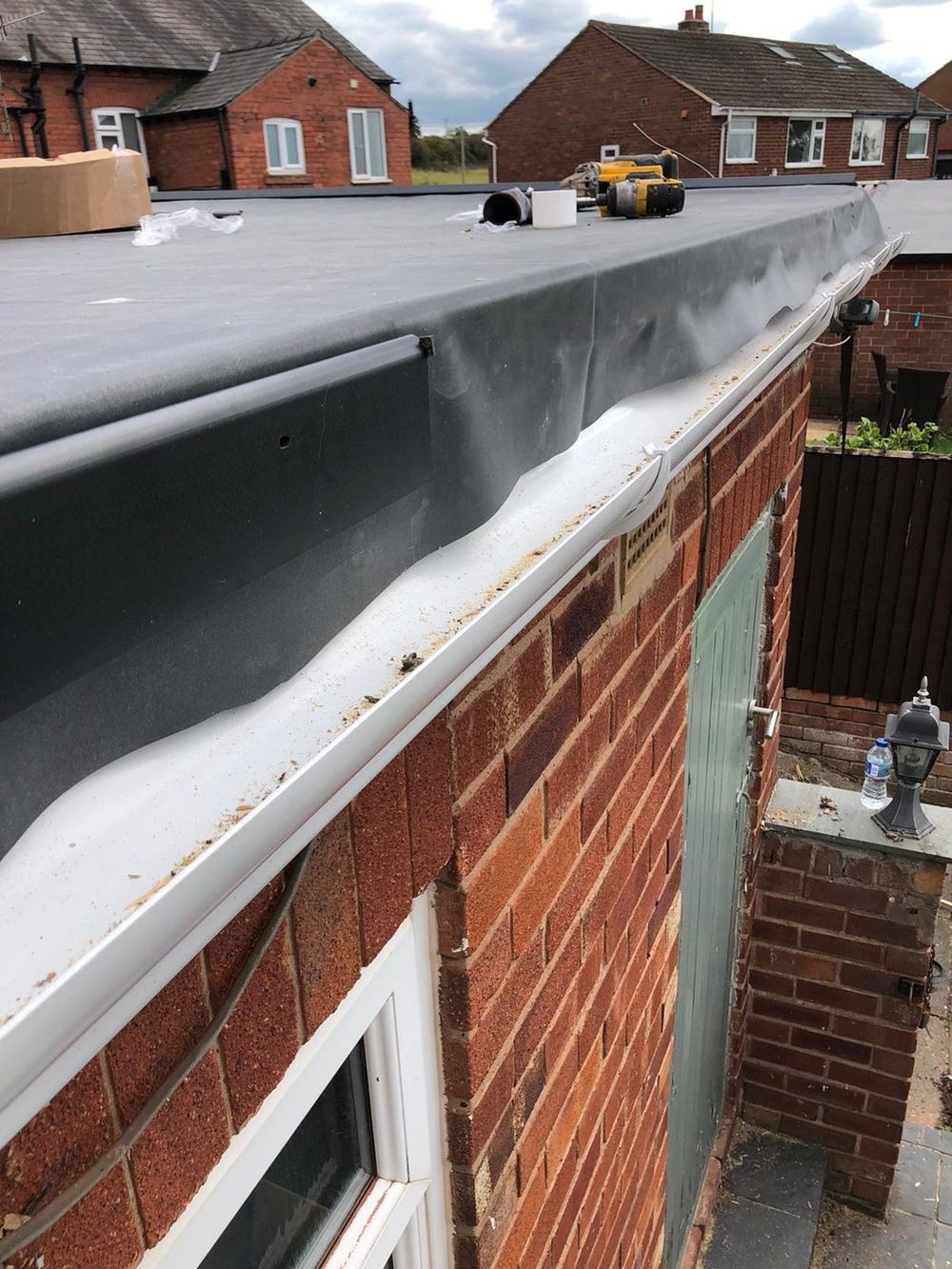
Photograph of our own work.
On any covering laid in strips, a lap is a bonded overlap, and it is only as good as the last stretch of it. Bitumen laps fail at the ends first, curling open into what roofers call a fishmouth, and they fail worst where three thicknesses meet at a staggered joint, because there is a step for water to work into. A lap that has been laid so water runs towards its open edge rather than over the top of it is a lap that was always going to leak, whatever the weather did.
On a rubber roof the equivalent risk is a joint somebody made by choice. Most domestic roofs do not need one, but where the shape or the size forces a join, it has to be made with the manufacturer’s seam tape and primer. The contact adhesive that bonds the sheet to the deck is not a jointing product, and a seam made with it will part company eventually. If you are looking at a rubber roof with a visible straight joint running across it, that joint is worth asking a direct question about.
The general point holds across all three common materials: the field of the covering is rarely the problem. Wherever one piece ends and another begins, water gets a chance it does not get anywhere else.
An edge trim does two jobs at once. It gives water a defined place to leave the roof, throwing it clear into the gutter instead of letting it run back under the edge, and it clamps the covering down along the line where the wind is trying hardest to get underneath. A roof without a proper trim has neither of those, and no amount of sealant substitutes for either.
The faults are consistent enough to list. Trim lengths butted together and the joint filled with mastic, when the joint should have a cover piece over it that allows the metal to expand. Trim screwed down through the covering with nothing bonded over the fixings. Trim that sits back from the fascia so water runs behind it and down the wall. A gutter set too high, so that water backs up against the trim in heavy rain instead of draining. And the corner itself, where two trims meet at right angles and somebody had to make a decision — a moulded corner piece and a dressed membrane, or a fold, a fixing and hope.
From the ground, this is the most readable part of the whole roof. Sight along the trim line from one end. It should be straight and level to the eye, tight to the covering all the way, with no gaps at the joints and no visible sealant doing structural work. Staining running down the fascia or the brickwork directly beneath one particular trim joint is telling you where the water is getting out, and therefore roughly where it got in.
Where a flat roof meets a wall, the covering must turn up the face of that wall and be held there, well clear of the roof surface — a hundred and fifty millimetres above the finished roof surface is the figure worth carrying in your head, because that is what BS 6229 and the NHBC standards ask for, and it is the height that copes with driving rain, a blocked outlet and drifted snow rather than just an average shower. A hundred millimetres is the bare bonding minimum some membrane makers will allow, and it is not the same thing. An upstand that stops an inch or two up is decorative.
What happens at the top of the upstand matters just as much. The membrane has to be terminated so that water running down the wall is thrown outwards over the top of it, not allowed in behind. That means a chase cut into the brickwork, a proprietary termination bar, a cover trim, or a lead or metal flashing dressed over the top. What it does not mean is a bead of mastic run along the top edge where it meets the brick, which is the commonest short cut there is, and which fails the first time the sun gets to it.
Inside the house, an upstand failure has a signature. Damp appears high up on the wall of the room below, at the line where the flat roof meets it, rather than out in the ceiling. It gets worse in wind-driven rain from one particular direction, and it may do nothing at all in heavy vertical rain, which is the detail that sends people looking in entirely the wrong place.
A corner is the only part of a flat roof where the covering has to work in three directions at once, and a folded corner always has a stress point hidden in the fold. Preformed corner pieces exist precisely because that stress point is predictable, and a roof detailed with them has removed a known fault rather than tidied it up.
Outlets are the other place where the roof has a deliberate hole in it. Done properly, a preformed outlet is bonded into the covering so the membrane runs continuously into the drain, and there is a guard on top to stop leaves getting in. Done badly, the covering stops somewhere near the hole and the last few centimetres are made up with sealant. Since every drop of water leaving the roof passes through this one point, it is worth more attention than it usually gets, and it is worth clearing of leaves and moss from time to time by whoever is already safely up there for another reason.
Rooflights are the modern version of the same problem. A rooflight sits on a kerb: a raised timber box, with the covering taken up the outside of it and over the top, and the unit sat down over the lot so that water can never reach the joint. Where the kerb was built too low, or the covering was cut off at the frame and sealed to it, the joint between glass and roof becomes the waterproofing, and sealant is doing a job it was never meant to do. A ceiling stain that draws a neat rectangle round a rooflight is one of the least ambiguous signs in this trade.
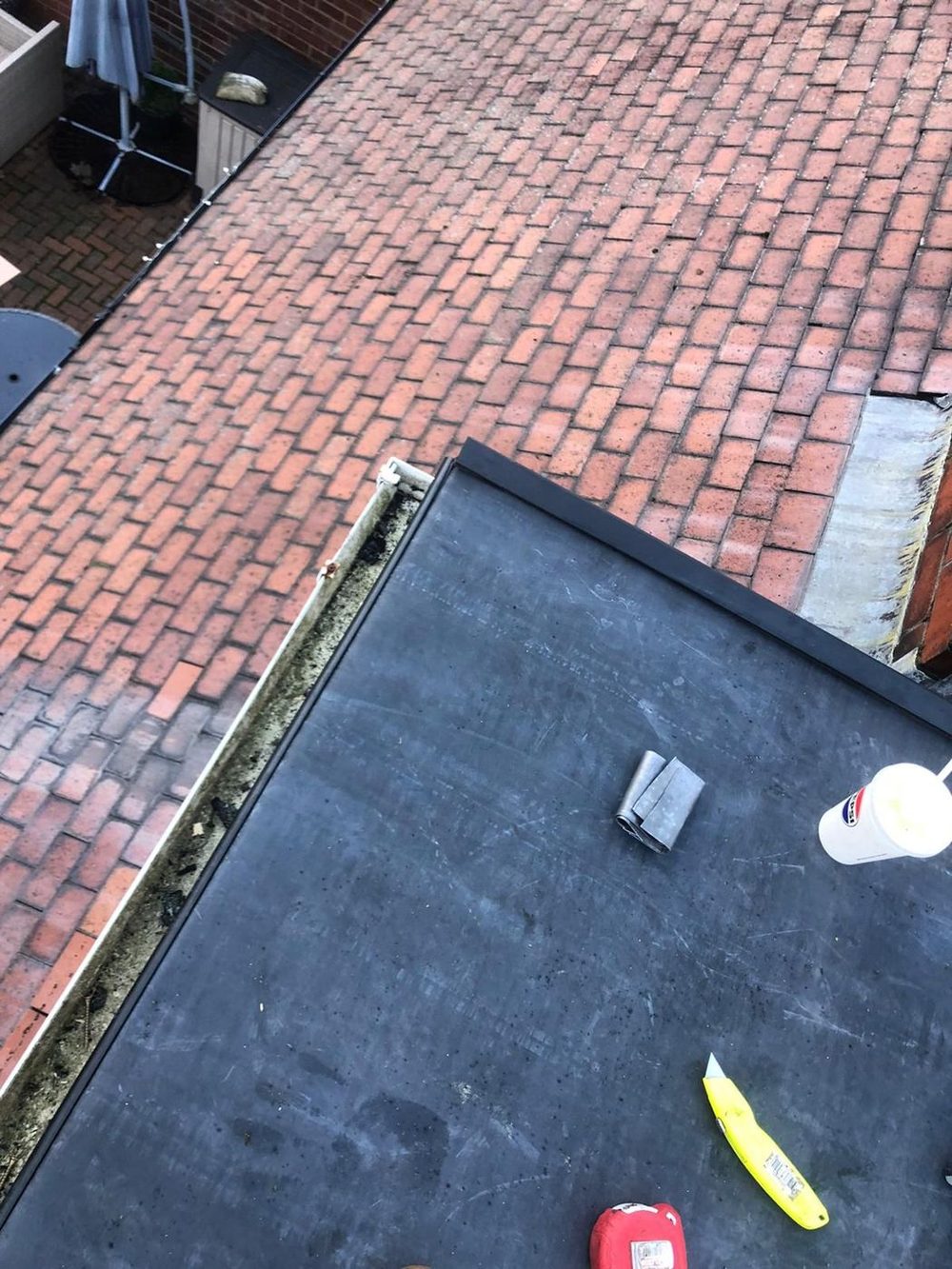
Photograph of our own work.
Every detail described above sits around the outside of the roof, which is the part you can see without being on it. From the garden, sight along each edge in turn. From an upstairs window, or a neighbour’s, look at where the covering meets the wall and whether there is a visible turn-up or just a line of sealant. A phone on a pole, recording video, will get you the corners and the outlet. Please do not go up to inspect it yourself, because the edge of a flat roof is the least supported part of it and the covering gives no warning of what the boards beneath are like.
What you are looking for is simple enough to hold in mind: gaps at trim joints, a trim that has lifted or bowed, sealant used as a detail rather than as a finishing touch, a membrane that stops at roof level against a wall, moss growing along one specific line, and staining on the wall or fascia directly below any of those. None of it tells you what needs doing, but all of it tells whoever comes out where to start, and it makes you a much harder customer to wave vaguely at. There is more on how the whole build-up fits together on the EPDM rubber roofing page.
The rest of the series, on the questions people ask most.
Across Chester, Cheshire, the Wirral and Deeside. Start with the main EPDM rubber roofing page.
“job well done good communication throughout the job very clean and tiddy when the job is finish flat roof replacement many thanks.”
Sumit Bal“I had a leak in my vally had a number of roofers to come and take a look couldn’t find the problem Roofline’s solutions fixed the problem first time. Very happy with these guys thank you for the brilliant service”
Michael Price“Highly recommend. Very quick and efficient. Great communication. Went above and beyond to work the weekend to complete the work that needed to be done. Very happy with the results.”
Karen JonesDescribe the roof and roughly where you are, and we will come back to you — usually the same day. If water is coming in now, please call instead.
Prefer to talk? Call 07464 259566 · WhatsApp 0044 7464 259566 · Email Evensbuddy@yahoo.com
We cover Chester, Cheshire, the Wirral and Flintshire from Elton, just north of Chester.
2 Manley View
Elton
Chester
CH2 4QF
Almost all of our work happens at your property rather than here, so please call before travelling.
Monday – Friday — 24hrs — Emergency Call-Outs
Saturday — 8:00 – 19:00
Sunday — 8:00 – 19:00
Weekday emergency call-outs are answered around the clock. Weekend cover is 8:00 to 19:00.