★★★★★
“job well done good communication throughout the job very clean and tiddy when the job is finish flat roof replacement many thanks.”
Sumit Bal
Flat roof repairs, overlays and full EPDM replacement in Crewe — on the back additions behind the railway terraces, where the only way in is a shared entry and everything goes up by hand.
Crewe was built for the railway and it was built fast: street after street of two-storey terraces for the men at the works, each with a single-storey back addition behind it. Those back additions — the old scullery, the kitchen, the downstairs bathroom somebody added later — are where most of the flat roofing in Coppenhall, Hightown and the West End actually sits. They are small roofs. Getting to them is what is not small.
What makes a Crewe flat roof job different from one on an estate has almost nothing to do with the roof and everything to do with the plot it sits on. The front door opens onto the pavement. There is no drive, frequently no side gate, and often no route round at all except the rear entry shared by the whole row. No lorry gets to the back of the house and no scaffold is offloaded beside it.
So the first question on a terrace is not what the covering needs. It is how material gets in, how waste gets out, and along whose ground. That is settled before anything else, because it decides how the week is organised and what the written quotation has to say. What goes on top of the deck, and how it is bonded and trimmed, is set out on the EPDM rubber roofing page rather than here.
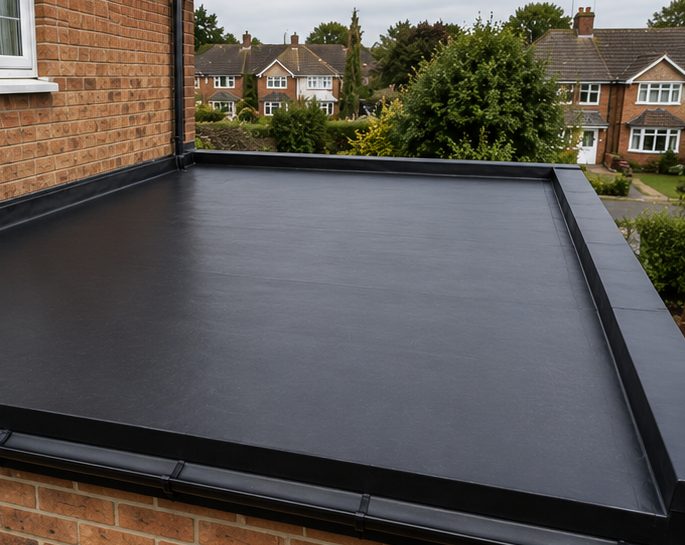
Images above are for illustration purposes only.
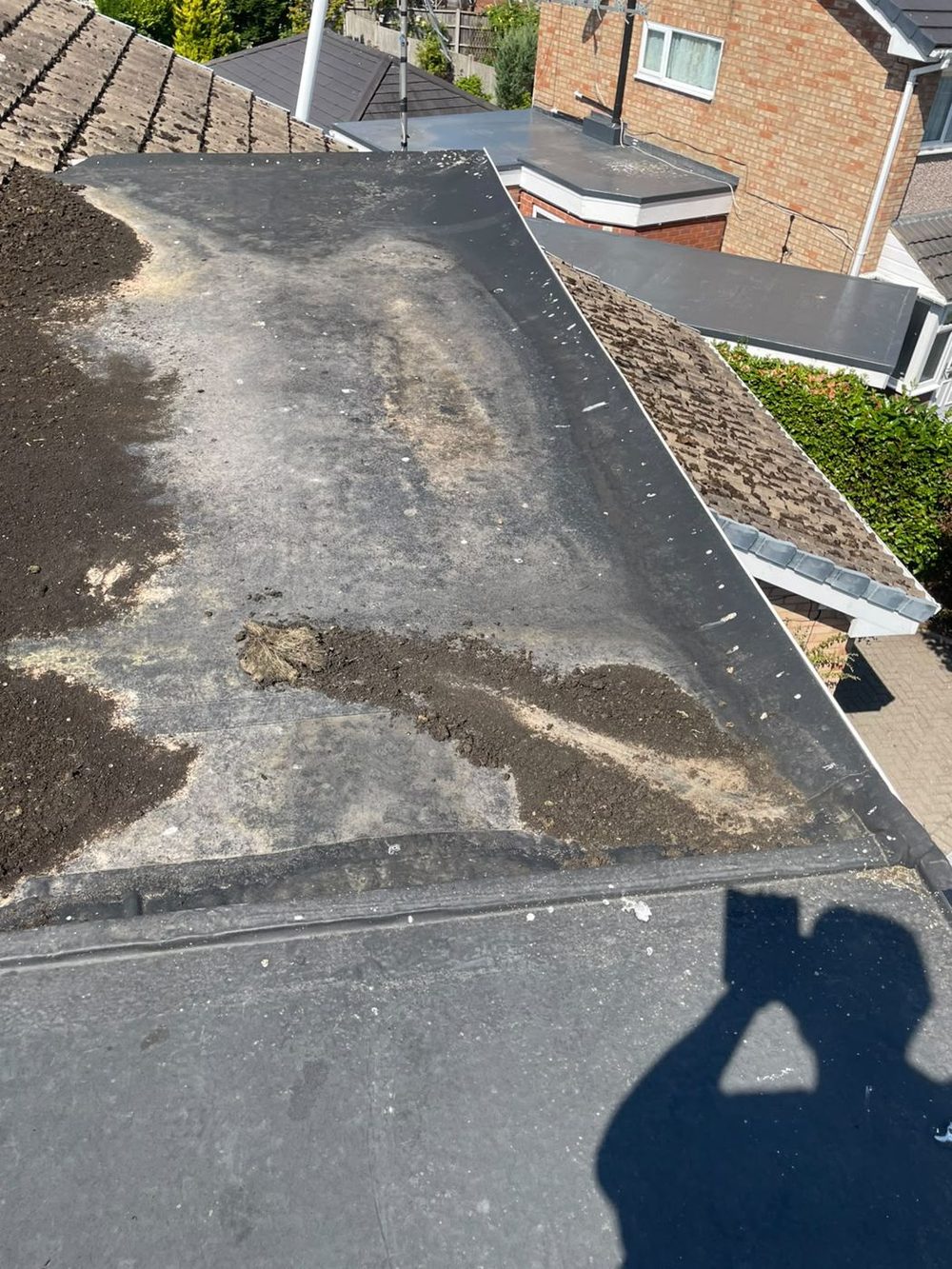
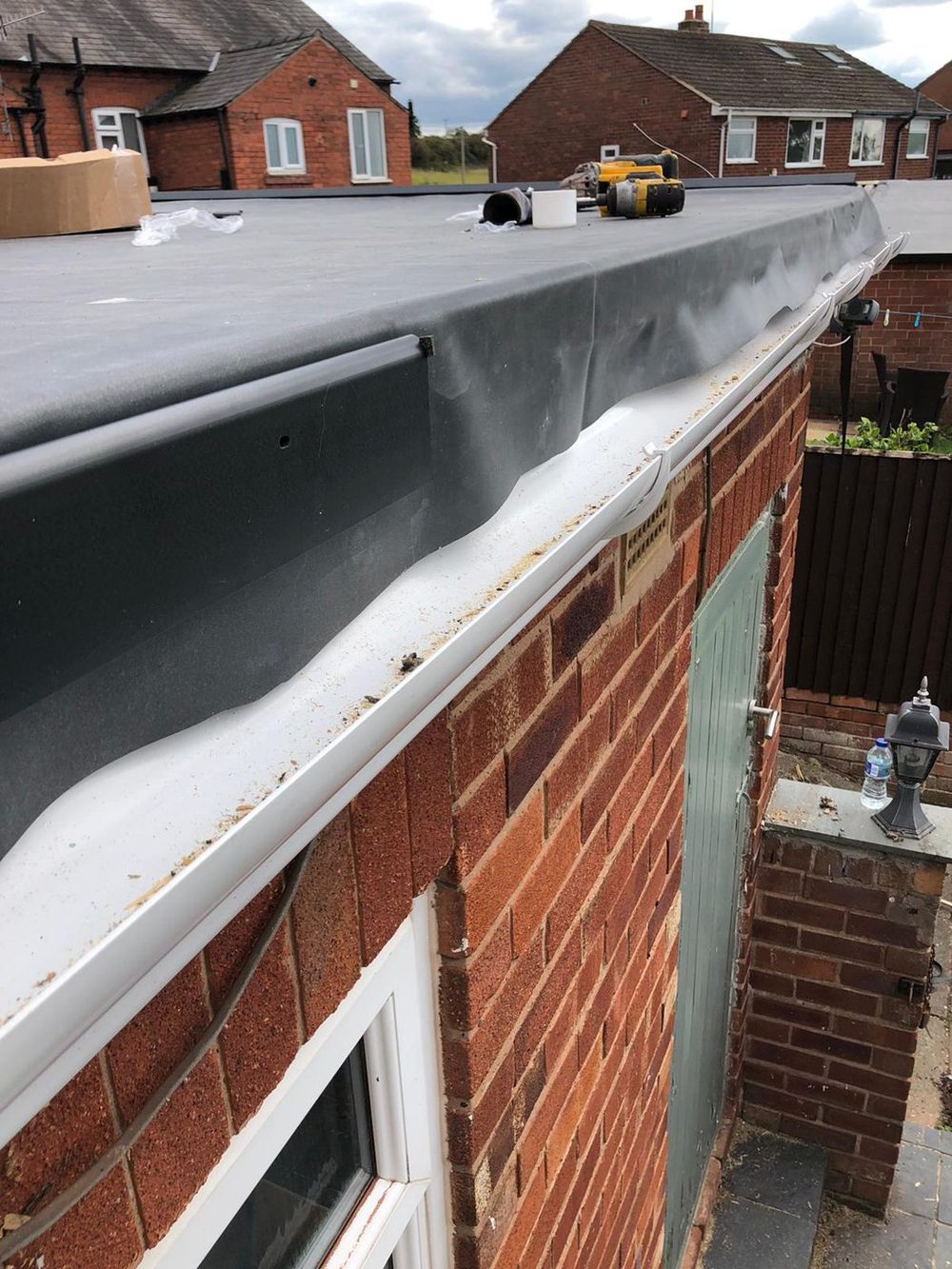
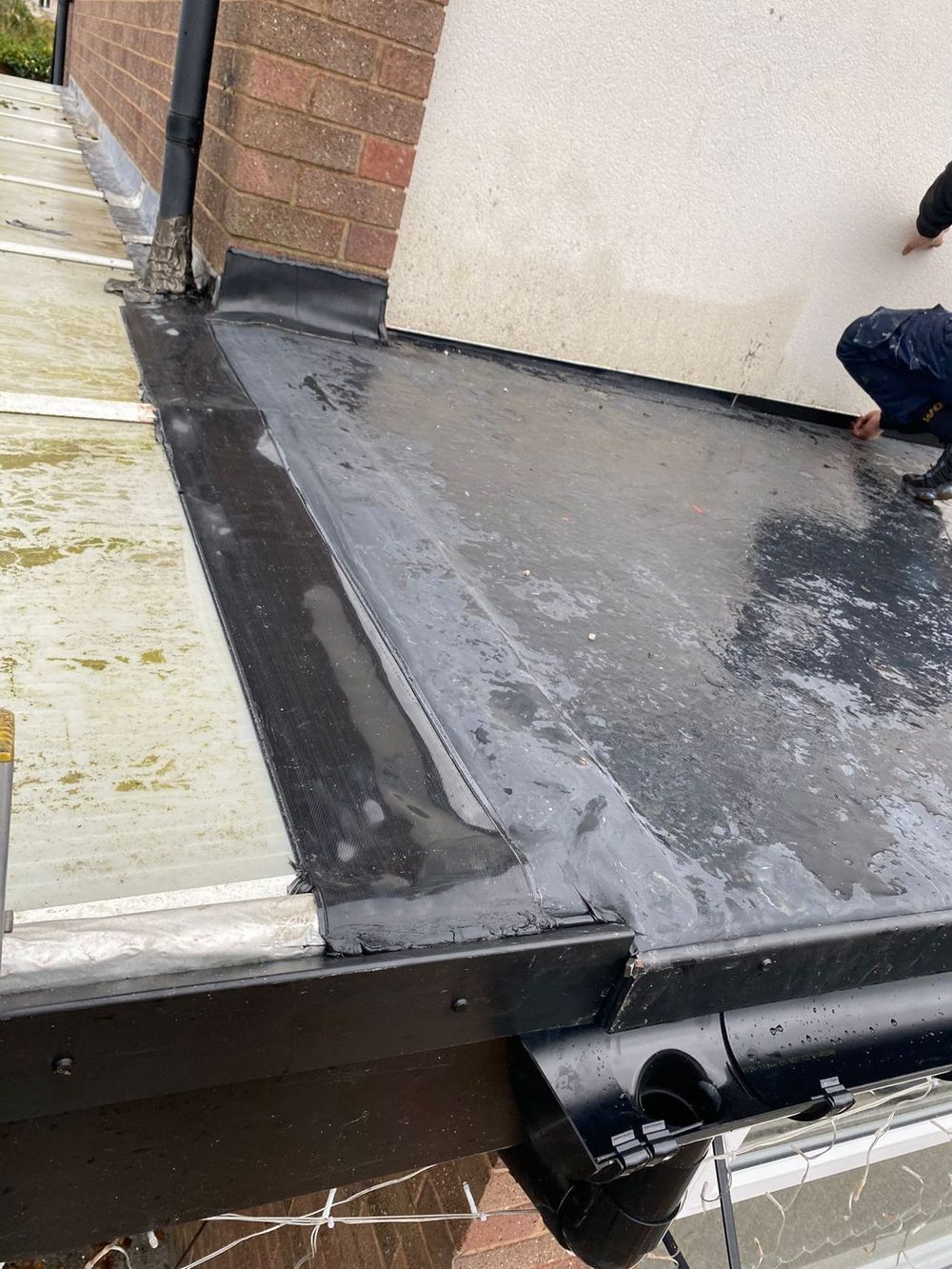
Photographs of our own flat roofing work. There are more on the main flat roof page and in the gallery.
On most of these streets the back of the house is reached down a ginnel and along a rear entry belonging to the whole row. It is rarely much wider than a wheelie bin, it may be gated at each end, and it is the way every household in the row gets its bins out. Everything for the job travels along it: the scaffold components, the deck boards, the insulation, the rolls, the adhesive tins — and every scrap of the old covering comes back the other way. That is slower than a job with a drive, and it is the honest reason a small roof in a terrace is not a small job.
It changes how the work is organised rather than what the work is. Deliveries are timed and met rather than tipped on the pavement, because a pallet of boards dropped at the front of a terrace has to be carried through board by board. Old felt comes off into bags instead of being thrown down, since there is nothing below to throw it into. If a skip is going on the street it needs a permit from the council as highway authority and that gets arranged beforehand. Where there is genuinely no rear access, the route runs through the house on boards and dust sheets, and we want to know that before the day rather than on it.
Then the scaffold. A back addition is usually single storey, so the roof is low — but the way to it is not always easy. Where a tower will fit in the yard and stand level, that is frequently enough. Where the yard is too small, where there is an open edge to work along, or where the job also takes in the main roof above, a scaffold has to be built in the yard from parts carried down the entry, and that takes considerably longer to erect than one a lorry can offload alongside. Scaffolding is quoted separately, so what the access costs is visible rather than folded into a rate.
On a terrace the back bedroom window is the survey, and it is by far the safest place to look from. You can see most of a back-addition roof from there, and a phone held out of an open window will photograph the rest. What is worth photographing: water lying in a strip instead of running off, a felt surface gone from grey to shiny black where the mineral has washed away, moss and soil built up in the low corner, and anything along an edge that has lifted or come adrift. Send those over on WhatsApp and a good deal of the guesswork goes out of the first visit.
Please do not go up to look yourself. A terrace is exactly the sort of place where there is nowhere safe to foot a ladder: the yard is small and often the only level ground on the plot, the entry is too narrow to pitch anything across, and the flags slope to a gully. Inside, a back addition shows a leak sooner than anywhere else in the house, because there is very little between the deck and the ceiling except plasterboard, so a stain that appears quickly after rain is worth reporting early rather than watching.
We ask two questions before coming out to a Crewe terrace: is there rear access, and if so how wide is the gate. They sound trivial and they decide how the entire job is run. A gated entry needs somebody there to open it. A shared one has to stay passable while we are working, because the rest of the row still needs to get down it. If there is no rear access at all we come through the house, and that goes in writing beforehand rather than being sprung on anyone at eight in the morning.
Parking is the other one. The terraced streets here have next to no off-street parking, so the van ends up wherever it can and the carry gets longer, which is accounted for in the written quotation along with whether a tower or a scaffold is required and whether a skip is going on the highway. None of this is dramatic. All of it is far better settled while somebody is standing in the yard with a tape than discovered once the covering is already off.
How the deck, the falls and the trims get specified here is no different from anywhere else, and the specification itself lives on the EPDM rubber roofing page. What is different is that on a terrace the decision about how much comes off is also a decision about how much travels. An overlay means the old surface stays put and only the new material comes down the entry. A strip-back means the covering, and usually the deck under it, comes out board by board and bag by bag first, and then everything new goes in the same way. The overlay or strip and replace guide sets out which of the two a roof actually qualifies for, and that test is about the roof, not about the carry.
The practical consequences run all the way through the job. Boards are ordered in a size that will turn the corner of a ginnel rather than the biggest sheet available. Deliveries are timed and met so nothing sits on the pavement. And because an unplanned trip out to the van is a walk to the end of the row and back, a change of plan halfway through costs more here than it does on a drive — which is why the quotation says in advance what happens if the timber turns out worse than it looked, and why we would far rather establish that with a tape in the yard than with a saw on the roof.
Leak tracing and repair, overlays where they are sensible, full strip-back and replacement in EPDM, new decks, corrected falls, trims, upstands and rooflight kerbs — and the pitched roof alongside when it needs it too.
“job well done good communication throughout the job very clean and tiddy when the job is finish flat roof replacement many thanks.”
Sumit Bal“Excellent service from Buddy and the team in installing a new garage roof in a really professional manner. Was kept updated at all stages and given good advice as to our options. Would highly recommend”
Peter Aspinall“Highly recommend. Very quick and efficient. Great communication. Went above and beyond to work the weekend to complete the work that needed to be done. Very happy with the results.”
Karen JonesWritten for homeowners working out what their flat roof actually needs, before anyone comes out.
Every town below has its own page, written around the flat roofs that are actually on the buildings there.
Describe the roof and roughly where you are, and we will come back to you — usually the same day. If water is coming in now, please call instead.
Prefer to talk? Call 07464 259566 · WhatsApp 0044 7464 259566 · Email Evensbuddy@yahoo.com
We cover Crewe from our base at Elton, just north of Chester.
2 Manley View
Elton
Chester
CH2 4QF
Almost all of our work happens at your property rather than here, so please call before travelling.
Monday – Friday — 24hrs — Emergency Call-Outs
Saturday — 8:00 – 19:00
Sunday — 8:00 – 19:00
Weekday emergency call-outs are answered around the clock. Weekend cover is 8:00 to 19:00.