★★★★★
“job well done good communication throughout the job very clean and tiddy when the job is finish flat roof replacement many thanks.”
Sumit BalThis page carries no figures at all. What it does instead is set out what a flat roof quotation ought to itemise, so that two documents can be compared on what they actually contain rather than on the number at the bottom.
There are no prices, bands or rates anywhere on this page, and that is deliberate rather than coy. No price list has been published for this work, and a figure invented for a web page would be worse than useless: flat roofs vary by area, by height, by access, by the state of the deck and by how much of the roof is perimeter, and any number quoted without seeing yours would either mislead you or be so wide as to mean nothing.
What is genuinely useful is something a price could not give you anyway. A quotation is a description of a piece of work, and the difference between a good one and a poor one is how much of that work it describes. Once you know what ought to be on the page, you can read any quotation from any firm and see immediately what has been thought about and what has been left as an assumption.
The rest of this guide is that list. None of it is unusual to ask for, and a contractor working to a system and pricing properly will have most of it written down already. If you want a figure for your own roof, it comes from somebody looking at it, and ours are free and in writing — the contact page is the shortest route to that.
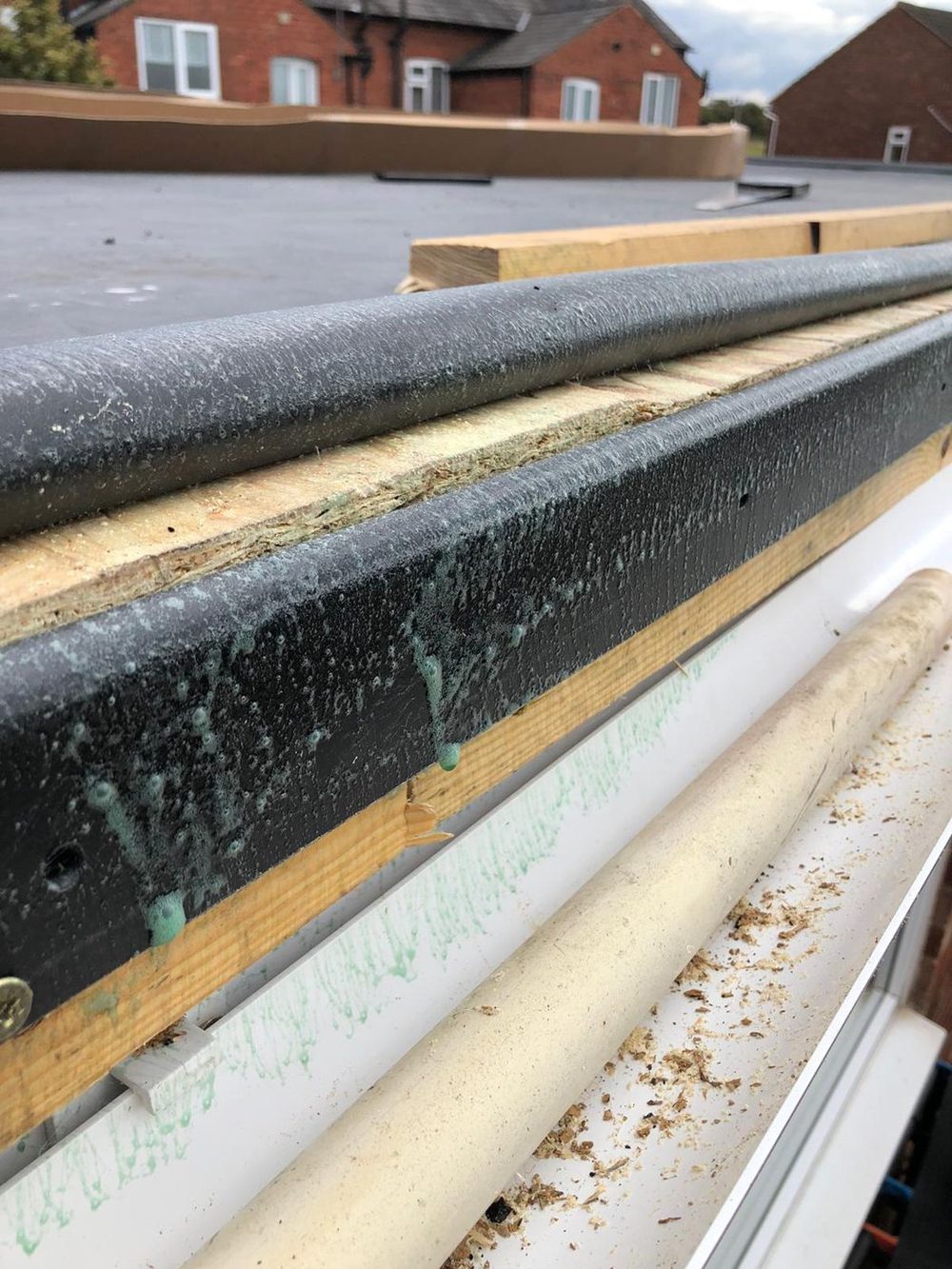
Photograph of our own work.
Access is the first item and one of the commonest gaps. Is the work reached from a scaffold, a tower or a ladder, who supplies it, how long does it stand and is it included? A first-floor roof or a dormer is scaffolded work by nature, and a quotation that is silent on that is either absorbing a real item or leaving it for later.
Then the strip. The document should say what is being removed: the covering only, or the covering and the deck, or the covering, the deck and insulation from between the joists. Those are three different jobs and the middle one is the most commonly assumed. If an overlay is being offered instead, it should say so in those words rather than describing itself as a new roof.
Disposal follows from the strip. Wet felt, a soaked deck, old insulation and the grit off a mineral surface are heavy and bulky, and the quotation should say that removing them is included. It should also cover protection: what happens to the room below and to your garden, and how an open roof is covered overnight if the work runs into a second day.
The deck should be specified rather than mentioned. Which board, at what thickness, screwed or nailed, and with what support at the joints — moisture-resistant OSB at eighteen millimetres and a suitable plywood are both ordinary answers, and neither of them is the same as the word “boarding”.
Falls deserve a line of their own, because they are the thing most often left exactly as found. Is the existing fall being kept, corrected by re-cutting or adding firrings, or built into tapered insulation? If your roof ponds now and the quotation does not mention falls, it is quoting to rebuild the same puddle, and that is worth one direct question before anything is agreed.
Then the honest problem at the centre of every flat roof quotation: nobody can see the condition of the joists before the covering comes off. What a good document does is say how that is handled — what is included as standard, how additional timber is dealt with, and, most importantly, that you will be shown it and asked before extra work goes ahead rather than told about it afterwards. A quotation that promises no surprises on a roof nobody has opened is promising something it cannot know.
If the build-up is changing, the quotation should describe the new one: where the insulation sits, what type and thickness it is, and that a vapour control layer goes beneath it on a warm deck. It should also say what that does to the finished height, and what that in turn does to the trims, the upstand against the house and any threshold nearby. If the roof is staying as a cold deck, the ventilation path should get a sentence, because that is the part that fails when nobody thinks about it.
The membrane is the item people assume is simple. It is not enough to say rubber, or even EPDM. The quotation should name the system and the manufacturer, and state the thickness of the sheet, so that you can go and read what that maker publishes about that specific product rather than relying on what was said in a conversation. Any product cover offered comes from the manufacturer and on their terms, and the document to read is theirs.
It should also be clear how the sheet is fixed. Is it fully bonded, partially bonded or mechanically fixed, and if the roof is too large or too awkward for one piece, how is the joint made? The answer to that last one should involve the system’s own seam tape and primer rather than the adhesive used to stick the sheet down.
This is where flat roofs leak and where quotations go quiet. The edge trim should be named by material — aluminium, GRP or plastic are not the same thing at the same place — along with its colour, how lengths are joined, and whether new fascia or gutter work is included or assumed to be somebody else’s.
Upstands need heights on them. The figure to look for is a hundred and fifty millimetres above the finished roof surface, which is what BS 6229 and the NHBC standards ask for, and the words “finished surface” matter because insulation raises it. Just as important is how the top of the upstand is terminated: into a chase, under a termination bar, beneath a cover trim, or under a metal flashing. Sealant along the top of a membrane against brickwork is not a termination, and a quotation that describes one that way has told you something useful about the firm.
Corners and outlets should be named as preformed components rather than left implied, and the outlet should connect to something: an existing gutter, a new one, or a hopper and downpipe that may need renewing at the same time. If there is a rooflight, the kerb belongs on the quotation as an item — who builds it, how high it is, and how the membrane is taken up and over it before the unit goes back on.
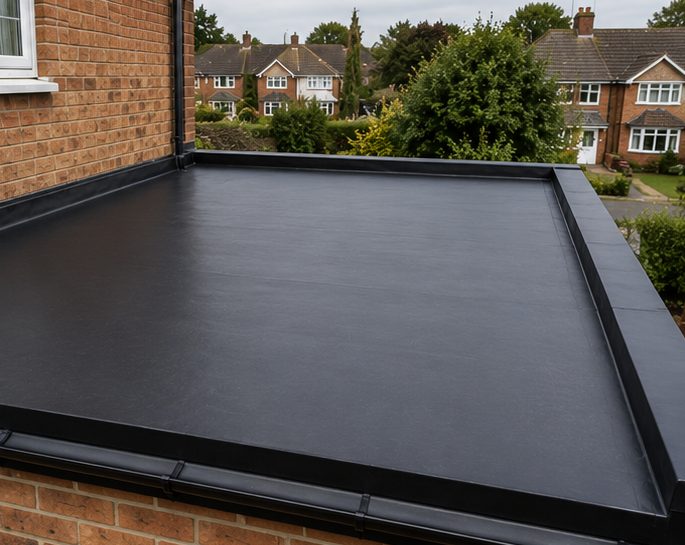
Image above is for illustration purposes only.
Making good is the section that decides how the job ends. Is the render or pointing disturbed by a new chase put back? Are the fascia and soffit reinstated, and in what? Does the gutter get refitted to the new line? Is the inside of the building made good where a ceiling has been opened, or is that yours? None of those are difficult; all of them are awkward when they surface on the last afternoon.
Then the practicalities: how long the work is expected to take and what weather stops it, who is on site, how payment is staged, and whether the firm is insured. We are fully insured, quotations are free and in writing, and neither of those is unusual to ask for from anybody.
When two quotations differ, resist comparing the totals first. Put them side by side and mark off the items above: access, what is stripped, disposal, deck, falls, insulation, membrane system and thickness, trim material, upstand height, terminations, corners, outlets, kerbs, making good. Nine times out of ten the gap is not value at all, it is scope — one is stripping and the other is overlaying, one is replacing trims and the other is bonding to the old ones, one is insulating and the other is not. Once the two documents describe the same work, the comparison becomes simple, and until they do it is not a comparison. What the full build-up involves is on the rubber roofing page, and the smaller end of the work is covered under flat roof repairs.
The rest of the series, on the questions people ask most.
Across Chester, Cheshire, the Wirral and Deeside. Start with the main EPDM rubber roofing page.
“job well done good communication throughout the job very clean and tiddy when the job is finish flat roof replacement many thanks.”
Sumit Bal“I had a leak in my vally had a number of roofers to come and take a look couldn’t find the problem Roofline’s solutions fixed the problem first time. Very happy with these guys thank you for the brilliant service”
Michael Price“Highly recommend. Very quick and efficient. Great communication. Went above and beyond to work the weekend to complete the work that needed to be done. Very happy with the results.”
Karen JonesDescribe the roof and roughly where you are, and we will come back to you — usually the same day. If water is coming in now, please call instead.
Prefer to talk? Call 07464 259566 · WhatsApp 0044 7464 259566 · Email Evensbuddy@yahoo.com
We cover Chester, Cheshire, the Wirral and Flintshire from Elton, just north of Chester.
2 Manley View
Elton
Chester
CH2 4QF
Almost all of our work happens at your property rather than here, so please call before travelling.
Monday – Friday — 24hrs — Emergency Call-Outs
Saturday — 8:00 – 19:00
Sunday — 8:00 – 19:00
Weekday emergency call-outs are answered around the clock. Weekend cover is 8:00 to 19:00.