★★★★★
“job well done good communication throughout the job very clean and tiddy when the job is finish flat roof replacement many thanks.”
Sumit BalA tired flat roof and a failed flat roof can look identical from the garden. This is how to work out which one you have, using the ceiling below, the weather, and a careful look that does not involve climbing anywhere.
A flat roof that looks dreadful and a flat roof that is letting water into the building are not necessarily the same roof. Coverings age where you can see them. Mineral granules wash off felt under rain and sunlight until the surface goes chalky and grey, lichen settles into the shaded corners, debris collects along the low edge, and the whole thing starts to look like something nobody has given a thought to in a very long time. On its own, none of that is failure.
Failure is mechanical, and it is specific. Something has split, lifted, come unbonded, been punctured or worn right through, and there is now a route for water to get past the covering and reach the timber. That route does not have to be dramatic. A flat roof holds water on its surface for minutes rather than shedding it in seconds, so a hairline split along a joint, or a trim that has eased away from the membrane by a couple of millimetres, is quite enough to let water through.
The useful question, then, is not whether your roof looks old. It is whether anything on it has actually broken, and whether water has already got behind it. Those are two separate pieces of evidence, and the second one is far easier to gather from inside the building than from on top of it.
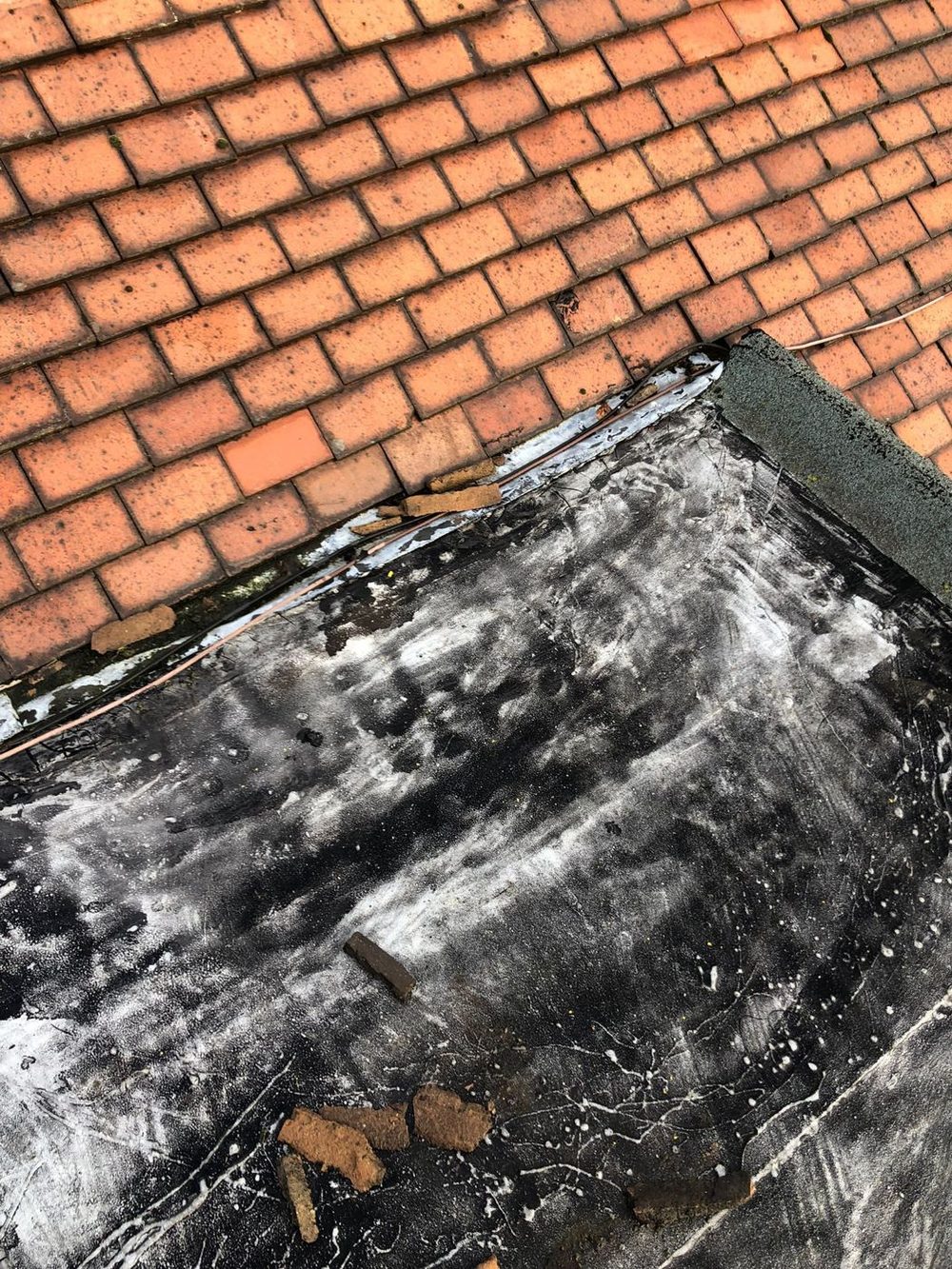
Photograph of our own work.
Start inside, under the roof, in daylight, and look at the ceiling properly rather than glancing at it. A leak normally shows as a brownish ring with a defined edge, often with a darker line marking where the water stopped last time and a paler halo where it has dried. Several rings inside one another mean it has happened more than once, on separate occasions.
Timing is the strongest clue you have. Damp that darkens within a few hours of heavy rain, and fades once a dry spell arrives, is water coming in from outside. Damp that is at its worst in a cold snap, appears without any rain at all, sits in the corner furthest from the heating, and is accompanied by black spotting or a musty smell is very probably condensation forming inside the roof build-up rather than rainwater coming through it. That distinction changes the entire conversation, because no new covering fixes the second one.
Position is the clue people over-trust. Water landing on the top of a deck runs along the timber until it finds somewhere to drop, so the wet patch on your ceiling is frequently nowhere near the hole that caused it. What position does tell you is which part of the roof to be suspicious of. A stain hugging the line where the flat roof meets the house wall points at the upstand. A stain in a square around a rooflight points at the kerb. A stain out in the open middle of the ceiling, with nothing above it, is the least common of the three and the most likely to turn out to be condensation.
Two other things are worth noting while you are standing there. Paint lifting in soft blisters, or plasterboard that has gone slightly convex, means water has been present for a while rather than arriving last week. And if there is a light fitting or a loft hatch in that ceiling, water will very often use it as the exit, which is worth knowing before you put the light on.
On a bitumen roof, the things that count are splits and joints. A crack that runs in a straight line for a distance is following something — a board joint beneath, or the edge of a sheet. Joints that have opened into little curled mouths, so you can see into the lap, are past sealing. Blisters are more ambiguous: a soft blister with air or vapour in it is not automatically a leak, but once one has been walked on and burst, it is. Surfaces that have crazed into a fine alligator pattern have lost their flexibility and will keep cracking wherever the building moves.
On a rubber roof, the failures are different and there are fewer of them. The sheet itself rarely goes; what goes is a joint somebody made in it, a spot where the adhesive never took and the membrane is now loose underfoot, or a puncture from something dropped or dragged. Ripples across an otherwise good sheet are usually a laying fault rather than a leak, but they collect water and dirt in the troughs, which does the roof no favours.
On any roof, previous repairs are evidence in themselves. A smear of mastic here, a strip of self-adhesive flashing band there, a patch that is a different colour from everything around it — each one marks a place where somebody stopped water once. If those marks are spreading outwards across the roof over time, each new one a little further from the last, the covering is not being repaired so much as chased.
A flat roof is the most inviting-looking surface on any house and the one that gives least warning before it lets you through. The boards that have rotted are underneath a covering that still looks continuous, so there is nothing to see until your weight is already on it. Please do not go up to have a look; there is a perfectly good view from elsewhere and it costs you nothing.
An upstairs window over the roof gives you most of what you need, especially just after rain has stopped, when the wet and dry areas draw you a map of where water sits. A neighbour’s upstairs window often gives you the angle yours does not. Failing both, tape a phone to a broom handle, set it recording video rather than stills, and walk it slowly along the edge of the roof from the ground — video is far more forgiving than trying to aim for a photograph you cannot see yourself taking.
Then look from underneath, where you can. In a garage or an outbuilding the underside of the deck is often open to view, and water staining on the boards, dark timber at the wall plate, or daylight visible anywhere it should not be tells you more in a minute than an hour on the roof would. In a house, an access hatch into a flat-roof void will sometimes let you see the same thing with a torch.
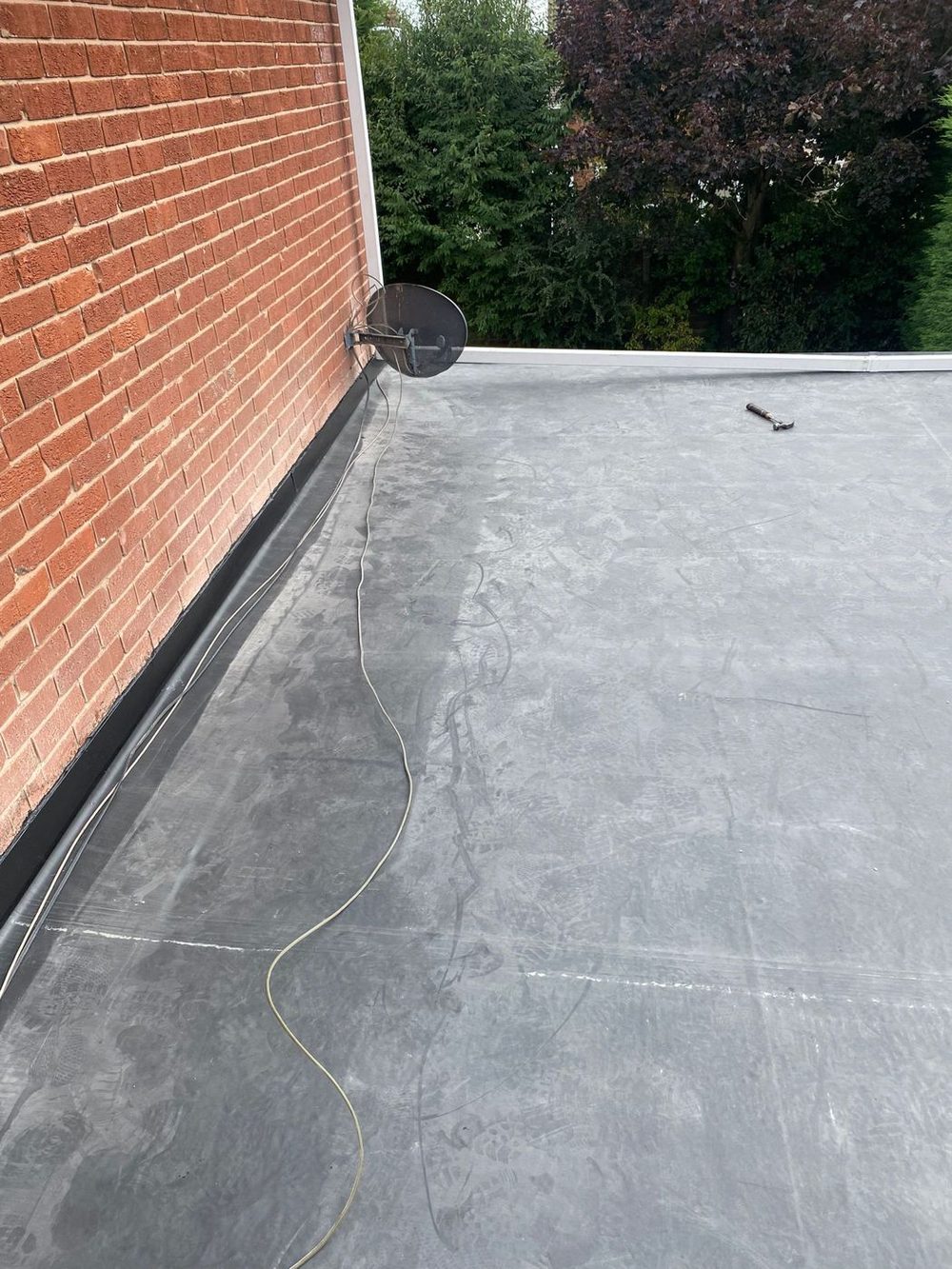
Photograph of our own work.
Repairs get a bad name they do not always deserve. Where a covering is still bonded down across the whole roof, the deck feels solid, the water leaves properly, and the damage is one identifiable thing in one identifiable place — a split at a single joint, a puncture, a trim that has come loose at one corner — then repairing that thing is not a fudge. It is the proportionate answer, and it leaves you with a roof that has one fewer fault than it had yesterday.
The picture changes when the faults stop being singular. Water appearing in more than one place, a surface that gives underfoot anywhere, a covering that has lost its grip over broad areas, or a roof that has already been patched repeatedly in different spots, all point the same way. So does water that has clearly been getting in for a long time, because by then the question is no longer about the covering at all. It is about what the deck and the joist ends under it have been quietly doing while the water was arriving.
If you are trying to settle that question, a survey that lifts a corner and looks is worth far more than any amount of staring at the surface. Our flat roof repairs pages cover the repair end of this, and the rubber roofing hub covers what a full replacement involves. If you want somebody to look, get in touch and send a photograph from that upstairs window while you are at it.
The rest of the series, on the questions people ask most.
Across Chester, Cheshire, the Wirral and Deeside. Start with the main EPDM rubber roofing page.
“job well done good communication throughout the job very clean and tiddy when the job is finish flat roof replacement many thanks.”
Sumit Bal“I had a leak in my vally had a number of roofers to come and take a look couldn’t find the problem Roofline’s solutions fixed the problem first time. Very happy with these guys thank you for the brilliant service”
Michael Price“Highly recommend. Very quick and efficient. Great communication. Went above and beyond to work the weekend to complete the work that needed to be done. Very happy with the results.”
Karen JonesDescribe the roof and roughly where you are, and we will come back to you — usually the same day. If water is coming in now, please call instead.
Prefer to talk? Call 07464 259566 · WhatsApp 0044 7464 259566 · Email Evensbuddy@yahoo.com
We cover Chester, Cheshire, the Wirral and Flintshire from Elton, just north of Chester.
2 Manley View
Elton
Chester
CH2 4QF
Almost all of our work happens at your property rather than here, so please call before travelling.
Monday – Friday — 24hrs — Emergency Call-Outs
Saturday — 8:00 – 19:00
Sunday — 8:00 – 19:00
Weekday emergency call-outs are answered around the clock. Weekend cover is 8:00 to 19:00.