★★★★★
“I had a leak in my vally had a number of roofers to come and take a look couldn’t find the problem Roofline’s solutions fixed the problem first time. Very happy with these guys thank you for the brilliant service”
Michael PriceA gutter joint that drips has usually been told to do something it cannot. This works backwards from the drip through the five things that cause it, in the order they are worth checking.
Before touching anything, watch the run in three different conditions, because the same drip means different things at different moments and this costs nothing but attention.
Water coming over the front edge during heavy rain, in the same place every time, and stopping within minutes of the rain stopping, is not a joint problem at all. That is a blockage upstream or a run that cannot carry the volume, and the water is simply going over the top at the low point.
Water still dripping from a specific joint an hour or two after the sky has cleared is the true joint leak. The gutter is holding standing water because it has lost its fall or dropped in the middle, and that standing water is sitting against a seal that was never meant to be permanently submerged.
A joint that weeps in cold weather and behaves in warm weather is almost always expansion. And a joint that drips whatever the weather, with a visible misalignment between the two lengths, has moved, which takes you straight to the fixings and the board behind them.
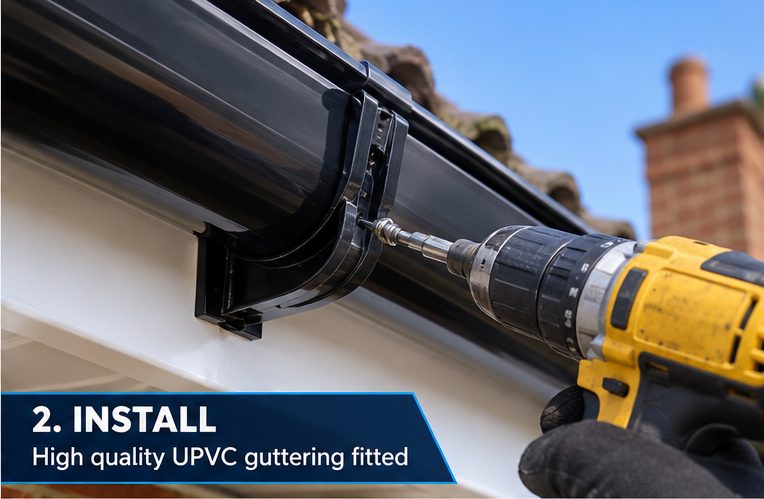
Plastic expands and contracts far more than cast iron ever did, and a long run in direct sun can change length by a noticeable amount between a frosty night and a hot afternoon. The system is designed around that. Inside a union or a socket there is a rubber or synthetic seal, and the gutter end is meant to sit against an expansion mark moulded into the fitting rather than be pushed fully home.
That mark is ignored constantly. A run assembled hard up against the stops on a cold day has nowhere to go when it warms; it bows outwards between brackets, lifts off its seal at the joints, or forces a union open. A run assembled tight on a hot day shrinks back in winter and can pull an end almost out of its socket. Both show up as joint leaks and neither is a faulty seal.
This is also why a gutter can start leaking years after it was fitted, with nothing having happened to it. Thousands of cycles of movement gradually work the seal out of position, polish a groove in it, or walk a bracket loose. It is not sudden failure, it is accumulated movement, and it concentrates at the joints because that is where the movement is taken.
Mixing manufacturers makes it worse. Two brands of half round gutter can look identical and differ enough in profile that a union never quite grips both. Repairs made with whatever fitting was available at the merchant are a common cause of a single joint that has never been right since somebody "fixed" it.
The seal itself does age. Sunlight, frost, grit washed down from the tiles and a permanent film of moss tea all harden it over time, and a hardened seal has lost the springiness it needs to stay in contact with a gutter that is moving. You can sometimes see the result from below as a fine line of green growth directly under one joint and nowhere else.
Clips are the other consumable. Most unions hold the gutter with a snap-down clip, and those clips fatigue, particularly where somebody has taken the run apart to clear a blockage and put it back. A clip that no longer holds the gutter down against the seal produces exactly the symptoms of a perished seal while the seal itself is fine.
Debris is the unglamorous answer and it is worth eliminating early. A single sycamore seed, a piece of grit or a fragment of moss caught between the gutter edge and the seal will hold a gap open permanently and produce a steady drip at one point on an otherwise faultless run. It is also the only cause on this list that fixes itself once the run is cleaned out.
Replacing a seal or a union is a legitimate repair on a run that is otherwise straight, sound and on solid board. Where the run has lost its line, replacing one fitting is redecorating: the next joint along will start within a season, because the cause was never the fitting.
A gutter only works because it is not level. It needs a steady, gentle slope from the far end to the outlet, set when it is fitted and easy to lose. If water stands in a length on a dry day, the fall has gone at that point, and standing water is both extra weight on the brackets and a permanent bath for every seal it covers.
Fall goes for three reasons. It was never set properly, which usually shows as a run that is level or actually falling away from the outlet. Or the brackets are too far apart, so the gutter sags in the middle of each span under the weight of water — spacing of roughly a metre is normal, with extra support close to joints and at the outlet. Or an individual bracket has moved, taking a local dip with it.
There is also the question of whether the run was ever big enough. A shallow half round gutter with one outlet serving a large roof will cope in ordinary rain and overtop in a downpour, and that is not a fault to be repaired, it is a section to be reconsidered. A deeper profile, or a second outlet and downpipe, changes the behaviour in a way that no amount of new seals will.
And look at what the water does after the gutter. A downpipe running into a gully that has silted up will back up and put water at the base of the wall, and it is easy to spend a season chasing a joint two storeys up when the actual problem is at ground level where you can reach it.
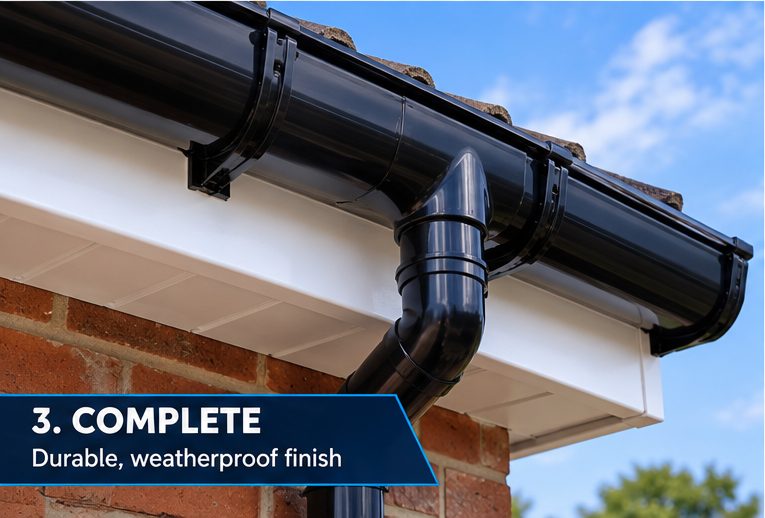
Every bracket is screwed into the fascia. That one fact sits underneath everything above, because if the timber will not hold a screw then the bracket moves, and if the bracket moves then the fall, the line and the joints all go with it. A gutter cannot be more accurate than the thing it is nailed to.
The pattern is recognisable from the pavement. Sight along the run against the sky. A sag that is local, with sound gutter either side of it, a bracket that has opened a visible gap behind the gutter, rust running down from a fixing, or a length that has rotated slightly so the front edge is higher than it should be — those are all fixings letting go rather than plastic failing. Please do not go up for a closer look; from across the road with a phone camera you will see all of it.
The sequence that follows is the one worth understanding. Soft timber lets a bracket drop. The dip holds standing water. Standing water sits against the nearest seals and starts them dripping. Water from the drip runs down the back of the gutter onto the fascia and the wall, keeping the timber wetter still, and the next bracket along begins to go. The joint leak is the last link in that chain and the first one anybody notices.
Which is why the honest answer to "can you just do the gutter" is sometimes no. New gutter on a sound board is a straightforward job and a sensible one. New gutter on a board that has gone is a year or two of quiet before the same conversation. The guide to spotting a failed fascia is the one to read before deciding which of those you are buying.
The rest of the series, on the questions people ask most.
Every town has its own page, written around what the houses there are actually like at eaves level. Start with the main roofline page.
“I had a leak in my vally had a number of roofers to come and take a look couldn’t find the problem Roofline’s solutions fixed the problem first time. Very happy with these guys thank you for the brilliant service”
Michael Price“Excellent work replacing ridge tiles, repointing chimney and repairing flashing. Also fixed other broken tiles. Clean and tidy job. Would definitely recommend.”
Neil“Highly recommend. Very quick and efficient. Great communication. Went above and beyond to work the weekend to complete the work that needed to be done. Very happy with the results.”
Karen JonesDescribe what is happening and roughly where you are, and we will come back to you — usually the same day. If water is coming in now, please call instead.
Prefer to talk? Call 07464 259566 · WhatsApp 0044 7464 259566 · Email Evensbuddy@yahoo.com
We cover Chester, Cheshire, the Wirral and Flintshire from Elton, just north of Chester.
2 Manley View
Elton
Chester
CH2 4QF
Almost all of our work happens at your property rather than here, so please call before travelling.
Monday – Friday — 24hrs — Emergency Call-Outs
Saturday — 8:00 – 19:00
Sunday — 8:00 – 19:00
Weekday emergency call-outs are answered around the clock. Weekend cover is 8:00 to 19:00.