★★★★★
“I had a leak in my vally had a number of roofers to come and take a look couldn’t find the problem Roofline’s solutions fixed the problem first time. Very happy with these guys thank you for the brilliant service”
Michael PriceCapping is a real method with a real place, and it is also the easiest way to sell a roofline that does not fix anything. The difference is entirely the condition of the timber underneath.
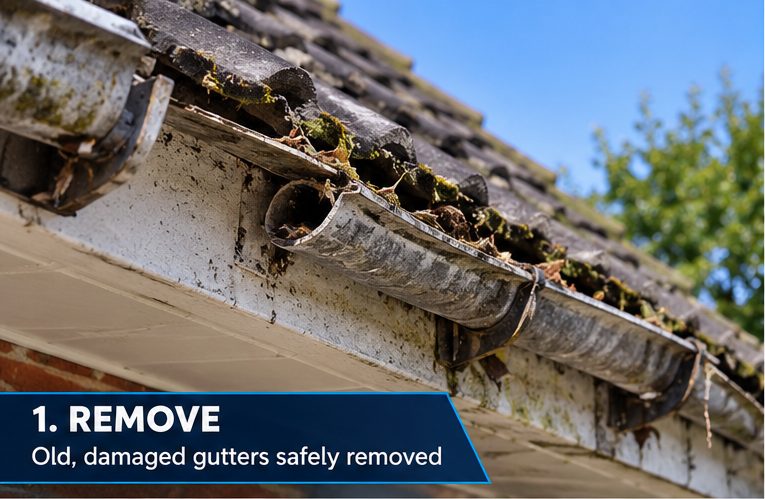
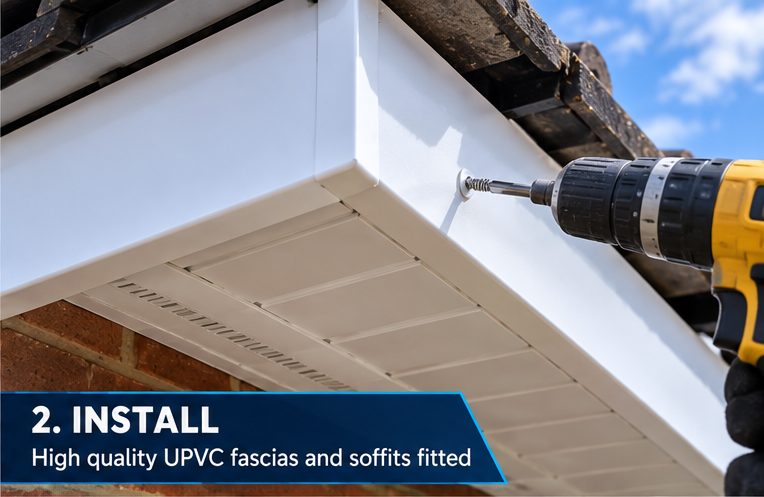
Capping, sometimes sold as overcladding or a recover, means leaving the existing timber fascia where it is and fixing a thin UPVC board over its face. The old gutter comes off, the cap goes on, new brackets and gutter go back through it. A vented UPVC soffit is often fitted under the old soffit at the same time. From the pavement, when it is finished, it looks identical to a full replacement.
Full replacement means the gutter, fascia and soffit all come off and go in the van. The rafter ends, the wall plate, the top course of brickwork and the eaves felt are all visible at that point. New full-thickness board is fixed to sound timber, the soffit goes on, and the gutter is set to a fall on brackets screwed into new material.
The two jobs differ in time, in mess and in what gets found out. That last one is the real difference. A capping job is designed not to expose anything, and a replacement cannot avoid exposing everything, which is why a replacement occasionally turns into a longer job and a capping never does — not because the problem was absent, but because nobody looked.
There is one, and it is worth stating plainly, because the honest argument for capping gets lost in the arguing about the dishonest one. Where the existing fascia is dry, hard and straight, capping it is a sound piece of work. The timber carries on doing its structural job, which it is perfectly capable of doing, and the plastic takes over the weathering job, which is the one it was failing at.
That situation is commoner than the internet suggests. A house with deep eaves on a sheltered elevation, or one that has been kept painted, or a later property with a generous fascia that has simply become tired-looking, can have entirely serviceable boards behind peeling paint. Ripping sound structural timber off a roof to throw it in a skip is not automatically the better engineering decision.
Capping also has practical advantages where the roof is awkward. It is quicker, it disturbs the tile edge and the felt less, and on a roof where the tiles are brittle or the felt is fragile there is a real argument for not pulling everything apart. On a listed or unusual property it is sometimes the only reversible option.
And it is a smaller job. Nothing on this site quotes figures, but it is no secret that less labour and less material means a smaller number, and on a house where the timber is genuinely sound that is a saving rather than a corner cut.
The case against capping is not aesthetic, it is mechanical. Every gutter bracket on the run has to be screwed into something that will hold a screw. A cap is a few millimetres of plastic; the screws pass straight through it and into the original board. If that board is soft, the plastic has changed nothing at all about what is holding the gutter up, and a full gutter after a week of rain is a surprisingly heavy thing.
Then there is the timber itself. Wet wood behind a sealed plastic face dries more slowly than wet wood in the open air, not faster. Capping a damp board does not stop the rot, it removes the ventilation and the visibility at the same time. The decay carries on behind a clean white front, and the next symptom is not a stained fascia but a bracket letting go or a rafter end crumbling.
The soffit version is worse and more common. Fitting a vented UPVC soffit beneath an intact solid timber soffit produces slots in a board with a sealed panel behind it. No air passes. The roof space is exactly as blocked as it was, the homeowner believes ventilation has been dealt with, and the condensation that follows gets blamed on the roof covering.
There is also a practical objection on a terrace or a semi. A cap stands proud of the original line by the thickness of the board, so where your work stops and next door’s begins there is a step, and a gutter union sitting over that step is the union that drips. Once the cap is on, it cannot be undone without starting the whole run again.
You cannot establish hardness from the garden, and it would be dishonest to pretend otherwise. What you can do is assemble enough circumstantial evidence to know which answer to expect, and to notice when the answer you get does not match.
Start with the gutter line, from across the road. A run that is dead straight, with brackets sitting tight against the board, on a house where the paint is tired but not gone, points towards timber that is still doing its job. Dips between brackets, a bracket that has opened away from the fascia, rust stains running down from fixings, or a gutter that has shifted out of line all point the other way.
Then the paint. Chalky, dull paint with the wood still covered is weathering. Paint that has cracked, lifted and exposed bare grey timber over long stretches, particularly along the bottom edge and at the joints between lengths, means water has been getting in for years. Green algae growing directly on bare board is a strong signal, because bare timber only stays green if it is staying wet.
Look at the elevations separately, too. It is entirely normal for the sunny front of a house to be capable of being capped and the shaded back to need stripping, and a quotation that treats all four sides identically has probably not looked. Please do not go up to check any of this — use an upstairs window and a phone camera from the pavement, which between them show you nearly everything that matters.
One question does most of the work: will a length come off so you can see what is behind it, and what happens if it is soft? Anyone intending to do the job properly has a ready answer, usually that a section gets lifted at the quotation stage or first thing on the day, and that the price changes in a stated way if the timber has gone. Anyone who has not thought about it will move the conversation elsewhere.
Follow it with three more. Are the gutter brackets going into the original board or into new timber? Is the old soffit being removed or left in place behind the new one? And if it is being left, how is air getting into the roof space, given there is a solid panel in the way? Those are fair questions and they are not difficult ones for somebody who fits roofline for a living.
It is also reasonable to ask to be shown. Once the old gutter is off, the top edge of the fascia is visible and a screw driven into it settles the question in a second. We take a length off and look before deciding which of the two jobs your house wants, and if the rafter ends have gone we say so then rather than after the new gutter is hanging on them.
The thing to avoid is treating capping as a category of firm rather than a method. The same house can be a capping job on one elevation and a strip on the other. What matters is that somebody looked, said which was which, and wrote it down before you agreed to anything. If you are still working out whether the roofline has failed at all, the guide on spotting a failed fascia covers that ground first.
The rest of the series, on the questions people ask most.
Every town has its own page, written around what the houses there are actually like at eaves level. Start with the main roofline page.
“I had a leak in my vally had a number of roofers to come and take a look couldn’t find the problem Roofline’s solutions fixed the problem first time. Very happy with these guys thank you for the brilliant service”
Michael Price“Excellent work replacing ridge tiles, repointing chimney and repairing flashing. Also fixed other broken tiles. Clean and tidy job. Would definitely recommend.”
Neil“Highly recommend. Very quick and efficient. Great communication. Went above and beyond to work the weekend to complete the work that needed to be done. Very happy with the results.”
Karen JonesDescribe what is happening and roughly where you are, and we will come back to you — usually the same day. If water is coming in now, please call instead.
Prefer to talk? Call 07464 259566 · WhatsApp 0044 7464 259566 · Email Evensbuddy@yahoo.com
We cover Chester, Cheshire, the Wirral and Flintshire from Elton, just north of Chester.
2 Manley View
Elton
Chester
CH2 4QF
Almost all of our work happens at your property rather than here, so please call before travelling.
Monday – Friday — 24hrs — Emergency Call-Outs
Saturday — 8:00 – 19:00
Sunday — 8:00 – 19:00
Weekday emergency call-outs are answered around the clock. Weekend cover is 8:00 to 19:00.