★★★★★
“I had a leak in my vally had a number of roofers to come and take a look couldn’t find the problem Roofline’s solutions fixed the problem first time. Very happy with these guys thank you for the brilliant service”
Michael PriceFour boards and a pipe, each with a separate job. Knowing which is which on your own house is what stops you comparing two quotations that are quietly for different amounts of work.
Stand at a corner of the house where you can see both the front and the side at once. The horizontal edge of the roof, the one with the gutter on it, is the eaves. The sloping edge that runs up the triangle of a gable end, or up the side of a dormer, is the verge. Every roofline name follows from those two words.
The fascia is the upright board at the eaves, fixed across the ends of the rafters. It closes the roof structure off and gives the gutter something to hang on. Look at it end-on and it is a plank on edge: you see its narrow face, the tiles overhang its top, and the gutter covers the upper part of it.
The soffit is the flat board underneath, running from the bottom of the fascia back to the wall. It is the one you see when you stand under the eaves and look up. Its width is set by how far the roof overhangs, which on a 1930s semi might be a hand-span and on a post-war estate house almost nothing at all.
The bargeboard is the sloping board at a gable, following the roof line up to the apex and meeting its opposite number there in a mitre. Under it there is often a narrow soffit too, sometimes called gable trim or a soffit return, and where the bargeboard meets the eaves there is a boxed corner — the box end — which is the fiddliest piece on the whole house.
The guttering and downpipes are the fifth element and the only moving part. The gutter hangs on brackets screwed to the fascia, runs to an outlet, and the downpipe takes the water to a gully. Everything about whether it works depends on things that are not the gutter: the fall it was set to and the board it is fixed to.
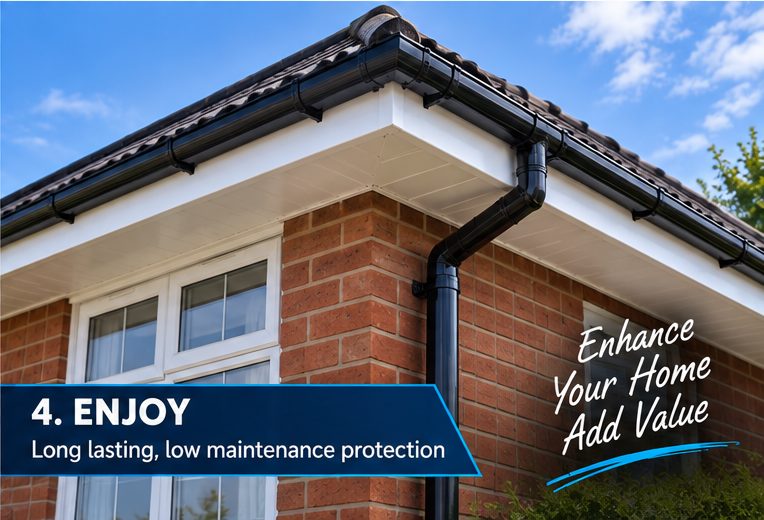
Two shortcuts sort out nearly every case. If the board is holding a gutter, it is a fascia. If you had to look upwards to see it, it is a soffit. A sloping board with no gutter is a bargeboard, and a house with a hipped roof — all four sides sloping, no triangle of brickwork at the end — has no bargeboards at all, which is worth knowing before you ask anyone to price them.
There are two awkward cases. Some houses have no soffit: the rafter feet are left open and you can see the underside of the roof from below. Others have a very deep soffit because the eaves were built to overhang a bay or a porch. Both are normal, both change the amount of board involved, and both are worth mentioning on the phone before anybody drives out.
The other thing people mix up is the verge. The verge is the tiled edge itself, usually bedded in mortar, and it sits above the bargeboard rather than being part of it. When that mortar cracks and starts dropping, the usual answer is dry verge — mechanically fixed caps instead of mortar. That is a roof edge job rather than a roofline one, but it is normally done at the same time because the access is already there.
Bargeboards generally go first, and they go fastest. There is no gutter below them, so every drop that lands on the roof slope above runs down the face of the board and out over the bottom end. They are also the most exposed thing on the house to wind-driven rain, being high up on a gable with nothing in front of them. The apex mitre opens, water runs into the joint, and the top of both boards rots outwards from there.
The fascia goes next and goes quietly. Because its failure starts on the top edge under the gutter, nothing shows for years, and the first symptom is usually mechanical rather than visual — a gutter bracket that has begun to pull, or a dip in a run that used to be straight.
Soffits come third, and usually not on their own account. A soffit is sheltered, so it survives until something else stops protecting it: an overflowing gutter running back behind the fascia, a fascia that has rotted through and stopped closing the joint, or eaves felt that has torn and is dropping water behind the gutter instead of into it.
The guttering outlives all of it, which is exactly the trap. UPVC gutter from the 1980s can still be perfectly serviceable plastic while the board it is screwed to has turned to compost. People see sound gutter and conclude the roofline is fine. The gutter is fine. What is holding it up is not.
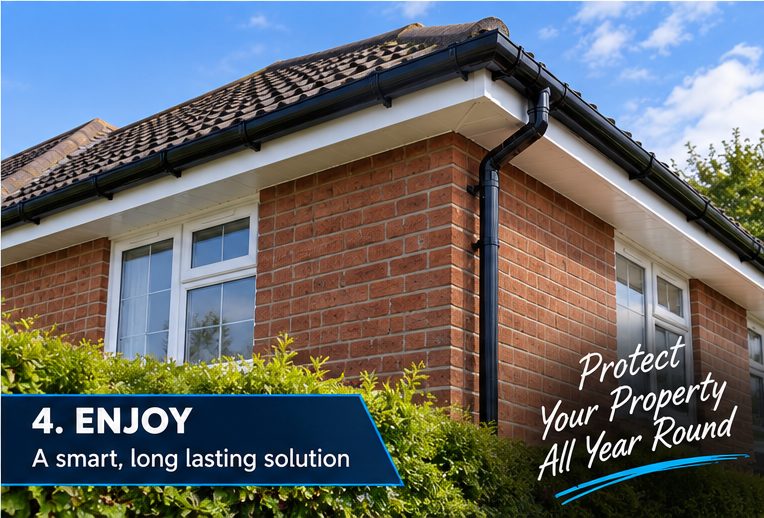
Roofline is priced by what has to be touched, and each of these parts is a separate quantity. A quotation for "fascias and soffits" on a semi with two gables can legitimately exclude both bargeboards, both sets of gable trim and the two box ends, and still be an honest quotation for exactly what it says. If the other one you are holding includes them, it will look dearer and be for more work.
The same applies at the bottom of the wall. Downpipes, shoes, hoppers and any rerouting are usually itemised separately from the gutter run, because a house can need new gutter and perfectly good downpipes or the reverse. Dry verge, felt support trays and eaves ventilation are all line items too, and all three are commonly left out of the cheaper document.
So when you ring round, describe the house in these terms and ask for the quotation to be itemised the same way: so many metres of fascia and soffit at the eaves, so many bargeboards and returns at the gables, gutter and how many downpipes, ventilation yes or no. Two quotations written like that can be compared. Two written as a single figure for "roofline" cannot.
It also stops a genuine misunderstanding on site. If you ask for the "fascias" doing on a bungalow with an open-rafter eaves, or for "soffits" on a gable where you actually mean the bargeboard, somebody measures the wrong thing and it surfaces on the day. The main roofline page sets out what we fit; this is simply about calling it the same thing that the person measuring is calling it.
The rest of the series, on the questions people ask most.
Every town has its own page, written around what the houses there are actually like at eaves level. Start with the main roofline page.
“I had a leak in my vally had a number of roofers to come and take a look couldn’t find the problem Roofline’s solutions fixed the problem first time. Very happy with these guys thank you for the brilliant service”
Michael Price“Excellent work replacing ridge tiles, repointing chimney and repairing flashing. Also fixed other broken tiles. Clean and tidy job. Would definitely recommend.”
Neil“Highly recommend. Very quick and efficient. Great communication. Went above and beyond to work the weekend to complete the work that needed to be done. Very happy with the results.”
Karen JonesDescribe what is happening and roughly where you are, and we will come back to you — usually the same day. If water is coming in now, please call instead.
Prefer to talk? Call 07464 259566 · WhatsApp 0044 7464 259566 · Email Evensbuddy@yahoo.com
We cover Chester, Cheshire, the Wirral and Flintshire from Elton, just north of Chester.
2 Manley View
Elton
Chester
CH2 4QF
Almost all of our work happens at your property rather than here, so please call before travelling.
Monday – Friday — 24hrs — Emergency Call-Outs
Saturday — 8:00 – 19:00
Sunday — 8:00 – 19:00
Weekday emergency call-outs are answered around the clock. Weekend cover is 8:00 to 19:00.