★★★★★
“I had a leak in my vally had a number of roofers to come and take a look couldn’t find the problem Roofline’s solutions fixed the problem first time. Very happy with these guys thank you for the brilliant service”
Michael PriceThis guide does not put a number on the work, and the first section explains why. What it does instead is set out everything that moves the figure, so you can read a quotation and understand what you are being charged for.
You have almost certainly arrived here wanting a figure, so here is the honest position. Roofline Solutions has not published a price list, a per metre rate or a day rate, and we are not going to print one on an advice page and call it guidance.
The reason is not coyness. A range invented to satisfy a search result is worse than useless: it is either so wide that it tells you nothing, or narrow enough to be wrong about your house, and the second kind causes real trouble. People budget against it, get a proper quotation that does not match, and conclude somebody is overcharging when in fact the invented number never described their building at all. Roofline work varies more between two houses on the same street than almost any other job at this scale.
What can be written down usefully is the mechanism — what a quoting installer is actually counting, in roughly the order it matters. Read the sections below and you will be able to look at a quotation and see where the number came from, which is a better position than knowing what somebody else paid.
For a figure on your own house, ring and ask for a quotation. It costs nothing, it is written against your elevations rather than an average, and you are under no obligation at the end of it.
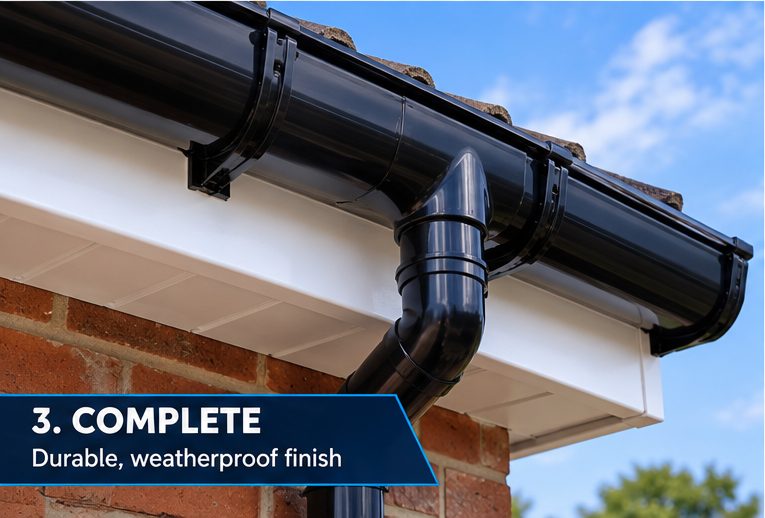
The first thing counted is length. Fascia, soffit, gutter and bargeboard are all priced by the metre before anything else is considered, and you can get a serviceable count yourself without leaving the ground: pace out each elevation at wall level and add them up. Front, back, both sides, any outrigger or rear projection, the garage if it is attached, the porch.
Where those metres sit matters as much as how many there are. Ground floor eaves on a bungalow and second floor eaves on a townhouse are the same metre of board and a very different amount of work to fit it. A gable is sloping, worked at height from a moving platform, and slower per metre than anything horizontal.
Bargeboards deserve their own count. They are frequently assumed to be included in a mental estimate and then appear as a separate item, and on a house with two gables they are a significant length of work in the most awkward position on the building.
One caution about doing the arithmetic yourself: total metres do not multiply into a price, because the metres are not equal. The count is for comparing quotations to each other, not for predicting what they will say.
Access is the item that most often separates two otherwise identical quotations, and it has nothing to do with the roofline at all. A bungalow with clear ground on all four sides can usually be worked from a tower, which is brought in a van, moved by the crew in minutes and taken away at the end. A two storey house with a conservatory under the rear run, a steep garden, or a boundary too close to stand anything on may need scaffold, which has to be delivered, erected, inspected, left standing, then struck and collected.
That difference is substantial and it is entirely a property of your house rather than of the work. Three storeys, a basement that puts the ground below pavement level, a run over a flat roof that cannot be loaded, a frontage onto a public footway that needs a licence from the council — each of those pushes the access from the cheap end towards the expensive one.
It is also why the phrase "scaffold not included" is the single most important thing to look for in a quotation that looks unusually attractive. Ask which method has been assumed, who is supplying it, and whether the figure covers it.
A straight fifteen metre run and fifteen metres made up of five short lengths are not the same job. Every change of direction is a mitre cut in the fascia and a matching angle in the gutter, every angle is a joint that has to seal, and the setting out takes longer than the cutting.
Bay windows are the clearest example. A bay with its own small tiled roof can have two or three external angles, a return into the wall each side, and a very short length of gutter that still needs its own fall and its own connection into the main run. It is a metre or two of material and an afternoon of work.
Dormers are the same problem taller. A dormer has cheeks, a small roof, returns where it meets the main slope and often a lead flashing that has to be worked around without disturbing it. On a house with two or three dormers that is a meaningful part of the job, and it is why a dormered bungalow can cost more than a plain semi with more floor area.
Hips, valleys, porches, garage returns and anywhere the roofline steps up or down all behave the same way. If you want a rough sense of whether your house sits at the quick end or the slow end, count the corners rather than the rooms.
Capping or full replacement is the largest single choice inside the specification. Capping covers the existing timber with a thinner board and is less work; full replacement strips the timber off and fixes a new board to the rafter ends. They are different amounts of labour, different amounts of material and different amounts of waste, and they are only alternatives at all where the timber behind is genuinely sound.
Where it is not, the cost of putting it right belongs in a category of its own, because nobody can see it before the gutter comes off. Cutting back rotten rafter ends and fitting new bearers, packing an uneven wall head straight, or replacing felt that has torn back are all found work. This is the item to have a written method for — how you will be told, and what is agreed before it proceeds.
Then the things being added rather than replaced. Eaves ventilation where the old soffits had none. Felt support trays. Dry verge in place of cracked mortar at the gable. None of these are large on their own and all of them are far cheaper now than as a separate visit later, which is the argument for deciding about them at quotation stage.
Resizing the gutter moves the number too, and by more than the section itself. Going up a profile or splitting a long run means new outlets, and an outlet means a downpipe, and a downpipe means somewhere for it to discharge — possibly a new connection into a gully that has to be dug to. A colour outside the stock range is an order rather than van stock, which affects timing more than anything else.
Finally, what leaves the site. The old boards, gutter and pipe have to go somewhere, and the volume is larger than people expect. Cast iron is heavy and slow to bring down safely. A soffit that turns out to be asbestos cement rather than timber changes the removal method completely and is handled by a specialist route, not broken up on site. Everything we take off goes with us, and a quotation should say what happens to yours.
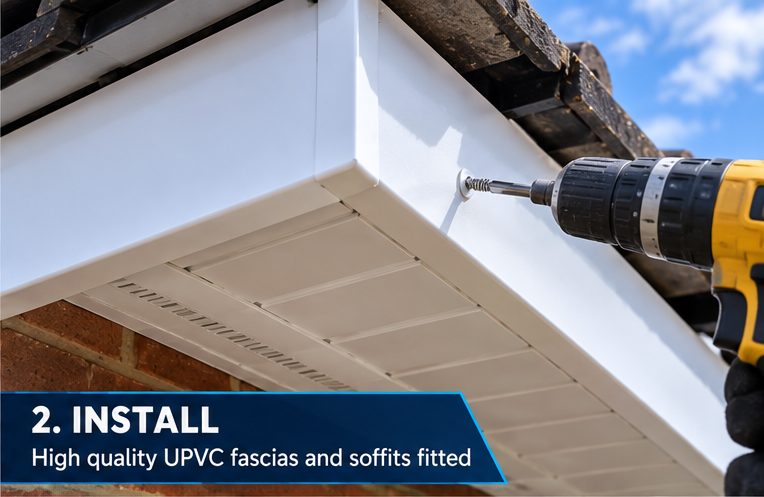
Compare the described work before the totals. Two quotations that differ noticeably are usually two different jobs — one capping and one replacing, one including the gable bargeboards and one stopping at the eaves, one with scaffold and one assuming a tower will reach.
The items to check first are the ones that vary most: access, ventilation, disposal, and the method for anything found behind the boards. Our guide to what should be on a roofline quotation goes through those line by line, and the main roofline page sets out what we fit and how a job runs.
And if a figure you have been given does not make sense against any of this, ask what is driving it. Any installer worth using can tell you which part of your house is the expensive part, and on a roofline it is usually the access, the corners, or the state of the timber — not the plastic.
The rest of the series, on the questions people ask most.
Every town has its own page, written around what the houses there are actually like at eaves level. Start with the main roofline page.
“I had a leak in my vally had a number of roofers to come and take a look couldn’t find the problem Roofline’s solutions fixed the problem first time. Very happy with these guys thank you for the brilliant service”
Michael Price“Excellent work replacing ridge tiles, repointing chimney and repairing flashing. Also fixed other broken tiles. Clean and tidy job. Would definitely recommend.”
Neil“Highly recommend. Very quick and efficient. Great communication. Went above and beyond to work the weekend to complete the work that needed to be done. Very happy with the results.”
Karen JonesDescribe what is happening and roughly where you are, and we will come back to you — usually the same day. If water is coming in now, please call instead.
Prefer to talk? Call 07464 259566 · WhatsApp 0044 7464 259566 · Email Evensbuddy@yahoo.com
We cover Chester, Cheshire, the Wirral and Flintshire from Elton, just north of Chester.
2 Manley View
Elton
Chester
CH2 4QF
Almost all of our work happens at your property rather than here, so please call before travelling.
Monday – Friday — 24hrs — Emergency Call-Outs
Saturday — 8:00 – 19:00
Sunday — 8:00 – 19:00
Weekday emergency call-outs are answered around the clock. Weekend cover is 8:00 to 19:00.