★★★★★
“I had a leak in my vally had a number of roofers to come and take a look couldn’t find the problem Roofline’s solutions fixed the problem first time. Very happy with these guys thank you for the brilliant service”
Michael PriceA roofline almost never announces itself. This is what failed timber really looks like from the pavement, which signs point at the board rather than the plastic in front of it, and what to settle before anyone quotes.
A fascia is a plank standing on edge with its top hidden under the gutter, its back against the rafter feet and only its face exposed to view. Paint gets put on the face. It rarely gets put on the top edge properly, almost never on the back, and on the sawn ends where lengths butt together it is usually a token brushful at best. So the surface you can inspect is the one part of the board that has been looked after.
Water finds the rest. Rain blowing onto the roof runs down the tiles, over the felt and into the gutter, and the top edge of the fascia sits in that wet strip all winter. End grain behaves like a bundle of straws: it draws water in along the length of the timber and holds it there. That is why a board can be dark and spongy for three or four inches in from a joint while the middle of the same length is still perfectly sound.
What you see on the outside, then, lags a long way behind what is happening inside. Blistered or flaking paint means the timber under it has been damp and has moved. It does not tell you how far the softening has gone, and a board that has been repainted recently tells you even less — fresh paint over wet wood seals the water in and speeds the whole thing up.
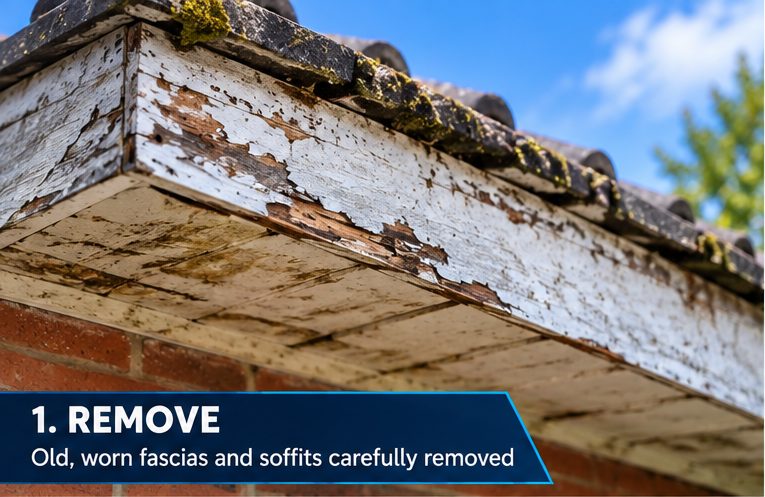
There is a sequence, and once you know it you can place your own house on it from the garden. Paint dulls and chalks first. Then it cracks along the grain and lifts in flakes, usually starting at the bottom edge where water runs off and at the joints between lengths. Bare wood appears, silver-grey at first and then dark. Green algae follows, because bare timber stays wet far longer than painted timber does.
After that the shape starts to go. A sound board is dead straight along its bottom edge and holds a hard line against the sky. A board that has taken water swells, cups, and begins to wave gently between the rafter feet. Splits open at the fixings. Nail heads and screw heads stand slightly proud or bleed a rust stain downwards, which is a reliable sign that the timber around them has softened enough to let go.
Soffits fail differently because they are horizontal and sheltered, so they stay dry until something above them fails. The tell is a stain or a dark patch spreading back from the front edge, or a board that has dropped away from the wall leaving a dark gap. A soffit that has begun to sag between its fixings has usually been carrying water from a gutter overflow for several seasons.
On a gable, look at the bargeboard separately. It has no gutter beneath it, so everything that lands on it runs straight down its face and off the bottom end. The apex joint at the top and the last foot or so at the bottom are where it goes, and a bargeboard can be well past saving on a house whose eaves boards are still reasonable.
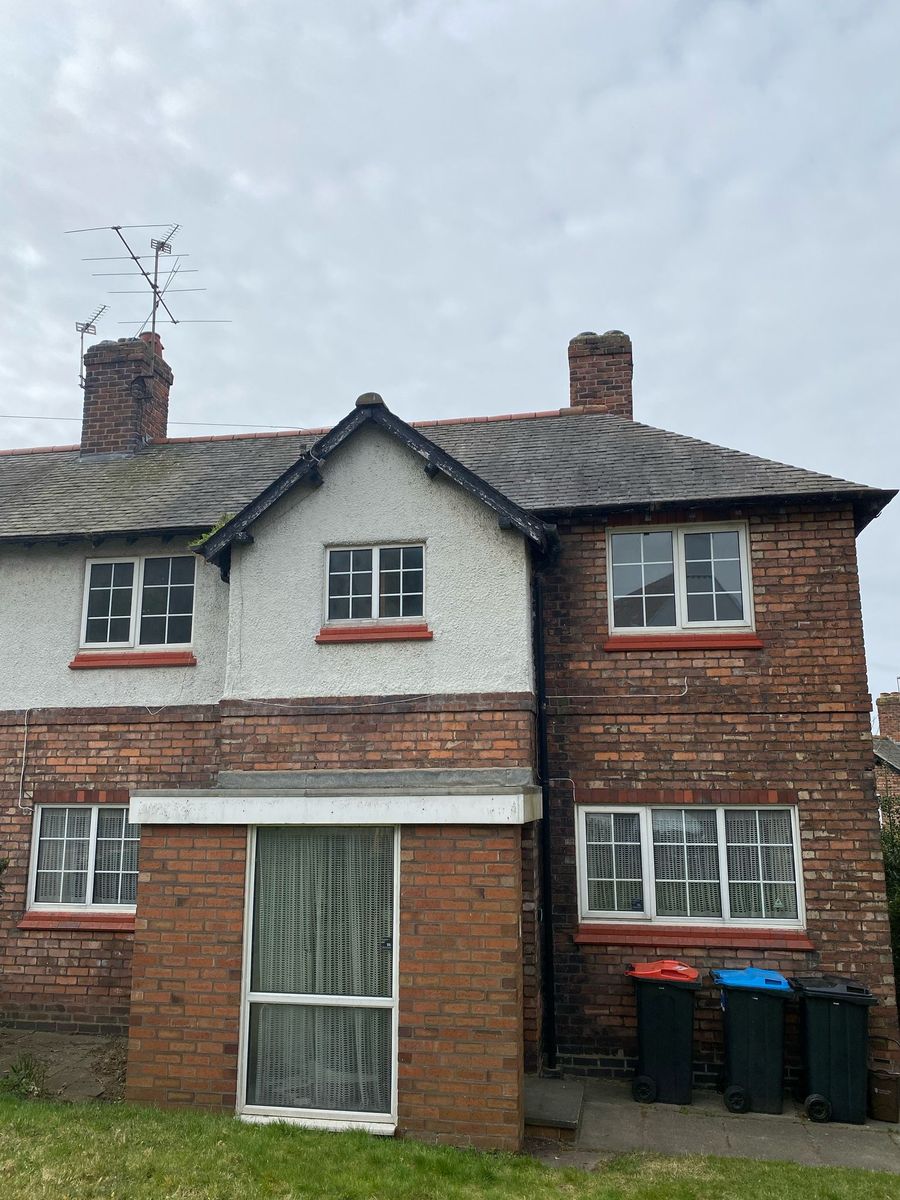
Cross the road first. Almost nobody looks at their own roofline from far enough away, and the single most useful observation — whether the gutter line is straight — needs distance rather than closeness. Sight along the run with the eaves against the sky and look for a dip, a kink at a joint, or a length that has dropped away from the board behind it.
Then use a phone. A modern camera zoomed in from the pavement will show you the bottom edge of the fascia, the state of the paint, the gaps at the joints and whether the gutter is sitting hard against the board or has opened a shadow behind it. Photograph each elevation, including the shaded one nobody walks past, because the north side of a house is normally the worst and the last to be noticed.
A first-floor window is the other free vantage point. Opening one and looking down and sideways along the eaves gives you the top face of the gutter, any standing water sitting in it in dry weather, and the line where the soffit meets the wall. Please do not go up a ladder to do any of this; there is nothing at eaves height that changes the answer enough to be worth the risk, and a roofer who is going to quote will be up there anyway.
Inside, the loft hatch is worth a torch on a cold morning. You are looking at the rafter feet where they pass over the wall, the underside of the felt and the insulation in the last half metre. Damp timber at the eaves and wet insulation against the outside wall usually mean the roof space cannot breathe, which is a soffit question rather than a tile question.
Guttering is the part people ring about, because it is the part that does something visible when it fails. A good deal of the time it is innocent. Every bracket on the run is screwed into the fascia, and once the timber has softened the screws have nothing to bite on, so the gutter starts to move under the weight of water and moss.
The pattern that points at the board rather than the plastic is a local one. A single low spot with sound gutter either side of it, water standing in that spot on a dry day, a bracket that has visibly opened away from the fascia, or a joint that has pulled out of line and drips for hours after the weather has cleared — those are fixings losing their grip. Replacing the gutter on a board in that state hangs new plastic off the same soft timber.
The pattern that points at the gutter itself is different. Overflow from the front lip only in heavy rain, always at the same place, stopping when the rain stops, is a blockage. A joint that weeps a little in cold weather and not in warm is usually an expansion or seal problem. Neither of those has anything to say about the timber.
Then there is the stain on the wall, which is the most misread sign of all. A vertical green or dark streak under one point on the run means water has been leaving there for a long time. A broad damp band along the brickwork under the whole length means the run has been overflowing along its length, which is a fall problem or a sizing problem rather than a single fault.
None of the above proves anything on its own. Softness is settled with a screwdriver and a screw, at eaves height, by somebody who is up there legitimately. What your own survey from the ground does is tell you which answer you should expect, so that you can tell a reasonable quotation from an optimistic one.
Ask whoever comes out to look behind the gutter rather than at the face of the board, and to say which lengths are sound and which are not. Ask what happens if a rafter end turns out to be rotten once the boards are off, because on an older house that is common and it changes the job. Ask whether the soffit is being replaced or covered, and whether the roof space is getting any ventilation out of the work.
If two quotations differ wildly, the difference is usually not the plastic. It is whether one of them intends to strip back to sound timber and the other intends to cover what is there. Both are legitimate jobs on the right house. They are not the same job, and they should not be compared as though they were. Our page on capping against replacing goes through how to tell which one your house is a candidate for.
The rest of the series, on the questions people ask most.
Every town has its own page, written around what the houses there are actually like at eaves level. Start with the main roofline page.
“I had a leak in my vally had a number of roofers to come and take a look couldn’t find the problem Roofline’s solutions fixed the problem first time. Very happy with these guys thank you for the brilliant service”
Michael Price“Excellent work replacing ridge tiles, repointing chimney and repairing flashing. Also fixed other broken tiles. Clean and tidy job. Would definitely recommend.”
Neil“Highly recommend. Very quick and efficient. Great communication. Went above and beyond to work the weekend to complete the work that needed to be done. Very happy with the results.”
Karen JonesDescribe what is happening and roughly where you are, and we will come back to you — usually the same day. If water is coming in now, please call instead.
Prefer to talk? Call 07464 259566 · WhatsApp 0044 7464 259566 · Email Evensbuddy@yahoo.com
We cover Chester, Cheshire, the Wirral and Flintshire from Elton, just north of Chester.
2 Manley View
Elton
Chester
CH2 4QF
Almost all of our work happens at your property rather than here, so please call before travelling.
Monday – Friday — 24hrs — Emergency Call-Outs
Saturday — 8:00 – 19:00
Sunday — 8:00 – 19:00
Weekday emergency call-outs are answered around the clock. Weekend cover is 8:00 to 19:00.