★★★★★
“I had a leak in my vally had a number of roofers to come and take a look couldn’t find the problem Roofline’s solutions fixed the problem first time. Very happy with these guys thank you for the brilliant service”
Michael PriceOn most pitched roofs, yes — and eaves ventilation is the part of a roofline job most often left out, because nobody can see it and nothing obvious happens on the day it is omitted.
A household puts a surprising amount of water into its own air. Cooking, washing, drying clothes indoors and simply breathing all release moisture, and warm air holds far more of it than cold air does. That warm, damp air rises, and a ceiling with a hatch in it and cables through it is not airtight, so a good deal of it ends up in the roof space.
In a traditional cold roof — insulation at ceiling level, nothing heating the space above it — the underside of the felt or sarking in January is close to outdoor temperature. Damp air meets that cold surface and gives up its moisture on it, exactly as a bathroom mirror does. If there is no through-draught, that water has nowhere to go but back onto the timber, the insulation and eventually the ceiling below.
The fix is dull and effective: let outside air in at the lowest point of the roof space, which is the eaves, and let it leave higher up. A slow, constant drift of cold dry air across the underside of the roof carries the moisture away before it can settle. It costs nothing to run and there is nothing to maintain, which is why it has been the standard approach for decades.
The eaves are the obvious inlet because they run the full width of the house, sit below everything else and are already being opened up whenever a roofline is replaced. That is the whole reason soffit ventilation and roofline work are the same conversation.
Older houses were draughty in the loft as well as everywhere else. Gaps at the eaves, unsealed verges, slates laid without felt and a thin layer of insulation meant a roof space that was both ventilated by accident and not especially cold. Condensation happened, but the air movement through all those gaps usually dealt with it.
Two things then changed. Insulation depths went up, which is entirely sensible and saves real money on heating, but it makes the roof space colder, because less warmth leaks up into it. A colder surface condenses more readily. At the same time houses got tighter lower down, so more of the moisture that used to escape through draughty windows now heads upwards instead.
The second change is more mechanical. Thick insulation laid right out to the edge of the ceiling gets pushed over the wall plate and into the gap where the rafter passes over the wall. That gap is the airway. A house can have a perfectly good vented soffit fitted and still have a completely sealed roof space, because the insulation is plugging the inside end of the path.
This is why the two jobs belong together. Eaves trays — rigid plastic formers that hold the insulation back and keep a clear channel over the wall plate — go in at the same time as the vents, from outside, while the eaves are open. Doing the vents without them is a job half done, and it is not visible from the ground afterwards.
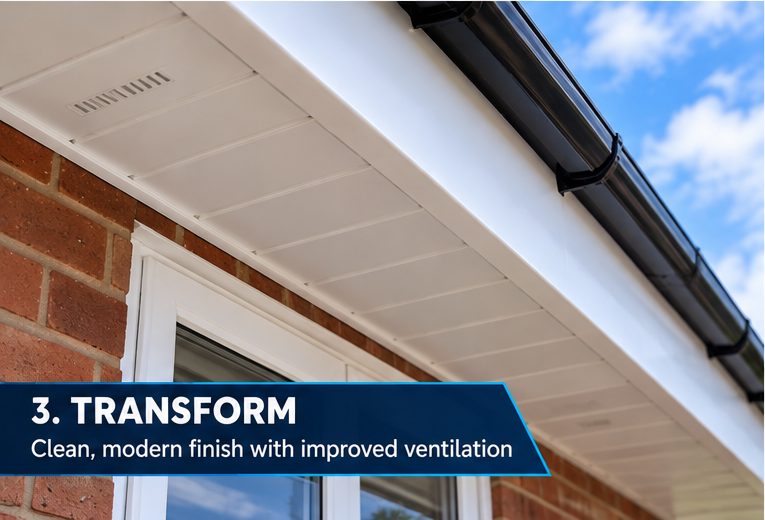
There are two ordinary ways to get air in at the eaves. Soffit ventilation sits in the board underneath: either round vents set into the panel at intervals, or a continuous slot strip running the length of the run. Continuous is better where it can be used, because it spreads the airflow evenly instead of concentrating it at points.
Over-fascia ventilation goes in above the board instead. A plastic comb or tray sits on top of the fascia under the first tile course, holding the felt clear and leaving an open channel along the whole eaves. It is the answer where there is no soffit at all, where the overhang is too shallow to take a vent, or where the soffit is being kept and cannot be opened up.
Which to use is decided by the house rather than by preference. A deep soffit on a 1930s semi takes a slot strip easily. A post-war estate house with barely any overhang usually wants over-fascia. A bungalow with wide eaves has room for either. What matters is that the chosen route is actually open from outside air to roof space, with nothing blocking either end of it.
Size matters as well as presence. Ventilation is specified against the area and pitch of the roof, and a shallow pitch needs more than a steep one. A handful of round vents dotted along a long elevation because they were what was in the van is not the same as a run sized to the roof, and it is worth asking which you are getting.
One more case is worth knowing about. Where rooms have been built into the roof, or the pitch is very shallow, air let in at the eaves has nowhere to come out, and ventilation has to be added higher up the slope as well. Eaves vents alone will not solve a room-in-roof condensation problem, and anybody who says they will has not looked at the ceiling line.
The classic call goes like this. There is a stain on an upstairs ceiling near an outside wall. Somebody looks in the loft and finds black mould on the rafter feet, dark streaks down the felt and insulation that is soaking along the edge. It is reported as a roof leak, and occasionally a roof gets stripped over it, at which point the problem carries on because nothing about the tiles was ever wrong.
The distinction is timing, and it is reliable enough to act on. A leak follows the weather: it appears during or shortly after heavy or wind-driven rain, and it dries out between events. Condensation follows temperature: it shows up on cold, still mornings, is worst in the months after Christmas, and can be dripping steadily on a day when it has not rained for a week.
Location helps too. Condensation is general rather than local, so you will find it along an entire eaves rather than in one spot, and worst on the coldest elevation. A leak is usually traceable to one place: a slipped tile, a chimney, a valley, a torn section of felt. If the damp is everywhere the roof is cold, it is not a hole. If you do think it is a hole, roof repairs is the other side of the house from this page.
The other symptom worth naming is smell. A roof space that cannot breathe develops a distinct stale, earthy smell long before anything stains a ceiling. If your loft smells like that and the soffits are solid boards with no vents in them, you have almost certainly found the cause without needing anyone to visit.
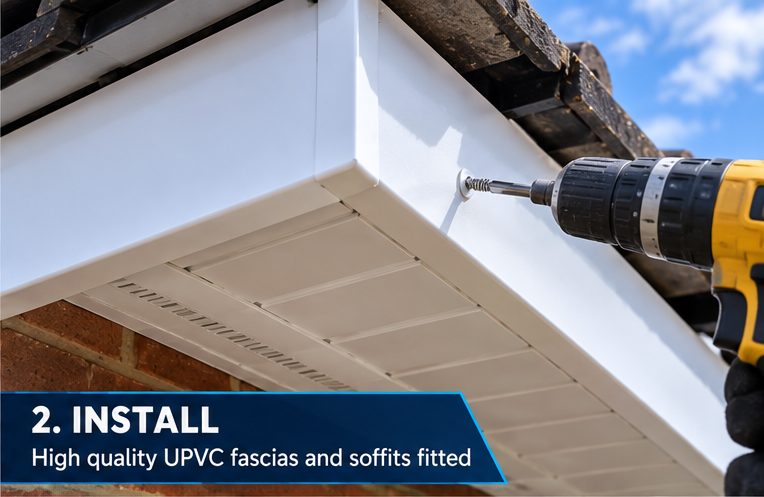
From outside, on a dry day, look up at the soffit from directly underneath. You are looking for either a line of round openings or a continuous slot near the outer edge. Painted timber with no openings at all means no soffit ventilation, which is the standard finding on anything built before the mid-1970s that has not been touched since.
From inside, a torch through the loft hatch on a cold morning tells you the rest. Look along the eaves where the rafters cross the wall: can you see daylight or feel moving air, or is the gap stuffed solid with insulation? Check the felt for beads of water and run marks, and press the insulation in the last half metre to see whether it is heavy and cold. Please do not go up outside to inspect the soffits — everything useful is visible from below or from the hatch.
When you come to ask for work, put ventilation in writing as its own item rather than assuming it is included. Ask whether the old soffit is being removed or left, how the air gets past the insulation at the wall plate, whether eaves trays are included, and whether the vent run is continuous or intermittent. Four short questions, and they separate a considered quotation from a measured one.
The rest of the series, on the questions people ask most.
Every town has its own page, written around what the houses there are actually like at eaves level. Start with the main roofline page.
“I had a leak in my vally had a number of roofers to come and take a look couldn’t find the problem Roofline’s solutions fixed the problem first time. Very happy with these guys thank you for the brilliant service”
Michael Price“Excellent work replacing ridge tiles, repointing chimney and repairing flashing. Also fixed other broken tiles. Clean and tidy job. Would definitely recommend.”
Neil“Highly recommend. Very quick and efficient. Great communication. Went above and beyond to work the weekend to complete the work that needed to be done. Very happy with the results.”
Karen JonesDescribe what is happening and roughly where you are, and we will come back to you — usually the same day. If water is coming in now, please call instead.
Prefer to talk? Call 07464 259566 · WhatsApp 0044 7464 259566 · Email Evensbuddy@yahoo.com
We cover Chester, Cheshire, the Wirral and Flintshire from Elton, just north of Chester.
2 Manley View
Elton
Chester
CH2 4QF
Almost all of our work happens at your property rather than here, so please call before travelling.
Monday – Friday — 24hrs — Emergency Call-Outs
Saturday — 8:00 – 19:00
Sunday — 8:00 – 19:00
Weekday emergency call-outs are answered around the clock. Weekend cover is 8:00 to 19:00.