★★★★★
“I had a leak in my vally had a number of roofers to come and take a look couldn’t find the problem Roofline’s solutions fixed the problem first time. Very happy with these guys thank you for the brilliant service”
Michael PriceMost of a roofline replacement is predictable and can be counted in advance. The part that is not predictable is what the old boards are hiding, and that is the part that changes the finish date.
Three things are countable from the pavement and they do most of the work in setting a timescale. The first is how many metres of board and gutter there are, which is not the same as how big the house feels — a long narrow terrace and a square detached of the same floor area can have very different lengths of eaves. The second is how many separate faces the job touches: front, back, two gables, a porch, a bay, an outrigger. Each one is a fresh set-up rather than more of the same. The third is how the installer gets to eaves level and how often that has to be moved.
Plan shape is the one people underestimate. A straight run is quick work; everything that interrupts it is slow. Every external corner is a mitred joint in the fascia and a matching one in the gutter, every internal corner is worse because it is cut blind, and a bay window with a small tiled roof of its own can have four or five short lengths and six joints in less than three metres. A gable apex is two boards meeting at an angle over a drop, and it is the slowest metre on the house.
Then there is what is being asked for. Fascia and gutter alone is a shorter job than fascia, soffit, bargeboards, new ventilation, dry verge and a rerouted downpipe, and the last of those list items has a drain at the bottom of it that may need lifting. If ventilation is being introduced where there was none, the soffit run has to be set out properly rather than simply replaced like for like.
None of this makes a job unpredictable. It makes it countable, which is why a number of days ought to appear in writing rather than being described as "a couple of days, give or take".
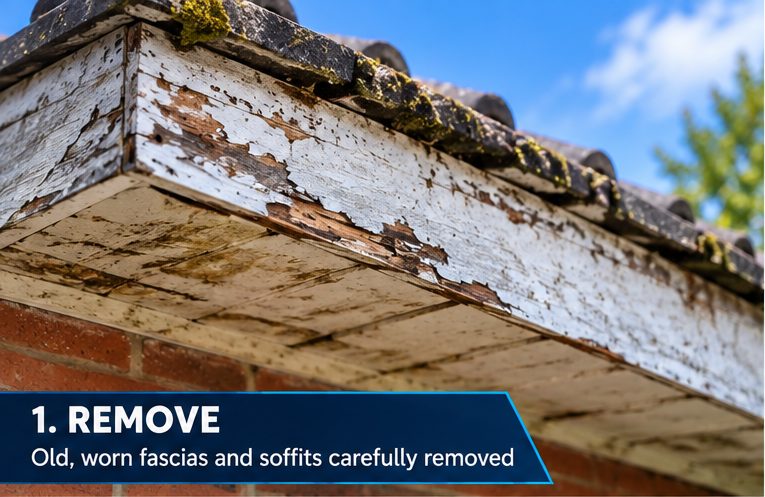
The first morning is rarely spent on the roofline at all. Access goes up first — a tower positioned and levelled, or scaffold erected, tied and handed over — and on a house where the eaves run over a conservatory, a steep garden or a shared drive that is not a ten minute job. Where scaffold is being used it may well have arrived the day before and be counted separately from the installation days, which is worth clarifying when somebody tells you the job takes two days.
The strip-out follows. Gutter and downpipes come off, then the old fascia, then the soffit, and the debris is cleared as it goes rather than left in a heap on the lawn. On a house that still has its original painted softwood this is heavier work than it looks, because the boards are nailed into rafter ends that have been there since the house was built and they do not come away cleanly.
What that exposes is the whole reason the day matters. With the boards off you can see the rafter ends, the underside of the roofing felt, the wall head and the top course of brick. That is the point at which anybody working properly stops and tells you what is there, because it is the only moment in the job when it can be seen at all. If you are at home, ask to be shown it. If you are at work, ask for photographs taken that morning.
New work goes back in a fixed order because each part depends on the one before it. Any timber repair comes first: new bearers, a replacement rafter end, a batten to pack a wall head that is not straight. Then the soffit, then the fascia over its edge, and only then the gutter.
Setting the gutter is the part that takes the time and the part nobody can see afterwards. Brackets go on at proper centres, closer where the run crosses a joint or carries a valley, and the whole length is set to a fall that runs to the outlet rather than being eyeballed off the brickwork. Houses have settled, wall heads wander, and a gutter hung parallel to a course of bricks that is itself out of level will hold water at one end.
Downpipes come after the gutter because they have to meet whatever is at the bottom, and that is where an afternoon occasionally disappears. A pipe that discharged into a gully now blocked with a century of grit, a swan neck that has to clear a rendered plinth, or an outlet being moved to split a long run are all small pieces of work with a drain at the end of them.
Bargeboards and gable trim are usually last, partly because they need the access moved to the gable and partly because the apex joint is the one worth doing when nobody is rushing to finish. On a house with two gables that move alone can be half a day.
Almost everything that adds days is found rather than planned. Rotten rafter ends are the commonest: the fascia has been letting water into the end grain for years and the timber the new board was going to be screwed to has nothing left in it. That is not a bodge you can work around, it is cutting back to sound wood and fixing new bearers, and on a full elevation it is a day of its own.
Torn or short eaves felt is the second. Felt that has perished and pulled back off the wall head drops water behind the gutter instead of into it, and the moment to correct that with a support tray is while the boards are off. It is quick work in itself and slow work to arrange afterwards.
Then the ones that come out of the house rather than the roof. A soffit that turns out to be asbestos cement rather than timber changes the removal method entirely and is not something to break up in a hurry. A satellite dish, an alarm sounder or a run of cable fixed through the old fascia has to come off and go back, and whoever owns it may need to do that. A colour that is not a stock line — a particular woodgrain foil, an unusual gutter shade — is an order rather than a van stock item.
Weather is the honest one. UPVC goes on fine in the cold, but a gable in a strong wind is a stop, and in December the working light runs out in the middle of the afternoon. A job quoted at three days in June is not always three days in January, and an installer who says so is telling you something useful rather than hedging.
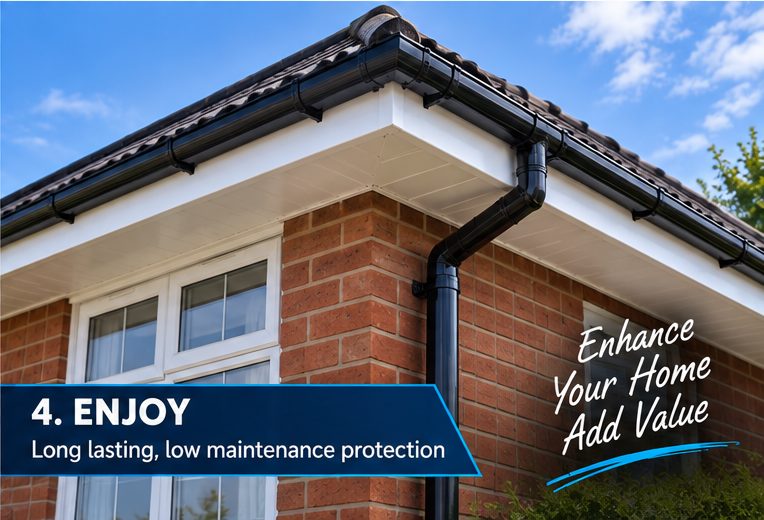
Ask for the days to be written down next to what they cover. "Two days" means one thing if scaffold goes up on the Monday and another if it does not, and it means a third thing if the bargeboards are a separate visit because the access has to be repositioned.
Ask what happens if the timber has gone. The useful answer is a method rather than a reassurance: work stops, you are shown or sent a photograph, the extra is agreed in writing, and then it carries on. The unhelpful answer is that it will be sorted out at the end, because by then the boards are back on and nobody can check anything.
Ask whether the house is left weathertight overnight. Part-stripped eaves with the felt exposed are fine in still, dry weather and not fine in a gale, and the answer tells you whether the sequence has been thought about at all. And if you want to satisfy yourself that the work is being done properly, ask for pictures from the access platform — please do not go up to look for yourself.
The rest of the series, on the questions people ask most.
Every town has its own page, written around what the houses there are actually like at eaves level. Start with the main roofline page.
“I had a leak in my vally had a number of roofers to come and take a look couldn’t find the problem Roofline’s solutions fixed the problem first time. Very happy with these guys thank you for the brilliant service”
Michael Price“Excellent work replacing ridge tiles, repointing chimney and repairing flashing. Also fixed other broken tiles. Clean and tidy job. Would definitely recommend.”
Neil“Highly recommend. Very quick and efficient. Great communication. Went above and beyond to work the weekend to complete the work that needed to be done. Very happy with the results.”
Karen JonesDescribe what is happening and roughly where you are, and we will come back to you — usually the same day. If water is coming in now, please call instead.
Prefer to talk? Call 07464 259566 · WhatsApp 0044 7464 259566 · Email Evensbuddy@yahoo.com
We cover Chester, Cheshire, the Wirral and Flintshire from Elton, just north of Chester.
2 Manley View
Elton
Chester
CH2 4QF
Almost all of our work happens at your property rather than here, so please call before travelling.
Monday – Friday — 24hrs — Emergency Call-Outs
Saturday — 8:00 – 19:00
Sunday — 8:00 – 19:00
Weekday emergency call-outs are answered around the clock. Weekend cover is 8:00 to 19:00.