★★★★★
“I had a leak in my vally had a number of roofers to come and take a look couldn’t find the problem Roofline’s solutions fixed the problem first time. Very happy with these guys thank you for the brilliant service”
Michael Price
New roofline in UPVC across Widnes — fascias, soffits, bargeboards and guttering, with eaves ventilation on the estate housing that was built with solid soffits and no way for the roof space to breathe.
Widnes has a great deal of housing put up in the 1950s and 1960s, and that housing shares a detail at eaves level: a solid timber soffit board, one piece, with no vents in it anywhere. It was normal for the period. Nobody was thinking about roof ventilation, because the lofts of the day were cold, draughty and full of gaps, and they dried themselves out by accident.
Then the insulation was upgraded. Over the last twenty years or so most of these houses have had the loft topped up to modern depth, often several times, and the insulation gets pushed right out to the edge where it fills the last gap over the wall plate. The house gets warmer and the roof space stops moving air entirely. The two things together are why so many lofts here are damp while nothing is wrong with the roof covering at all.
Roofline Solutions fits new UPVC fascias, soffits, bargeboards, guttering and downpipes throughout Widnes. On this kind of house the ventilation is not an extra to be added if the budget stretches — it is most of the point of doing the work, and it is the part most often left off a quotation.
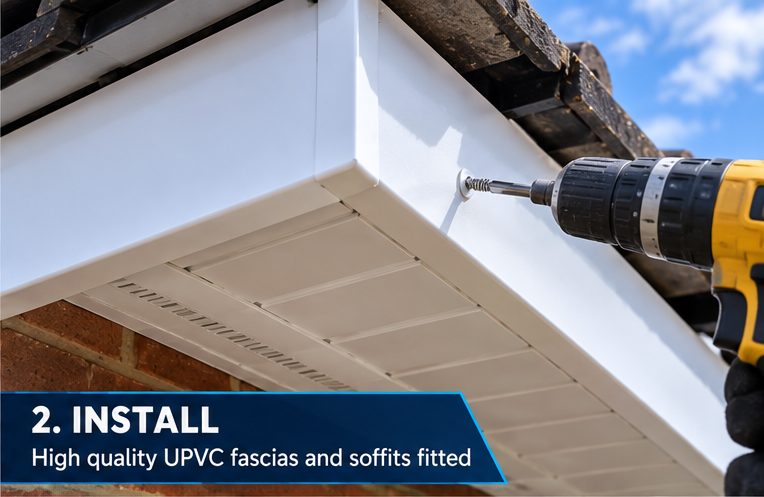
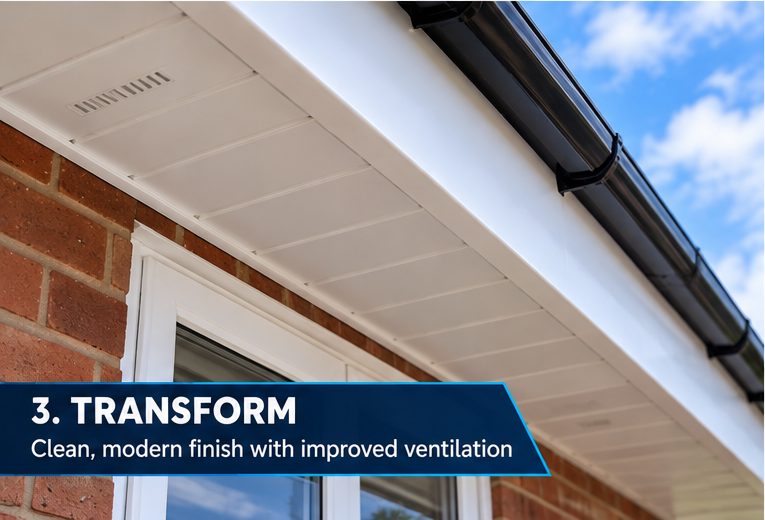
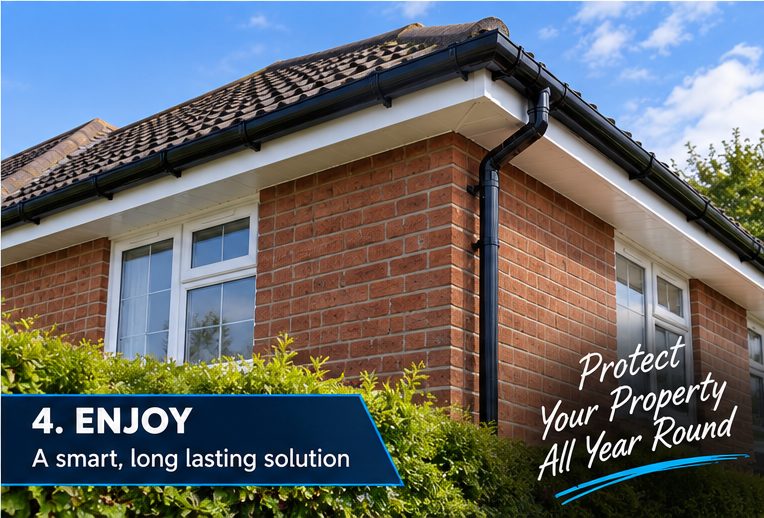
Images above are for illustration purposes only. Photographs of our own work are on the main roofline page and in the gallery.
Start with what is actually up there. A one-piece timber soffit, painted, fixed to a batten at the wall and to the rafter feet at the front, with bitumen felt from the same era draped over the rafters and turned into the gutter. On some houses of this period the soffit is not timber at all but a grey, brittle cement-based board, and that is worth identifying before anybody puts a saw near it, because boards of that type can contain asbestos and are handled differently.
What happens next is predictable. Warm moist air from the house rises into the roof space, meets the cold underside of the felt in winter, and condenses there because there is nowhere for it to go. You get water running down the felt, dark staining and black mould on the rafter feet, insulation that is wet through along the outside wall, and eventually a stain on the bedroom ceiling near the external wall. It is very commonly reported as a roof leak, and roofs get stripped over it. The clue is that it appears in cold weather rather than during heavy rain.
Replacing the roofline is the natural moment to deal with it, because the eaves are open anyway. A vented soffit gives a continuous airway along the run — either a slot strip or round vents, sized to the roof rather than assumed. Eaves trays hold the insulation back off the wall plate so the path over it stays clear, and felt support trays carry the old felt where it has sagged and split at the gutter. It is worth saying that soffit ventilation alone is not always enough: on a shallow pitch, or where rooms have been built into the roof, air has to leave at high level too, and that means vents further up the slope.
Go up with a torch on a cold day rather than a wet one. Look at the rafter feet where they cross the wall, at the underside of the felt, and at the insulation in the last half metre before the eaves. Black spotting on the timber, felt that is beaded with water or has run marks down it, insulation that feels heavy and cold, and rusty nail points coming through the boarding all point the same way. Drips in dry frosty weather are condensation, not a leak.
From outside, the soffit itself gives plenty away. Boards bowed downwards between fixings, splits opening at the joints, a dark stained line along the bottom edge, or a gap where the board has dropped away from the wall are all worth reporting. That gap is also how birds and wasps get into a roof space, and a nest in the eaves will hold the whole job up until it can legally be dealt with.
There is one thing to be clear about on a Widnes house, and it is the most important sentence on this page: fitting a vented UPVC soffit over the top of the old solid board achieves nothing unless the board behind it is opened up. Air cannot pass through a sealed timber panel because there are slots in the plastic in front of it. That is decoration, and it will be sold as ventilation if nobody asks the question.
Which is the real argument for stripping back rather than capping on this kind of estate housing. Taking the old soffit off lets us see the rafter feet, the state of the felt and the wall plate, clear the insulation back to leave the airway open, and fit the new vented board to timber that is known to be sound. On the fascia the usual point applies too: the gutter brackets have to be screwed into something solid, not through a cap into a board that has softened.
The guttering on these estates is often undersized for the roof it serves — a shallow half round section on a fairly large plain roof area, with one outlet doing all the work. It copes in ordinary rain and gives up in a downpour, and the overflow usually lands exactly where the eaves are already damp. Moving to a deeper section, or adding a second outlet and downpipe, is often a bigger improvement than anything else on the list.
The other thing to look at is what happens at the bottom. A downpipe running into a back-inlet gully that has silted up will back water out at ground level and wet the base of the wall, which from an upstairs window looks like nothing at all. The gully wants checking while the scaffold or tower is there and the pipe is off, because after that it means taking the pipe apart again.
Fascias, soffits, bargeboards, guttering, downpipes, dry verge and eaves ventilation — and the roof above them when it needs attention at the same time.
“I had a leak in my vally had a number of roofers to come and take a look couldn’t find the problem Roofline’s solutions fixed the problem first time. Very happy with these guys thank you for the brilliant service”
Michael Price“Excellent work replacing ridge tiles, repointing chimney and repairing flashing. Also fixed other broken tiles. Clean and tidy job. Would definitely recommend.”
Neil“Excellent workmanship by Buddy Evans. I was impressed and amazed at how quickly the job was done. Obviously due to many years' experience. I've used several mediocre or bad roofers in the past and now I've finally found a good one.”
Czeslaw birukowskWritten for homeowners working out what their roofline actually needs, before anyone comes out.
Every town below has its own page, written around what the houses there are actually like at eaves level.
Describe what is happening and roughly where you are, and we will come back to you — usually the same day. If water is coming in now, please call instead.
Prefer to talk? Call 07464 259566 · WhatsApp 0044 7464 259566 · Email Evensbuddy@yahoo.com
We cover Widnes from our base at Elton, just north of Chester.
2 Manley View
Elton
Chester
CH2 4QF
Almost all of our work happens at your property rather than here, so please call before travelling.
Monday – Friday — 24hrs — Emergency Call-Outs
Saturday — 8:00 – 19:00
Sunday — 8:00 – 19:00
Weekday emergency call-outs are answered around the clock. Weekend cover is 8:00 to 19:00.